\n
## Diagram: Knowledge and Memory Hierarchy in Transformer Circuits
### Overview
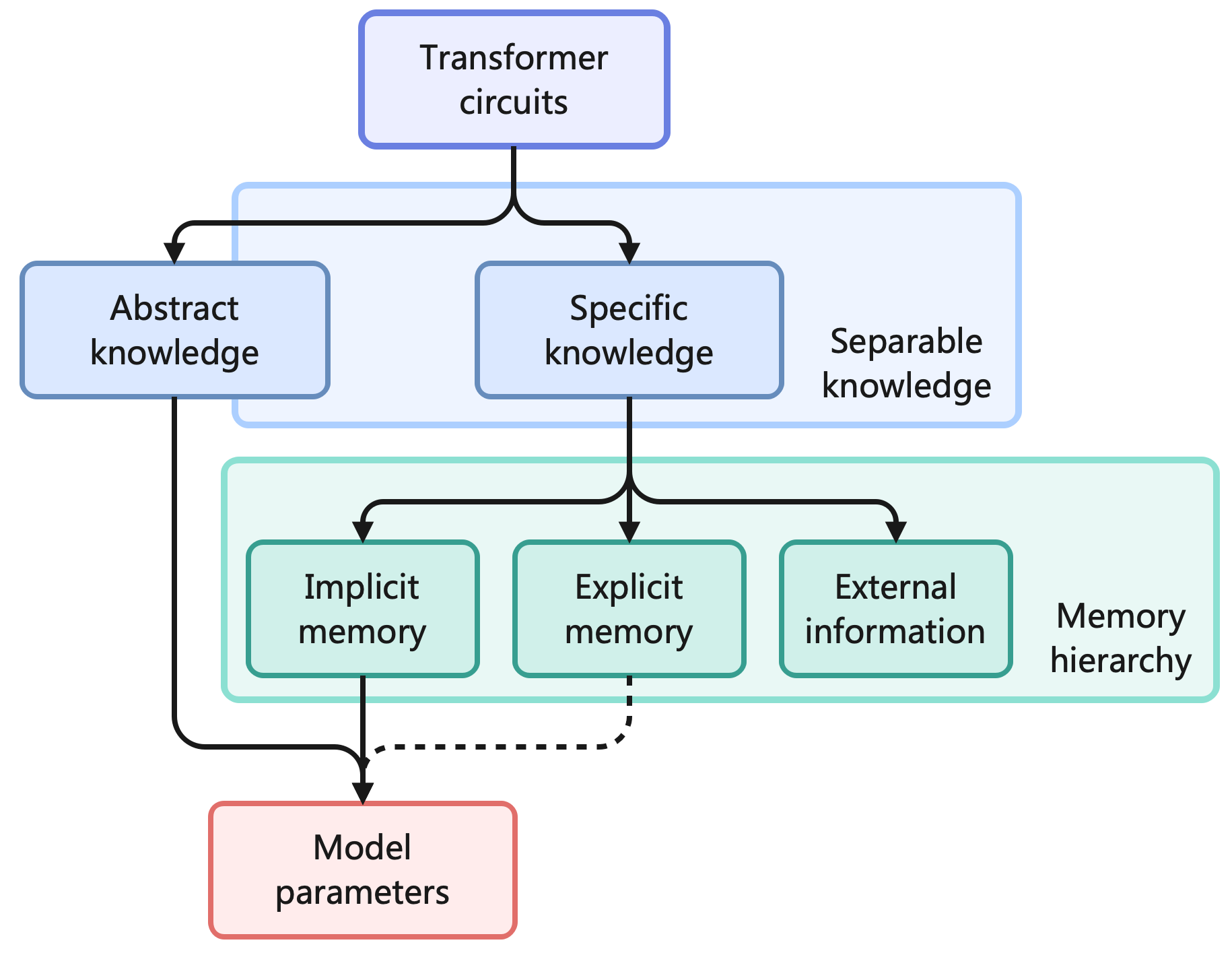
The image is a diagram illustrating the relationship between Transformer circuits, different types of knowledge (Abstract, Specific, Separable), memory types (Implicit, Explicit, External), and Model Parameters. The diagram uses boxes and arrows to represent components and information flow. A blue rectangle encompasses "Implicit memory", "Explicit memory", and "External information", labeling this as a "Memory hierarchy".
### Components/Axes
The diagram consists of the following components:
* **Transformer circuits:** Located at the top center of the diagram, in a light blue rectangle.
* **Abstract knowledge:** A light blue rectangle positioned to the left of "Specific knowledge".
* **Specific knowledge:** A light blue rectangle positioned between "Abstract knowledge" and "Separable knowledge".
* **Separable knowledge:** A light blue rectangle positioned to the right of "Specific knowledge".
* **Implicit memory:** A light green rectangle positioned in the lower-left portion of the blue "Memory hierarchy" rectangle.
* **Explicit memory:** A light green rectangle positioned in the lower-center portion of the blue "Memory hierarchy" rectangle.
* **External information:** A light green rectangle positioned in the lower-right portion of the blue "Memory hierarchy" rectangle.
* **Model parameters:** A red rectangle positioned at the bottom center of the diagram.
* **Memory hierarchy:** A blue rectangle encompassing "Implicit memory", "Explicit memory", and "External information".
* **Arrows:** Black arrows indicate the flow of information between components. A dashed arrow connects "Explicit memory" to "Model parameters".
### Detailed Analysis or Content Details
The diagram shows a hierarchical structure.
1. **Transformer circuits** feed into three types of knowledge: **Abstract knowledge**, **Specific knowledge**, and **Separable knowledge**.
2. These three knowledge types are connected to the **Memory hierarchy** (enclosed in a blue rectangle).
3. The **Memory hierarchy** consists of **Implicit memory**, **Explicit memory**, and **External information**.
4. **Implicit memory** and **Explicit memory** both feed into **Model parameters**.
5. There is a dashed arrow indicating a connection from **Explicit memory** to **Model parameters**, suggesting a less direct or more nuanced relationship than the solid arrow from **Implicit memory**.
There are no numerical values or quantitative data present in the diagram. It is a conceptual representation of relationships.
### Key Observations
* The diagram emphasizes the distinction between different types of knowledge and memory.
* The dashed arrow suggests that the relationship between explicit memory and model parameters is different from the relationship between implicit memory and model parameters.
* The "Memory hierarchy" grouping suggests that these three memory types work together.
* The diagram does not specify the nature of the information flow; it only indicates the direction.
### Interpretation
The diagram illustrates a model of how Transformer circuits acquire and utilize knowledge. The Transformer circuits process information and generate different types of knowledge. This knowledge is then stored in various memory systems (implicit, explicit, and external). Finally, these memory systems influence the model parameters, which determine the model's behavior.
The distinction between implicit and explicit memory is significant. Implicit memory likely refers to knowledge learned through training data and embedded within the model's weights, while explicit memory might refer to knowledge stored in external databases or knowledge graphs. The dashed arrow from explicit memory to model parameters suggests that explicit knowledge may be used to refine or adjust the model's parameters, rather than being directly encoded into them.
The diagram suggests a complex interplay between knowledge, memory, and model parameters. It highlights the importance of considering different types of knowledge and memory when designing and understanding Transformer models. The diagram is a high-level conceptual overview and does not provide details about the specific mechanisms involved in each process.