## Diagram: Knowledge Hierarchy and Model Parameter Flow
### Overview
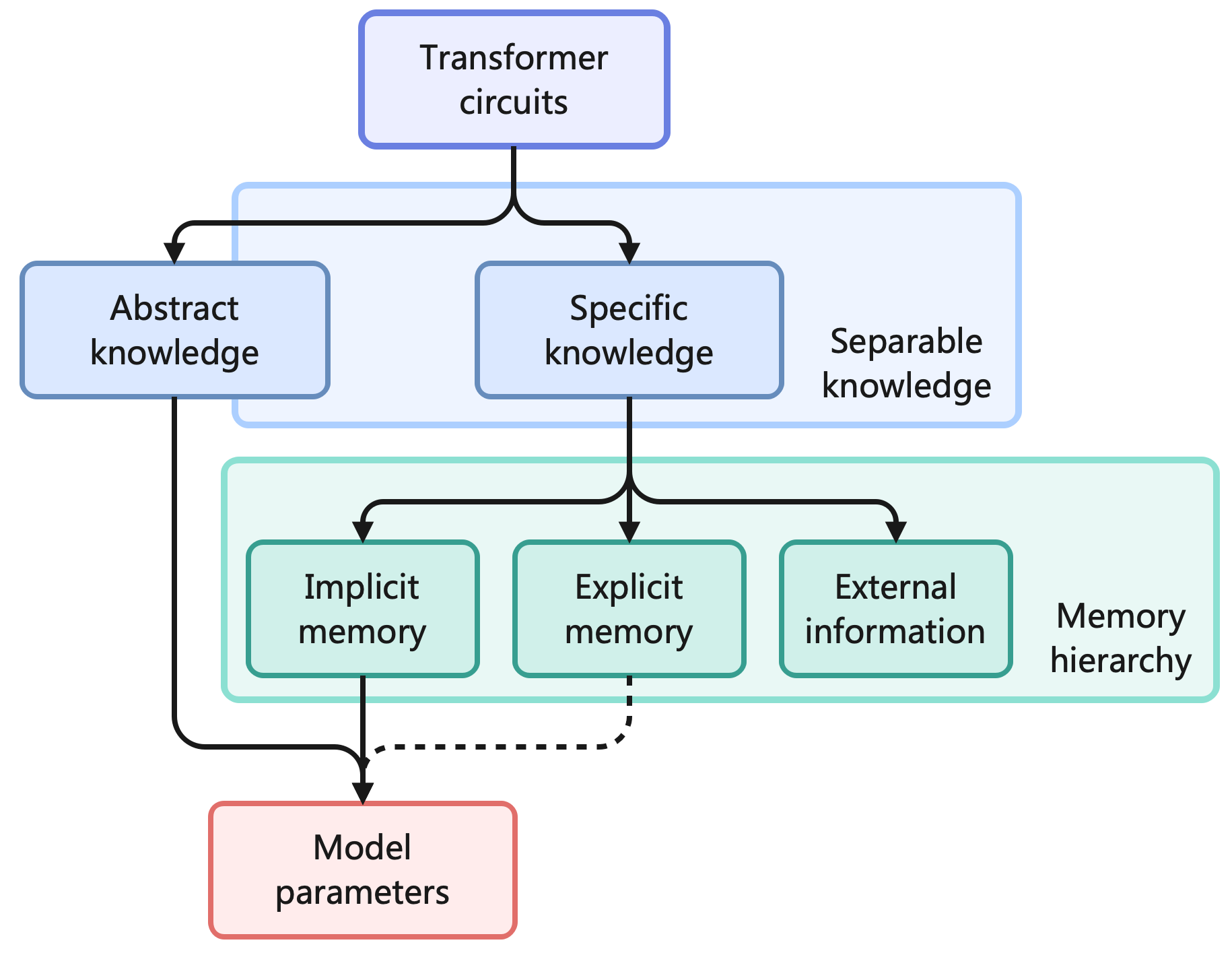
The diagram illustrates a hierarchical knowledge processing system with transformer circuits at the top, followed by abstract/specific knowledge domains, memory hierarchies, and model parameters at the base. Arrows indicate directional relationships, with a dashed line showing a weaker connection between explicit memory and model parameters.
### Components/Axes
1. **Top Layer**:
- **Transformer circuits** (purple box)
2. **Knowledge Domains**:
- **Abstract knowledge** (blue box)
- **Specific knowledge** (blue box)
- **Separable knowledge** (blue box, right-aligned)
3. **Memory Hierarchy**:
- **Implicit memory** (green box)
- **Explicit memory** (green box)
- **External information** (green box)
- **Memory hierarchy** (light green container)
4. **Base Layer**:
- **Model parameters** (pink box)
### Detailed Analysis
- **Transformer circuits** branch into:
- **Abstract knowledge** → **Implicit memory**
- **Specific knowledge** → **Explicit memory** and **External information**
- **Separable knowledge** is isolated on the right side of the knowledge domain layer.
- **Implicit memory** and **Explicit memory** feed into **Model parameters** via solid arrows.
- **External information** connects directly to **Model parameters** via a solid arrow.
- A **dashed arrow** from **Explicit memory** to **Model parameters** suggests a weaker or indirect relationship.
### Key Observations
1. **Hierarchical Flow**: Knowledge flows from transformer circuits through abstract/specific domains into memory systems, ultimately influencing model parameters.
2. **Memory Specialization**:
- Abstract knowledge → Implicit memory (likely for generalized patterns)
- Specific knowledge → Explicit memory (for detailed facts)
3. **External Information** bypasses memory hierarchies, directly impacting model parameters.
4. **Dashed Connection**: Explicit memory's weaker link to model parameters may indicate conditional or context-dependent influence.
### Interpretation
This diagram represents a cognitive architecture where transformer circuits act as the primary processor, organizing knowledge into abstract (general) and specific (contextual) domains. The memory hierarchy separates implicit (automatic) and explicit (conscious) memory systems, with external information providing real-time input. Model parameters at the base likely represent learned representations or decision-making rules shaped by these knowledge flows. The dashed line suggests explicit memory's influence is modulated by other factors (e.g., attention mechanisms or context gates), aligning with theories of working memory integration in AI systems.