\n
## Diagram: Scattered Objects with Multiple-Choice Options
### Overview
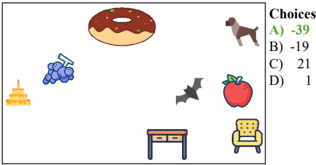
The image displays a collection of nine distinct clipart-style objects scattered across a white background, with a separate boxed list of four numerical choices positioned on the right side. The layout appears to be a visual puzzle or a test item, where the relationship between the objects and the numerical choices is not explicitly stated.
### Components/Axes
**Main Area (Objects):**
The objects are placed without a clear grid or axis. Their approximate positions are:
1. **Top-Center:** A large chocolate-frosted donut with sprinkles.
2. **Top-Right:** A brown dog, standing and facing left.
3. **Center-Left:** A bunch of purple grapes with a green leaf.
4. **Center-Right:** A black bat in flight.
5. **Bottom-Left:** A three-tiered yellow cake with candles.
6. **Bottom-Center:** A brown wooden table or desk.
7. **Bottom-Right:** A red apple with a green leaf.
8. **Bottom-Right (below apple):** A yellow armchair.
9. **Center (between grapes and bat):** No object; this is the approximate center of the white space.
**Choices Box (Right Side):**
A rectangular box with a black border contains the following text, aligned to the left:
* **Header:** `Choices`
* **Option A:** `A) -39`
* **Option B:** `B) -19`
* **Option C:** `C) 21`
* **Option D:** `D) 1`
### Detailed Analysis
* **Object Description:** All objects are simple, colorful illustrations with no embedded text, labels, or numerical values. They represent common items: food (donut, grapes, cake, apple), animals (dog, bat), and furniture (table, chair).
* **Text Transcription:** The only textual information is contained within the "Choices" box on the right. The text is in English. It has been transcribed exactly as it appears above.
* **Spatial Relationship:** The "Choices" box is vertically centered on the right edge of the image. The objects are distributed in the remaining space, with no obvious grouping or ordering that correlates to the choice list (A, B, C, D).
### Key Observations
1. **Lack of Explicit Data:** The image does not contain a chart, graph, or data table. There are no axes, legends, or data points to extract numerical trends from.
2. **Absence of Labels:** None of the illustrated objects have identifying labels or associated values.
3. **Potential Puzzle Format:** The structure—a set of images followed by a list of numerical options—suggests this could be a visual reasoning puzzle where the solver must deduce a rule or pattern connecting the objects to one of the numbers (-39, -19, 21, 1). The rule is not provided in the image.
4. **Object Count:** There are exactly nine distinct objects.
### Interpretation
The image presents a **visual stimulus paired with a multiple-choice question**, but the question itself (e.g., "What is the sum of...", "Which number represents...") is missing. The data provided is purely categorical (the set of objects) and numerical (the choice options).
* **What the data suggests:** The image is likely a component of a larger test, puzzle, or game. The nine objects are the input, and the four numbers are the possible outputs or answers. The connection between them is the core of the puzzle but is not deducible from the image alone.
* **How elements relate:** The "Choices" box is spatially separate, indicating it is the response area. The objects are the subject of analysis. The relationship is implied to be logical or mathematical but is not defined.
* **Notable anomalies:** The numbers in the choices include both negative and positive values, and a wide range (from -39 to 21). This suggests the underlying rule might involve operations that can yield negative results (e.g., subtraction, assigning negative values to certain object attributes).
* **Peircean investigative reading:** From a semiotic perspective, the objects are *icons* (they resemble what they represent). The choices are *symbols* (their meaning is conventional). The missing element is the *index*—the rule or sign that connects the iconic input to the symbolic output. Without that index, the image is an incomplete sign system, presenting a problem without its solution framework. The viewer is left to hypothesize about potential rules (e.g., counting letters in the object names, assigning point values, looking for visual patterns) but cannot verify any hypothesis.