\n
## Diagram: LLM Execution Flow
### Overview
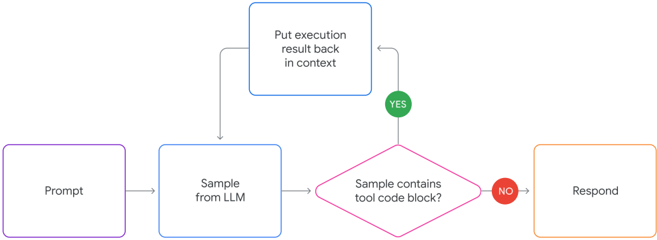
The image depicts a flowchart illustrating the process of executing a prompt with a Large Language Model (LLM), specifically focusing on whether the LLM's response contains tool code. The diagram shows a cyclical process where the LLM's output is re-integrated into the context if tool code is present.
### Components/Axes
The diagram consists of four main components, represented as rounded rectangles connected by arrows:
1. **Prompt:** (Purple) - The initial input to the LLM.
2. **Sample from LLM:** (Light Blue) - The output generated by the LLM in response to the prompt.
3. **Sample contains tool code?:** (Diamond Shape, Green/Red) - A decision point evaluating whether the LLM's output includes tool code.
4. **Put execution result back in context:** (Light Blue) - A process that re-integrates the LLM's output into the context for further processing.
5. **Respond:** (Orange) - The final output or action taken when no tool code is present.
Arrows indicate the flow of the process. A "YES" branch (Green) leads back to "Put execution result back in context", creating a loop. A "NO" branch (Red) leads to "Respond".
### Detailed Analysis or Content Details
The diagram illustrates a conditional flow:
1. A "Prompt" is sent to the LLM.
2. The LLM generates a "Sample".
3. A check is performed to determine if the "Sample" contains "tool code".
4. If the "Sample" *does* contain tool code ("YES"), the "execution result" is fed back into the context, and the process repeats.
5. If the "Sample" *does not* contain tool code ("NO"), the system "Responds".
There are no numerical values or specific data points in this diagram. It is a purely conceptual representation of a process.
### Key Observations
The diagram highlights a feedback loop where the LLM's output is iteratively refined based on the presence of tool code. This suggests a system designed to handle tasks that require external tools or actions. The conditional branching indicates a decision-making process based on the content of the LLM's response.
### Interpretation
This diagram represents a sophisticated LLM execution strategy. The presence of a feedback loop suggests the system is capable of complex reasoning and task completion. The check for "tool code" indicates the LLM can generate instructions for external tools, and the system is designed to execute those instructions and incorporate the results back into the LLM's context. This is a common pattern in agent-based LLM systems, where the LLM acts as a controller for various tools. The diagram implies a system that can dynamically adapt its behavior based on the LLM's output, allowing it to perform tasks that would be impossible with a simple prompt-response interaction. The system is designed to continue processing until the LLM's output does not require further tool execution, at which point a final response is generated.