## Flowchart: LLM Tool Code Handling Workflow
### Overview
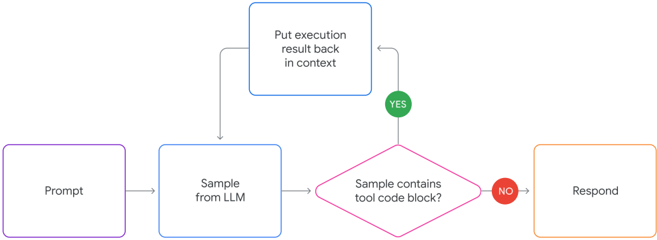
The image depicts a flowchart illustrating the process of handling tool code blocks in LLM (Large Language Model) outputs. The workflow includes conditional checks, iterative feedback loops, and sequential processing steps.
### Components/Axes
1. **Nodes**:
- **Prompt** (Purple box, leftmost)
- **Sample from LLM** (Blue box, center-left)
- **Sample contains tool code block?** (Diamond-shaped decision node, center)
- **Put execution result back in context** (Blue box, center-right)
- **Respond** (Orange box, rightmost)
2. **Arrows**:
- Solid arrows indicate sequential flow
- Dashed arrow represents feedback loop
- Color-coded connections (blue, pink, gray)
3. **Decision Logic**:
- "YES" branch (green circle) loops back to "Put execution result back in context"
- "NO" branch (red circle) proceeds to "Respond"
### Detailed Analysis
1. **Prompt** → **Sample from LLM**:
- Initial input processed by LLM to generate output
- Blue box indicates core LLM processing step
2. **Decision Node**:
- Binary check for tool code presence
- Pink diamond shape standardizes decision points
3. **Feedback Loop**:
- Green "YES" path creates iterative refinement
- Allows multiple attempts to incorporate tool code results
4. **Final Response**:
- Orange "Respond" box marks terminal output
- Direct path when no tool code is detected
### Key Observations
- **Iterative Design**: The green feedback loop enables recursive processing when tool code is detected
- **Color Coding**: Blue boxes represent LLM-related steps, orange for final output
- **Decision Point**: Central diamond node acts as critical control mechanism
- **Sequential Flow**: Left-to-right progression with exception handling
### Interpretation
This flowchart represents an automated system for handling tool code in LLM outputs. The process suggests:
1. **Tool Code Detection**: The system identifies when LLM outputs contain executable code blocks
2. **Execution Feedback**: Detected code is executed, and results are re-injected into the context for improved responses
3. **Conditional Branching**: The workflow adapts based on code presence, either refining outputs iteratively or proceeding to final response
4. **Efficiency Consideration**: The orange "Respond" box suggests optimized paths for non-tool code scenarios
The design implies a balance between thorough code handling (through feedback loops) and efficient processing (direct response path). The use of distinct colors helps visualize the workflow's logical structure and decision points.