## Bar Chart: R1-Llama | GK23EN
### Overview
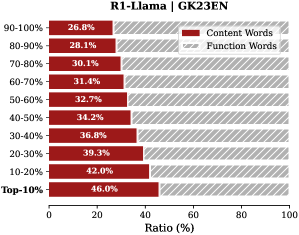
The image is a horizontal bar chart titled "R1-Llama | GK23EN," comparing the distribution of "Content Words" and "Function Words" across performance-based categories. The x-axis represents the "Ratio (%)" from 0 to 100, while the y-axis lists performance ranges (e.g., "90-100%", "80-90%", ..., "Top-10%"). Each bar is divided into two segments: red for "Content Words" and gray for "Function Words," with numerical values explicitly labeled for the red segments.
### Components/Axes
- **Title**: "R1-Llama | GK23EN" (top center).
- **X-Axis**: Labeled "Ratio (%)" with a scale from 0 to 100.
- **Y-Axis**: Categories labeled as performance ranges:
`90-100%`, `80-90%`, `70-80%`, `60-70%`, `50-60%`, `40-50%`, `30-40%`, `20-30%`, `10-20%`, `Top-10%`.
- **Legend**: Located on the right, with:
- **Red**: "Content Words"
- **Gray**: "Function Words"
- **Data Labels**: Numerical percentages (e.g., "26.8%", "28.1%") are placed next to the red segments of each bar.
### Detailed Analysis
- **Content Words (Red)**:
- `90-100%`: 26.8%
- `80-90%`: 28.1%
- `70-80%`: 30.1%
- `60-70%`: 31.4%
- `50-60%`: 32.7%
- `40-50%`: 34.2%
- `30-40%`: 36.8%
- `20-30%`: 39.3%
- `10-20%`: 42.0%
- `Top-10%`: 46.0%
- **Function Words (Gray)**:
- Not explicitly labeled, but inferred as the remaining percentage (100% - red value) for each category. For example, in `90-100%`, Function Words would be 73.2% (100% - 26.8%).
### Key Observations
1. **Trend**: The proportion of "Content Words" increases as the performance range decreases (e.g., from 26.8% in `90-100%` to 46.0% in `Top-10%`).
2. **Inverse Relationship**: "Function Words" decrease correspondingly as "Content Words" increase (e.g., 73.2% to 54.0% across the same range).
3. **Outlier**: The `Top-10%` category has the highest "Content Words" (46.0%), suggesting a potential focus on content in lower-performing segments.
### Interpretation
The data suggests that lower-performing categories (e.g., `Top-10%`) exhibit a higher reliance on "Content Words" compared to "Function Words." This could imply that models or systems in these categories prioritize factual or descriptive language over grammatical or structural elements. The inverse relationship between the two word types highlights a trade-off in linguistic composition across performance tiers. The explicit labeling of "Content Words" percentages ensures clarity, while the absence of Function Words values requires inference, introducing minor uncertainty in their exact distribution.