## Screenshot: Credibility Assessment Interface
### Overview
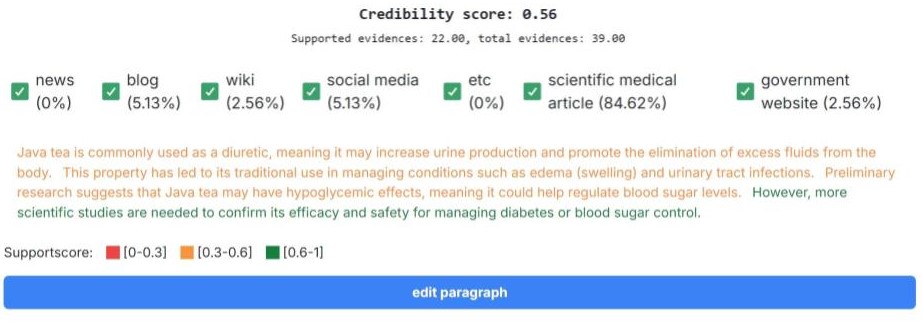
The image is a screenshot of a digital interface, likely from a fact-checking or research validation tool. It displays a credibility score for a specific claim about "Java tea," breaks down the supporting evidence by source type, presents the analyzed text with color-coded support indicators, and includes a legend for the support score.
### Components/Axes
The interface is structured into four distinct horizontal sections from top to bottom:
1. **Header Section (Top):**
* **Primary Metric:** "Credibility score: 0.56"
* **Supporting Data:** "Supported evidences: 22.00, total evidences: 39.00"
2. **Source Category Breakdown (Upper Middle):**
A horizontal row of seven source categories, each with a checkbox icon, a label, and a percentage value in parentheses.
* `news (0%)`
* `blog (5.13%)`
* `wiki (2.56%)`
* `social media (5.13%)`
* `etc (0%)`
* `scientific medical article (84.62%)`
* `government website (2.56%)`
3. **Analyzed Text Paragraph (Center):**
A block of text with sentences or phrases highlighted in different colors (orange and green). The full text reads:
"Java tea is commonly used as a diuretic, meaning it may increase urine production and promote the elimination of excess fluids from the body. This property has led to its traditional use in managing conditions such as edema (swelling) and urinary tract infections. Preliminary research suggests that Java tea may have hypoglycemic effects, meaning it could help regulate blood sugar levels. However, more scientific studies are needed to confirm its efficacy and safety for managing diabetes or blood sugar control."
4. **Legend and Action Footer (Bottom):**
* **Support Score Legend:** "Supportscore:" followed by three color-coded ranges:
* Red square: `[0-0.3]`
* Orange square: `[0.3-0.6]`
* Green square: `[0.6-1]`
* **Action Button:** A full-width blue button labeled "edit paragraph".
### Detailed Analysis
* **Credibility Score:** The overall score is 0.56, which falls within the orange `[0.3-0.6]` range according to the legend, indicating moderate or partial support.
* **Evidence Composition:** The score is derived from 22 supported evidences out of a total of 39 considered.
* **Source Distribution:** The evidence is overwhelmingly from "scientific medical article" sources, accounting for 84.62% of the total. Other sources (blog, social media, wiki, government website) contribute minimally (each ≤5.13%), while news and "etc" categories contribute 0%.
* **Textual Analysis & Color Coding:**
* The first two sentences ("Java tea is commonly used...urinary tract infections.") are highlighted in **orange**. According to the legend, this corresponds to a support score between 0.3 and 0.6.
* The final two sentences ("Preliminary research suggests...blood sugar control.") are highlighted in **green**. According to the legend, this corresponds to a higher support score between 0.6 and 1.0.
* The text presents a claim about Java tea's diuretic properties and traditional uses, followed by a claim about preliminary hypoglycemic effects, concluding with a note on the need for more research.
### Key Observations
1. **Dominant Source Type:** The credibility assessment is heavily reliant on "scientific medical article" evidence (84.62%), suggesting the tool prioritizes or has found primarily academic sources for this claim.
2. **Mixed Support within Text:** The analysis differentiates the support level for different parts of the claim. The statements about traditional diuretic use receive moderate (orange) support, while the statements about hypoglycemic effects and the call for more research receive stronger (green) support.
3. **Low Overall Score Despite Green Highlights:** The overall credibility score (0.56, orange) is lower than the score indicated by the green highlights (0.6-1). This suggests the scoring algorithm may weigh the orange-highlighted sections heavily or incorporate other factors (like the total evidence count) that moderate the final score.
4. **Absence of Certain Sources:** The "news" and "etc" categories show 0%, indicating no evidence from these source types was found or considered for this specific claim.
### Interpretation
This interface provides a multi-faceted credibility assessment of a health-related claim about Java tea. The data suggests the claim is **moderately credible (0.56)**, with its foundation resting almost entirely on scientific literature.
The color-coding reveals a nuanced evaluation: the tool finds stronger evidence for the hypoglycemic effects and the need for more research (green) than for the traditional diuretic uses (orange). This could imply that the modern, testable biochemical claims are better supported in recent literature than the historical usage claims, or that the tool's source weighting differs for different types of statements.
The discrepancy between the green-highlighted text segments and the lower overall orange score is a critical point. It indicates that a simple reading of the text highlights might overestimate the credibility. The final score likely aggregates all evidence (including the less-supported orange sections) and may apply penalties for the limited total evidence count (22 out of 39 considered) or the lack of corroboration from news or government sources.
**In essence, the image depicts a system that doesn't just label a claim as "true" or "false," but provides a granular, source-aware, and partially quantified analysis, highlighting both the strengths (strong scientific backing for some aspects) and limitations (moderate support for traditional uses, limited total evidence) of the information presented.**