## Block Diagram: Parallel Processing Architecture
### Overview
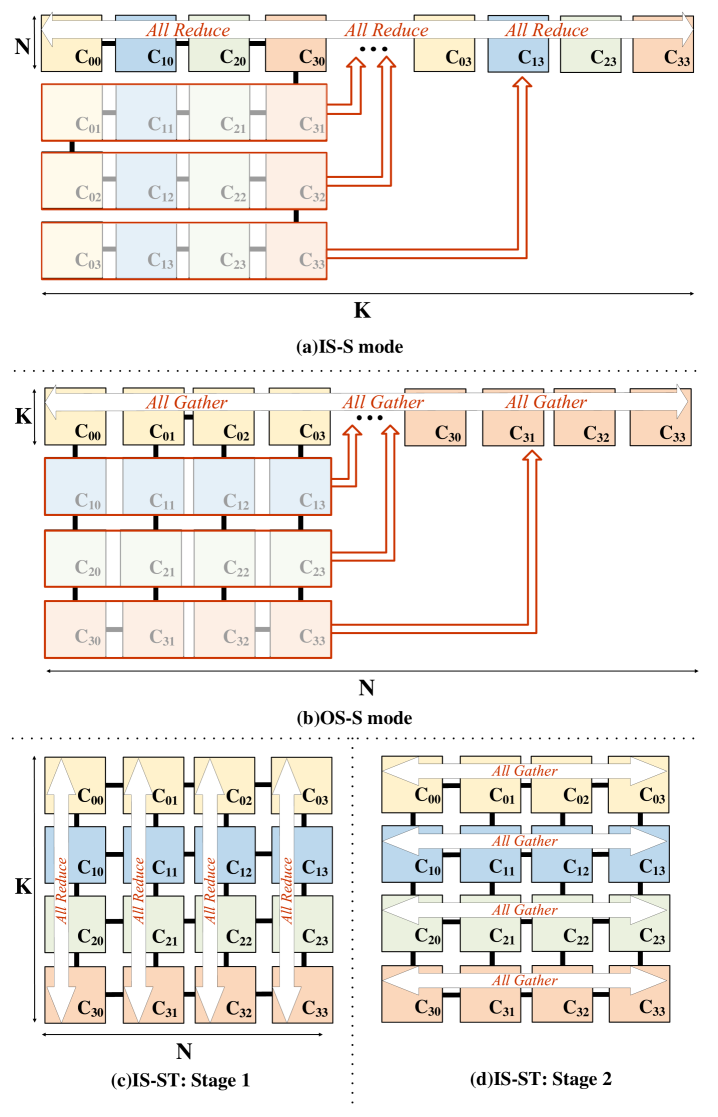
The diagram illustrates a multi-stage parallel processing architecture with four configurations:
1. **IS-S mode** (top-left)
2. **OS-S mode** (top-right)
3. **IS-ST Stage 1** (bottom-left)
4. **IS-ST Stage 2** (bottom-right)
Each configuration uses labeled blocks (C00, C01, ..., C33) and directional arrows to represent data flow operations ("All Reduce" and "All Gather").
---
### Components/Axes
- **Axes**:
- Horizontal axis labeled **N** (left to right).
- Vertical axis labeled **K** (top to bottom).
- **Blocks**:
- Organized in a grid with labels like **C00**, **C10**, **C20**, **C30** (first column), **C01**, **C11**, etc.
- Colors differentiate blocks (e.g., yellow, blue, green, orange), though no explicit legend is provided.
- **Arrows**:
- **Red arrows** labeled "All Reduce" (vertical/horizontal).
- **White arrows** labeled "All Gather" (horizontal/vertical).
---
### Detailed Analysis
#### (a) IS-S Mode
- **Structure**:
- 4 rows (K=4) and 4 columns (N=4).
- Blocks are grouped into 4x4 subgrids (e.g., C00-C03, C10-C13).
- **Flow**:
- Vertical red arrows ("All Reduce") aggregate data upward within each column.
- Horizontal red arrows ("All Reduce") aggregate results across columns.
#### (b) OS-S Mode
- **Structure**:
- Similar 4x4 grid but with reversed flow direction.
- **Flow**:
- Horizontal white arrows ("All Gather") collect data across rows.
- Vertical white arrows ("All Gather") propagate results downward.
#### (c) IS-ST Stage 1
- **Flow**:
- Vertical red arrows ("All Reduce") operate within each column (K-axis).
- No horizontal aggregation yet.
#### (d) IS-ST Stage 2
- **Flow**:
- Horizontal white arrows ("All Gather") aggregate results across rows (N-axis).
---
### Key Observations
1. **Operation Order**:
- IS-S mode prioritizes vertical reduction first, then horizontal.
- OS-S mode reverses this, starting with horizontal gathering.
2. **Stage Progression**:
- IS-ST stages show a two-phase process: reduction (Stage 1) followed by gathering (Stage 2).
3. **Block Grouping**:
- Blocks are organized in subgrids (e.g., C00-C03, C10-C13), suggesting hierarchical processing.
---
### Interpretation
This diagram models a distributed computing workflow, likely for tasks like matrix operations or data aggregation.
- **IS-S vs. OS-S**:
- IS-S reduces data vertically first, minimizing intermediate data movement.
- OS-S gathers data horizontally first, which may optimize for row-wise dependencies.
- **IS-ST Stages**:
- Stage 1 focuses on intra-column reduction, while Stage 2 handles inter-row gathering.
- **Efficiency Implications**:
- The choice of operation order (reduce vs. gather) impacts communication overhead in parallel systems.
- IS-ST’s staged approach balances computational and communication costs.
No explicit numerical values or trends are provided, but the directional flow and operation labels define the algorithmic logic.