## Diagram: Ponyc Code Generation Process
### Overview
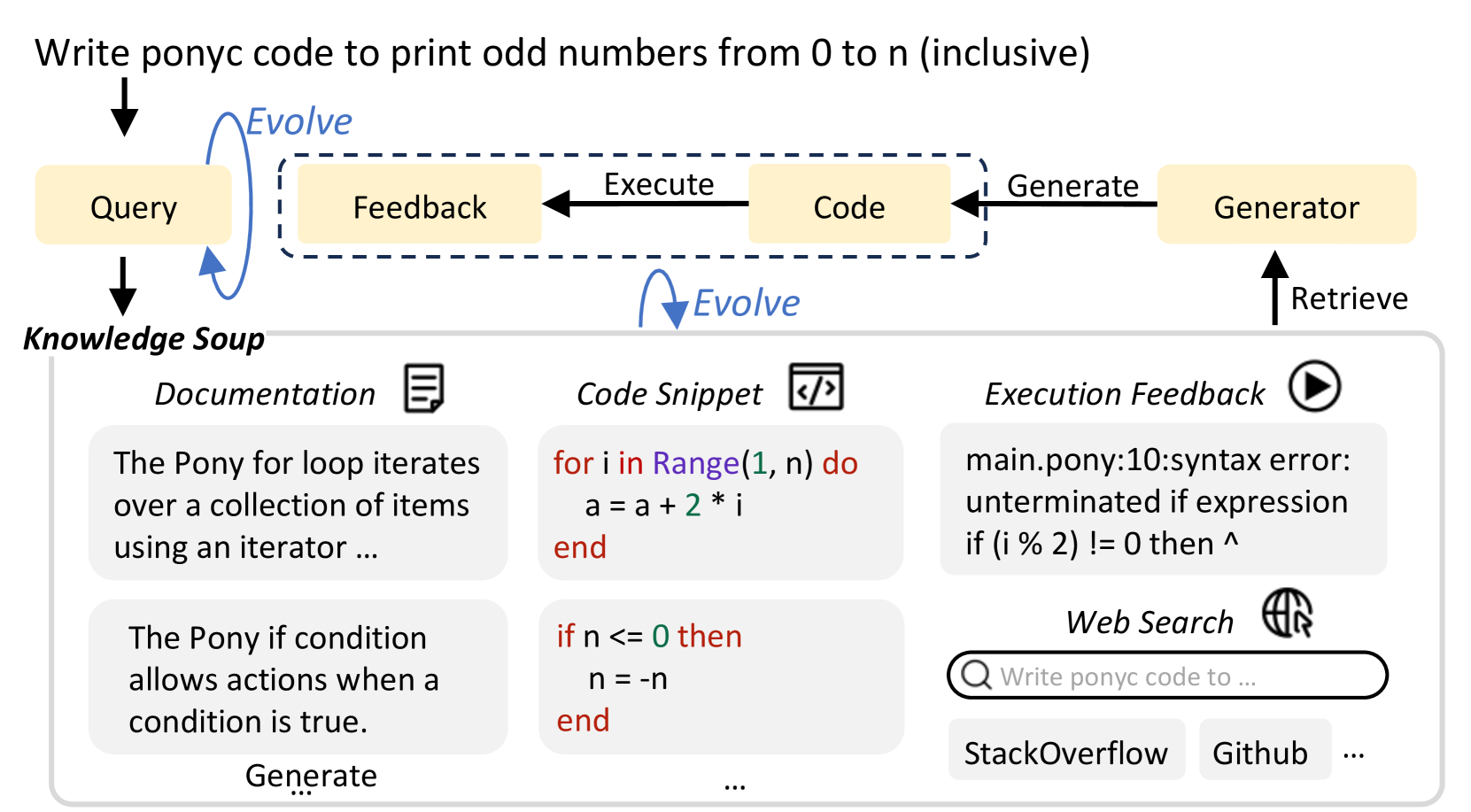
The image illustrates a diagram of a process for generating Ponyc code, likely through an iterative refinement loop. It involves querying, feedback, code execution, and leveraging a "Knowledge Soup" that includes documentation, code snippets, and execution feedback.
### Components/Axes
* **Title:** "Write ponyc code to print odd numbers from 0 to n (inclusive)"
* **Main Flow:**
* **Query:** A starting point, represented by a yellow rectangle. An arrow points downwards from the title to the Query box.
* **Feedback:** A yellow rectangle with a dashed border.
* **Code:** A yellow rectangle.
* **Generator:** A yellow rectangle.
* **Arrows:**
* Downward arrow from the title to "Query".
* Curved blue arrow labeled "Evolve" connecting "Query" to "Feedback".
* Horizontal arrow labeled "Execute" connecting "Feedback" to "Code".
* Horizontal arrow labeled "Generate" connecting "Code" to "Generator".
* Upward arrow labeled "Retrieve" connecting "Knowledge Soup" to "Generator".
* Curved blue arrow labeled "Evolve" connecting "Generator" to "Query".
* **Knowledge Soup:** A rounded rectangle containing:
* **Documentation:** A text snippet with an icon of a document. The text reads: "The Pony for loop iterates over a collection of items using an iterator... The Pony if condition allows actions when a condition is true. Generate ..."
* **Code Snippet:** A text snippet with an icon of angle brackets. The text contains Ponyc code:
```
for i in Range(1, n) do
a = a + 2 * i
end
if n <= 0 then
n = -n
end
...
```
* **Execution Feedback:** A text snippet with a play icon. The text reads: "main.pony:10:syntax error: unterminated if expression if (i % 2) != 0 then ^"
* **Web Search:** A search bar with the text "Write ponyc code to..." and a globe icon. Below are buttons labeled "StackOverflow" and "Github" and "...".
### Detailed Analysis
* The process starts with a "Query," which leads to "Feedback."
* The "Feedback" is used to "Execute" and generate "Code."
* The "Code" is then used by a "Generator."
* The "Knowledge Soup" provides information to the "Generator."
* The process is iterative, with "Evolve" loops connecting "Query" to "Feedback" and "Generator" back to "Query."
* The "Knowledge Soup" contains documentation, code snippets, and execution feedback, suggesting it's a repository of information used to improve the code generation process.
* The code snippet shows examples of Ponyc code, including a `for` loop and an `if` statement.
* The execution feedback shows a syntax error, indicating that the generated code may not always be correct and requires refinement.
* The web search suggests that external resources like StackOverflow and GitHub are used to aid in the code generation process.
### Key Observations
* The diagram highlights an iterative process of code generation, incorporating feedback and external knowledge.
* The "Knowledge Soup" is a crucial component, providing the necessary information for the generator.
* The presence of execution feedback indicates that the process is not perfect and requires debugging and refinement.
### Interpretation
The diagram illustrates a system for automatically generating Ponyc code. The system uses a query as a starting point and iteratively refines the code based on feedback and information from a "Knowledge Soup." The "Knowledge Soup" contains documentation, code snippets, and execution feedback, suggesting that the system learns from its mistakes and improves over time. The inclusion of web search indicates that the system also leverages external resources to aid in the code generation process. The syntax error in the execution feedback highlights the challenges of automated code generation and the need for continuous refinement.
```