## Diagram: Compute Contributions from Matrix Elements
### Overview
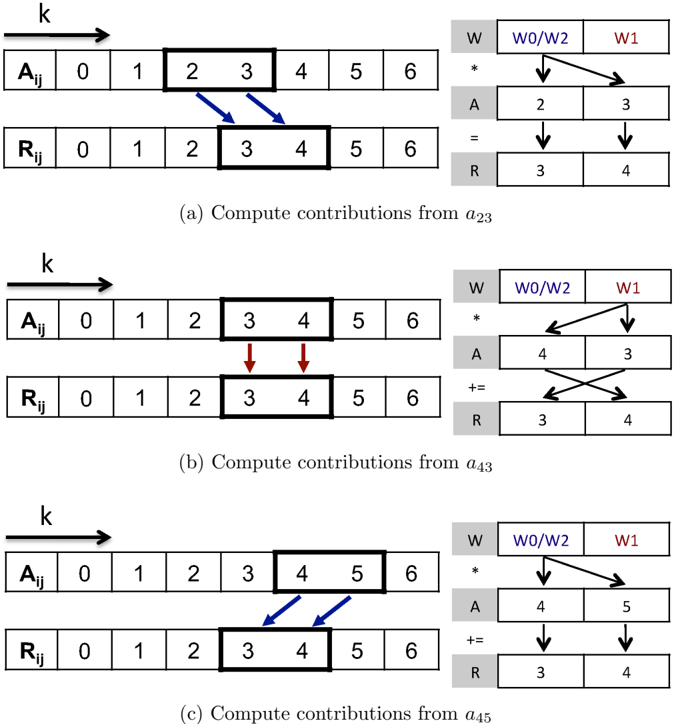
The image presents a diagram illustrating the computation of contributions from matrix elements in a sequence of steps. It shows how elements from matrix A are used to update matrix R, using weights from matrix W. The diagram is divided into three sub-figures, each demonstrating the computation for a different element of matrix A.
### Components/Axes
* **A<sub>ij</sub>**: Represents a row of matrix A, indexed from 0 to 6.
* **R<sub>ij</sub>**: Represents a row of matrix R, indexed from 0 to 6.
* **k**: Indicates the direction of computation (arrow pointing right).
* **W**: Represents a row of matrix W, with elements W0/W2 and W1.
* **A**: Represents elements from matrix A used in the computation.
* **R**: Represents elements from matrix R being updated.
* **(a) Compute contributions from a<sub>23</sub>**: Caption for the first sub-figure.
* **(b) Compute contributions from a<sub>43</sub>**: Caption for the second sub-figure.
* **(c) Compute contributions from a<sub>45</sub>**: Caption for the third sub-figure.
### Detailed Analysis
**Sub-figure (a): Compute contributions from a<sub>23</sub>**
* A<sub>ij</sub> row: \[0, 1, 2, 3, 4, 5, 6]
* Elements 2 and 3 are enclosed in a bold rectangle.
* R<sub>ij</sub> row: \[0, 1, 2, 3, 4, 5, 6]
* Elements 3 and 4 are enclosed in a bold rectangle.
* Arrows: Two blue arrows point from elements 2 and 3 of A<sub>ij</sub> to elements 3 and 4 of R<sub>ij</sub>, respectively.
* W row: \[W0/W2, W1]
* A row: \[2, 3]
* R row: \[3, 4]
* Operation: W \* A = R
**Sub-figure (b): Compute contributions from a<sub>43</sub>**
* A<sub>ij</sub> row: \[0, 1, 2, 3, 4, 5, 6]
* Elements 3 and 4 are enclosed in a bold rectangle.
* R<sub>ij</sub> row: \[0, 1, 2, 3, 4, 5, 6]
* Elements 3 and 4 are enclosed in a bold rectangle.
* Arrows: Two red arrows point from elements 3 and 4 of A<sub>ij</sub> to elements 3 and 4 of R<sub>ij</sub>, respectively.
* W row: \[W0/W2, W1]
* A row: \[4, 3]
* R row: \[3, 4]
* Operation: W \* A += R
**Sub-figure (c): Compute contributions from a<sub>45</sub>**
* A<sub>ij</sub> row: \[0, 1, 2, 3, 4, 5, 6]
* Elements 4 and 5 are enclosed in a bold rectangle.
* R<sub>ij</sub> row: \[0, 1, 2, 3, 4, 5, 6]
* Elements 3 and 4 are enclosed in a bold rectangle.
* Arrows: Two blue arrows point from elements 4 and 5 of A<sub>ij</sub> to elements 3 and 4 of R<sub>ij</sub>, respectively.
* W row: \[W0/W2, W1]
* A row: \[4, 5]
* R row: \[3, 4]
* Operation: W \* A += R
### Key Observations
* Each sub-figure demonstrates how two elements from the A<sub>ij</sub> row contribute to two elements in the R<sub>ij</sub> row.
* The arrows indicate the mapping of elements from A<sub>ij</sub> to R<sub>ij</sub>.
* The W matrix provides weights for the elements from matrix A.
* The operations differ: the first sub-figure uses "=", while the other two use "+=".
### Interpretation
The diagram illustrates a computational process where elements from a matrix A are used to update elements in a matrix R, weighted by elements from a matrix W. The process involves selecting two elements from a row in A (A<sub>ij</sub>) and using them to update two elements in a row of R (R<sub>ij</sub>). The weights W0/W2 and W1 determine the contribution of each element from A to the corresponding elements in R. The first step overwrites the values in R, while the subsequent steps add to the existing values. This process is likely part of a larger algorithm, possibly related to matrix multiplication or convolution. The indices in the sub-figure captions (a<sub>23</sub>, a<sub>43</sub>, a<sub>45</sub>) suggest that the computation is performed iteratively for different elements of matrix A.