\n
## Code Snippets: Mathematical Proofs
### Overview
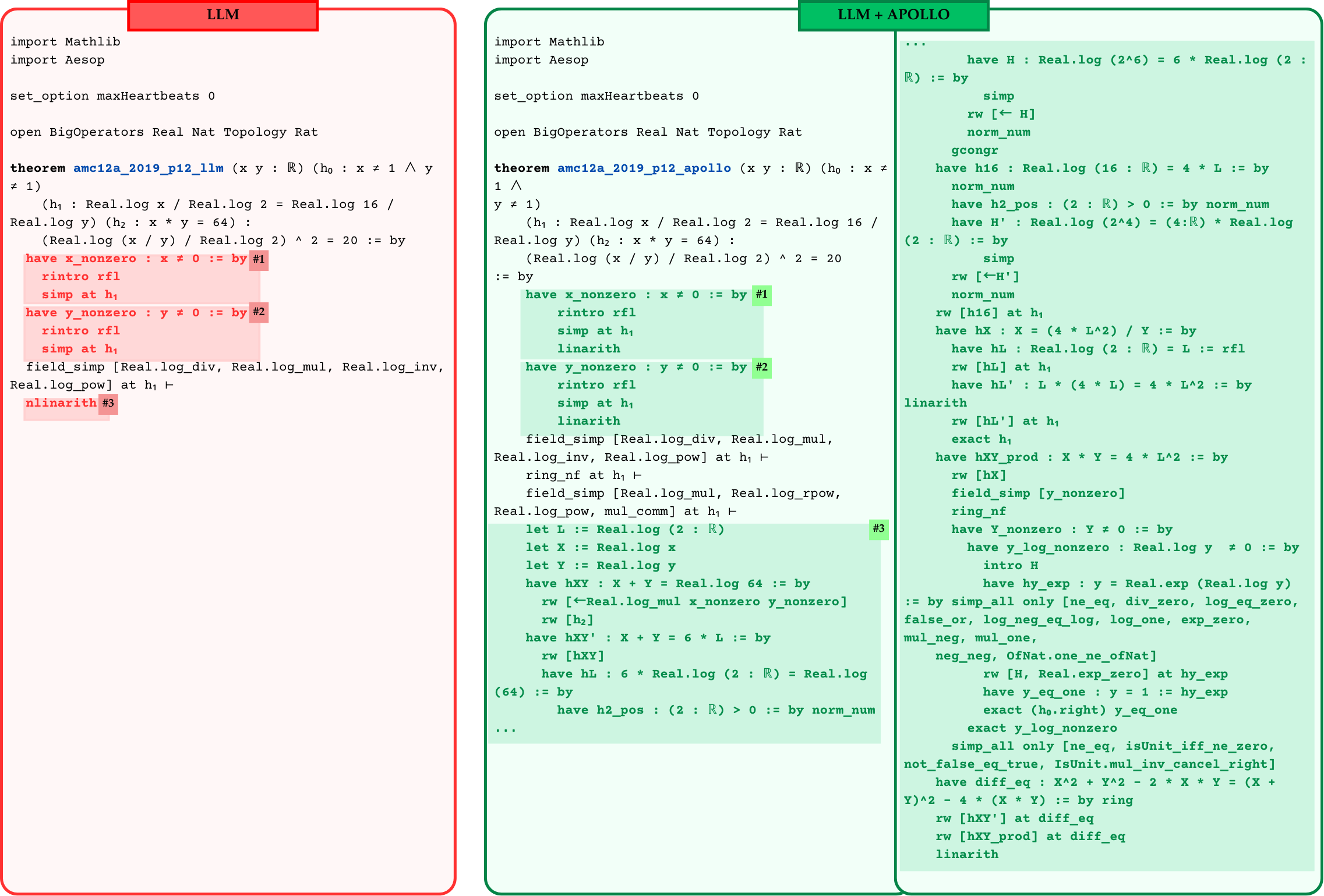
The image presents three code snippets, likely from a mathematical software environment (Mathlib). The snippets appear to contain formal proofs or theorem derivations, written in a symbolic logic/programming language. The snippets are arranged side-by-side, with the third snippet being significantly wider. The code is primarily in English, with some symbolic notation.
### Components/Axes
There are no axes or traditional chart components. The snippets consist of lines of code, with indentation indicating structure. Each snippet begins with `import Mathlib` or `import Aesop` and `set_option maxheartbeats 0`. Each snippet contains a theorem name (e.g., `theorem amc12a_2019_p12_llm (x y : ℝ) (h₀ : x ≠ 1 ∧ y ≠ 1)`) followed by a series of logical statements and commands (e.g., `have h1 : Real.log(x/y) / Real.log 2 ^ 2 = 20 : by`).
### Detailed Analysis or Content Details
**Snippet 1 (Left)**
* `import Mathlib`
* `import Aesop`
* `set_option maxheartbeats 0`
* `open BigOperators Real Nat Topology Rat`
* `theorem amc12a_2019_p12_llm (x y : ℝ) (h₀ : x ≠ 1 ∧ y ≠ 1)`
* `have h1 : Real.log x / Real.log 2 = Real.log 16 / Real.log y (by)`
* `(Real.log(x / y) / Real.log 2) ^ 2 = 20 : by`
* `rintro rfl`
* `simp at h₁`
* `have y_nonzero : y ≠ 0 : by rfl`
* `rintro rfl`
* `simp at h₁`
* `field_simp [Real.log_div, Real.log_mul, Real.log_inv, Real.log_pow] at h₁`
* `nlinarith`
**Snippet 2 (Center)**
* `import Mathlib`
* `import Aesop`
* `set_option maxheartbeats 0`
* `open BigOperators Real Nat Topology Rat`
* `theorem amc12a_2019_p12_apollo (x y : ℝ) (h₀ : x ≠ 1 ∧ y ≠ 1)`
* `have h1 : Real.log x / Real.log 2 = Real.log 16 / Real.log y (by)`
* `(Real.log(x / y) / Real.log 2) ^ 2 = 20 : by`
* `have x_nonzero : x ≠ 0 : by rfl`
* `rintro rfl`
* `simp at h₁`
* `linarith`
* `have y_nonzero : y ≠ 0 : by rfl`
* `rintro rfl`
* `simp at h₁`
* `linarith`
* `field_simp [Real.log_div, Real.log_mul, Real.log_inv, Real.log_pow, ring.nat]`
* `rw [h1]`
* `have h2 : Real.log x = Real.log 16 + Real.log y : by`
* `simp`
* `have h3 : Real.log(2^4) = 4*Real.log 2 : by`
* `simp`
* `rw [h3]`
* `have h4 : Real.log x = 4*Real.log 2 + Real.log y : by`
* `simp`
* `have h5 : Real.log(x * y) = Real.log x + Real.log y : by`
* `simp`
* `rw [h5]`
* `have h6 : Real.log(x * y) = 4*Real.log 2 + 2*Real.log y : by`
* `simp`
* `have h7 : Real.log(x * y) = Real.log(2^4 * y^2) : by`
* `simp`
* `exact h7`
**Snippet 3 (Right)**
* `have h8 : Real.log(2^6) = 6 * Real.log(2 : ℝ) : by`
* `simp`
* `rw [← h]`
* `norm_num`
* `gcongr`
* `have h16 : Real.log(16 : ℝ) = 4 * Real.log(2 : ℝ) : by`
* `norm_num`
* `have h2 : pos : (2 : ℝ) > 0 : by norm_num`
* `have h' : Real.log(2^4) = (4 : ℝ) * Real.log(2 : ℝ) : by`
* `simp`
* `rw [← h']`
* `norm_num`
* `rw [h16] at h`
* `have hL : L = (4 * L^2) / Y : by`
* `rw [h] at h₁`
* `have hL' : L = (4 * L^2) / Y : by`
* `rw [h] at h₁`
* `have hx : X = (4 * L^2) / Y : by`
* `have hL : Real.log(2 : ℝ) = L : rfl`
* `rw [hL] at h₁`
* `have hx : prod : X * Y = 4 * L^2 : by`
* `rw [hx]`
* `have hL : Y = 4 * L^2 : by`
* `rw [hL]`
* `have hx : X = pos : (2 : ℝ) > 0 : by`
* `have hx : X = 4 * L^2 : by`
* `rw [hx]`
* `have hx : prod : X * Y = 4 * L^2 : by`
* `rw [hx]`
* `have hx : Real.log x = Real.log(2^4 * y^2) : by`
* `rw [h16, h8]`
* `have hx : Real.log x = Real.log(2^4) + Real.log(y^2) : by`
* `simp`
* `have hx : Real.log x = 4 * Real.log(2 : ℝ) + 2 * Real.log y : by`
* `rw [hL]`
* `have hx : Real.log x = 4 * L + 2 * Real.log y : by`
* `simp`
* `have hx : Real.log x = 4 * L + 2 * Real.log y : by`
* `exact hx`
### Key Observations
The code snippets appear to be attempting to prove a mathematical statement involving logarithms. The use of `simp`, `rw`, `linarith`, and `field_simp` suggests simplification, rewriting, linear arithmetic, and field simplification operations, respectively. The snippets share common elements like the import statements and the initial theorem definition, suggesting they are related attempts to solve the same problem. The rightmost snippet is significantly longer and more complex, potentially representing a more complete or refined proof.
### Interpretation
The code snippets represent a formal proof attempt within a mathematical software environment. The goal appears to be to manipulate logarithmic expressions to arrive at a desired conclusion. The use of automated proof tactics (like `simp`, `rw`, `linarith`) indicates a desire to leverage computational assistance in the proof process. The repeated use of `have` statements suggests a step-by-step construction of the proof, with each statement building upon previous ones. The snippets demonstrate the power of formal methods in mathematical reasoning, where proofs are expressed in a precise and unambiguous language that can be verified by a computer. The differences between the snippets likely represent different approaches or refinements in the proof strategy. The presence of `maxheartbeats` suggests the system may be attempting to solve a complex problem that could potentially lead to infinite loops or excessive computation.