## Diagram: Solution Process
### Overview
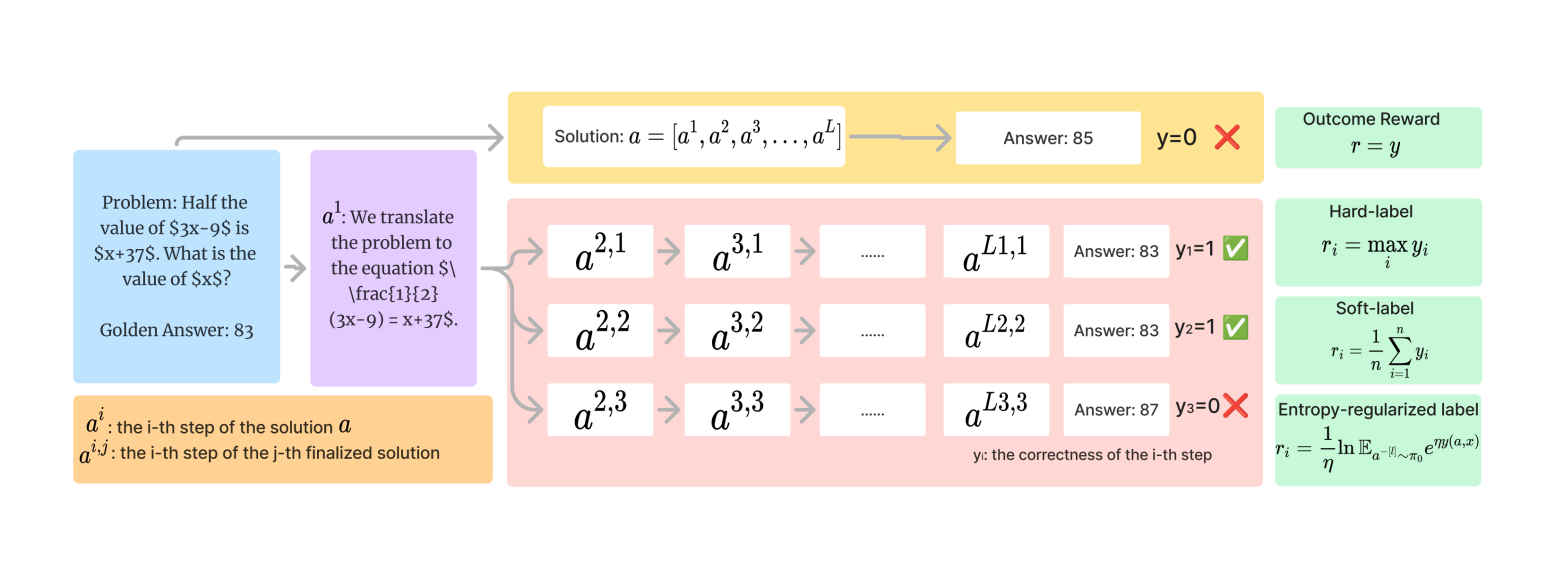
The image presents a diagram illustrating a solution process, likely within a machine learning or AI context. It outlines the steps from problem statement to solution evaluation, incorporating concepts like hard-label, soft-label, and entropy-regularized label.
### Components/Axes
* **Problem Statement (Blue Box, Top-Left):** "Problem: Half the value of $3x-9$ is $x+37$. What is the value of $x$?" "Golden Answer: 83"
* **Translation (Purple Box, Left):** "a¹: We translate the problem to the equation $\frac{1}{2}(3x-9) = x+37$."
* **Solution Representation (Yellow Box, Top):** "Solution: a = \[a¹, a², a³, ..., aᴸ]" "Answer: 85", "y=0 X"
* **Iterative Solution Steps (Pink Box, Center):** This section contains a grid-like structure representing iterative steps in the solution process. The rows are labeled as a², a², a² and the columns are labeled as 1, 2, 3, L.
* a²,¹ -> a³,¹ -> ... -> aᴸ,¹ Answer: 83, y₁=1 ✓
* a²,² -> a³,² -> ... -> aᴸ,² Answer: 83, y₂=1 ✓
* a²,³ -> a³,³ -> ... -> aᴸ,³ Answer: 87, y₃=0 X
* **Reward/Label Definitions (Green Boxes, Right):**
* "Outcome Reward: r = y"
* "Hard-label: rᵢ = max yᵢ"
* "Soft-label: rᵢ = (1/n) * Σ yᵢ (summation from i=1 to n)"
* "Entropy-regularized label: rᵢ = (1/η) * ln Eₐ~π₀ e^(ηy(a,x))"
* **Legend (Orange Box, Bottom-Left):**
* "aⁱ: the i-th step of the solution a"
* "aⁱ,ʲ: the i-th step of the j-th finalized solution"
* **Correctness Indicator:** "yᵢ: the correctness of the i-th step"
### Detailed Analysis or ### Content Details
* **Problem and Translation:** The problem is a simple algebraic equation. The translation step converts the word problem into a mathematical equation.
* **Solution Representation:** The solution 'a' is represented as a vector of steps, from a¹ to aᴸ. The initial solution yields an incorrect answer of 85, indicated by "y=0 X".
* **Iterative Solution Steps:** The pink box shows a series of iterative steps, denoted as aⁱ,ʲ. Each row represents a different attempt or path towards the solution. The final column shows the answer and a correctness indicator (yᵢ).
* The first two rows converge to the correct answer of 83, indicated by "y₁=1 ✓" and "y₂=1 ✓".
* The third row converges to an incorrect answer of 87, indicated by "y₃=0 X".
* **Reward/Label Definitions:** The green boxes define different types of rewards or labels used in the learning process. These include a simple outcome reward, hard-label, soft-label, and an entropy-regularized label.
### Key Observations
* The diagram illustrates an iterative approach to problem-solving, where multiple attempts are made to reach the correct solution.
* The correctness indicator (yᵢ) plays a crucial role in evaluating the solution at each step.
* Different types of rewards/labels are used to guide the learning process, each with its own characteristics and advantages.
### Interpretation
The diagram likely represents a reinforcement learning or optimization process where an agent attempts to solve a problem through trial and error. The iterative solution steps (aⁱ,ʲ) can be seen as different episodes or trajectories. The reward/label definitions provide feedback to the agent, guiding it towards the optimal solution. The entropy-regularized label suggests an exploration-exploitation trade-off, encouraging the agent to explore different solution paths while also exploiting the knowledge it has gained. The diagram highlights the importance of exploration, evaluation, and feedback in the learning process. The fact that some paths lead to incorrect answers emphasizes the need for robust learning algorithms that can handle noisy or incomplete data.