## Raven's Progressive Matrices Style Diagram
### Overview
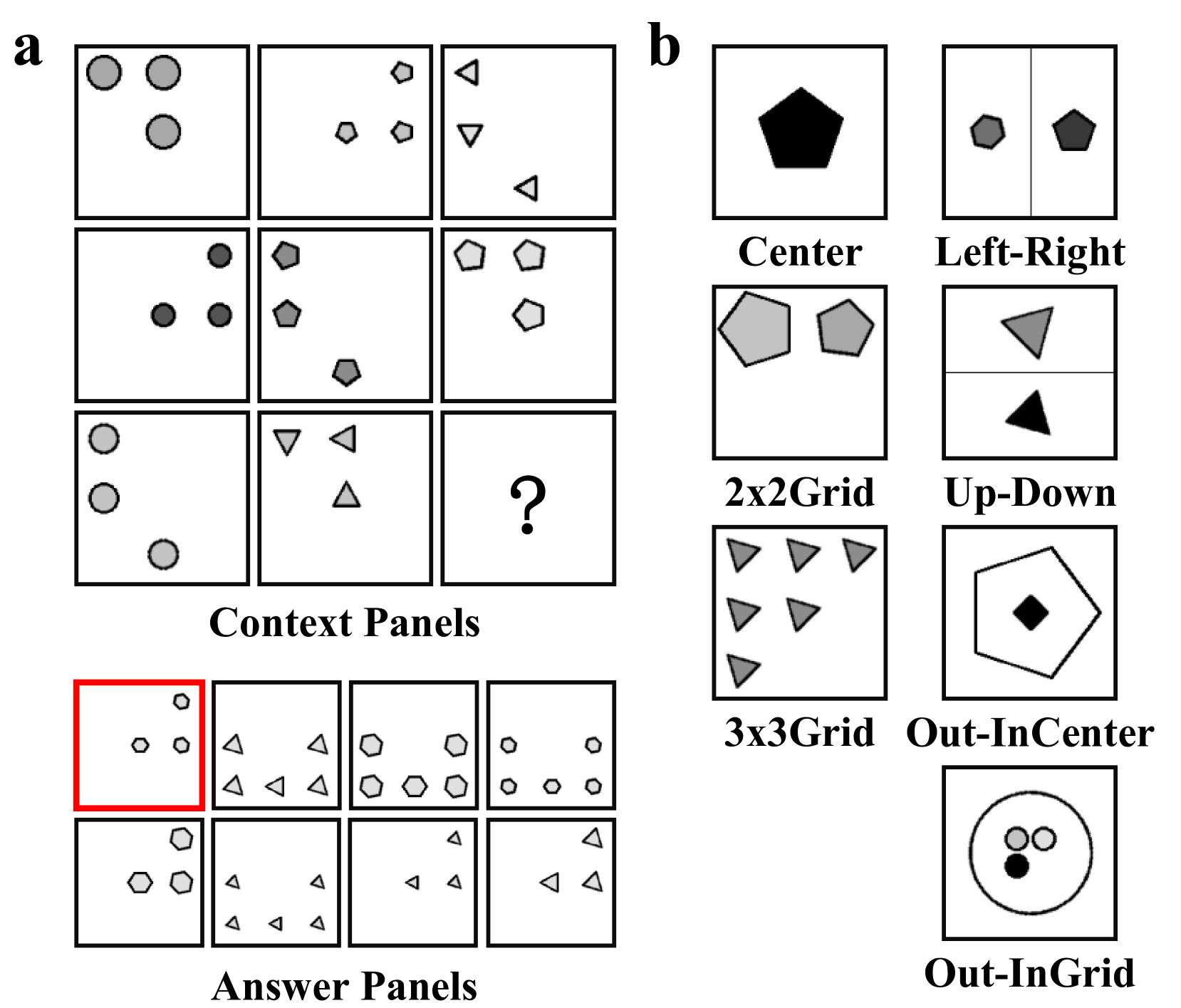
The image presents a visual reasoning puzzle, similar to Raven's Progressive Matrices. It consists of two main sections: "Context Panels" arranged in a 3x3 grid with the bottom-right panel missing and replaced with a question mark, and "Answer Panels" arranged in a 2x5 grid. The task is to select the correct panel from the "Answer Panels" to complete the pattern in the "Context Panels". A second section shows examples of different types of spatial relationships.
### Components/Axes
* **Section a:**
* **Context Panels:** A 3x3 grid of panels, each containing a set of geometric shapes (circles, triangles, pentagons) with varying shades of gray. The bottom-right panel is replaced with a question mark.
* **Answer Panels:** A 2x5 grid of panels, each containing a set of geometric shapes (circles, triangles, pentagons) with varying shades of gray. The first panel in the top row is highlighted with a red border.
* **Labels:** "Context Panels" and "Answer Panels" are labeled below their respective grids.
* **Section b:**
* **Spatial Relationship Examples:** A series of panels demonstrating different spatial relationships between shapes.
* **Labels:** Each panel is labeled with a description of the spatial relationship. The labels are: "Center", "Left-Right", "2x2Grid", "Up-Down", "3x3Grid", "Out-InCenter", "Out-InGrid".
### Detailed Analysis or Content Details
**Section a: Context Panels**
* **Row 1:**
* Panel 1: Three circles of varying sizes and shades of gray.
* Panel 2: Three pentagons of varying sizes and shades of gray.
* Panel 3: Three triangles of varying sizes and shades of gray.
* **Row 2:**
* Panel 4: Three circles of varying sizes and shades of gray.
* Panel 5: Two pentagons of varying sizes and shades of gray.
* Panel 6: Two pentagons of varying sizes and shades of gray.
* **Row 3:**
* Panel 7: Two circles of varying sizes and shades of gray.
* Panel 8: Three triangles of varying sizes and shades of gray.
* Panel 9: Question mark.
**Section a: Answer Panels**
* **Row 1:**
* Panel 1 (red border): Three circles of the same size and shade of gray.
* Panel 2: Four triangles of the same size and shade of gray.
* Panel 3: Two pentagons and two circles of the same size and shade of gray.
* Panel 4: Two circles of the same size and shade of gray.
* Panel 5: Four triangles of the same size and shade of gray.
* **Row 2:**
* Panel 6: Two pentagons and two circles of the same size and shade of gray.
* Panel 7: Four triangles of the same size and shade of gray.
* Panel 8: Four triangles of the same size and shade of gray.
* Panel 9: Two triangles of the same size and shade of gray.
* Panel 10: Four triangles of the same size and shade of gray.
**Section b: Spatial Relationship Examples**
* **Center:** A single black pentagon in the center of the panel.
* **Left-Right:** Two pentagons of varying sizes and shades of gray, positioned on the left and right sides of the panel.
* **2x2Grid:** Four triangles of the same size and shade of gray, arranged in a 2x2 grid.
* **Up-Down:** Two triangles of varying sizes and shades of gray, positioned on the top and bottom of the panel.
* **3x3Grid:** Nine triangles of the same size and shade of gray, arranged in a 3x3 grid.
* **Out-InCenter:** A pentagon with a smaller diamond shape inside it, both in black.
* **Out-InGrid:** A circle with three smaller circles inside it, one black and two white.
### Key Observations
* The "Context Panels" appear to follow a pattern based on the type of shape (circle, triangle, pentagon) and their arrangement.
* The "Answer Panels" provide potential solutions to complete the pattern.
* The red border around the first "Answer Panel" suggests it might be the correct answer.
* The "Spatial Relationship Examples" demonstrate different ways shapes can be arranged within a panel.
### Interpretation
The image presents a visual reasoning problem that requires identifying patterns and relationships between shapes. The "Context Panels" establish a pattern, and the task is to select the "Answer Panel" that best completes the pattern. The "Spatial Relationship Examples" provide additional context and demonstrate different ways shapes can be arranged. The red border around the first "Answer Panel" suggests it might be the correct answer, but careful analysis of the pattern in the "Context Panels" is necessary to confirm this. The pattern appears to be based on the type of shape, the number of shapes, and their relative sizes and shades of gray.