\n
## Diagram: Raven's Progressive Matrices - Pattern Recognition
### Overview
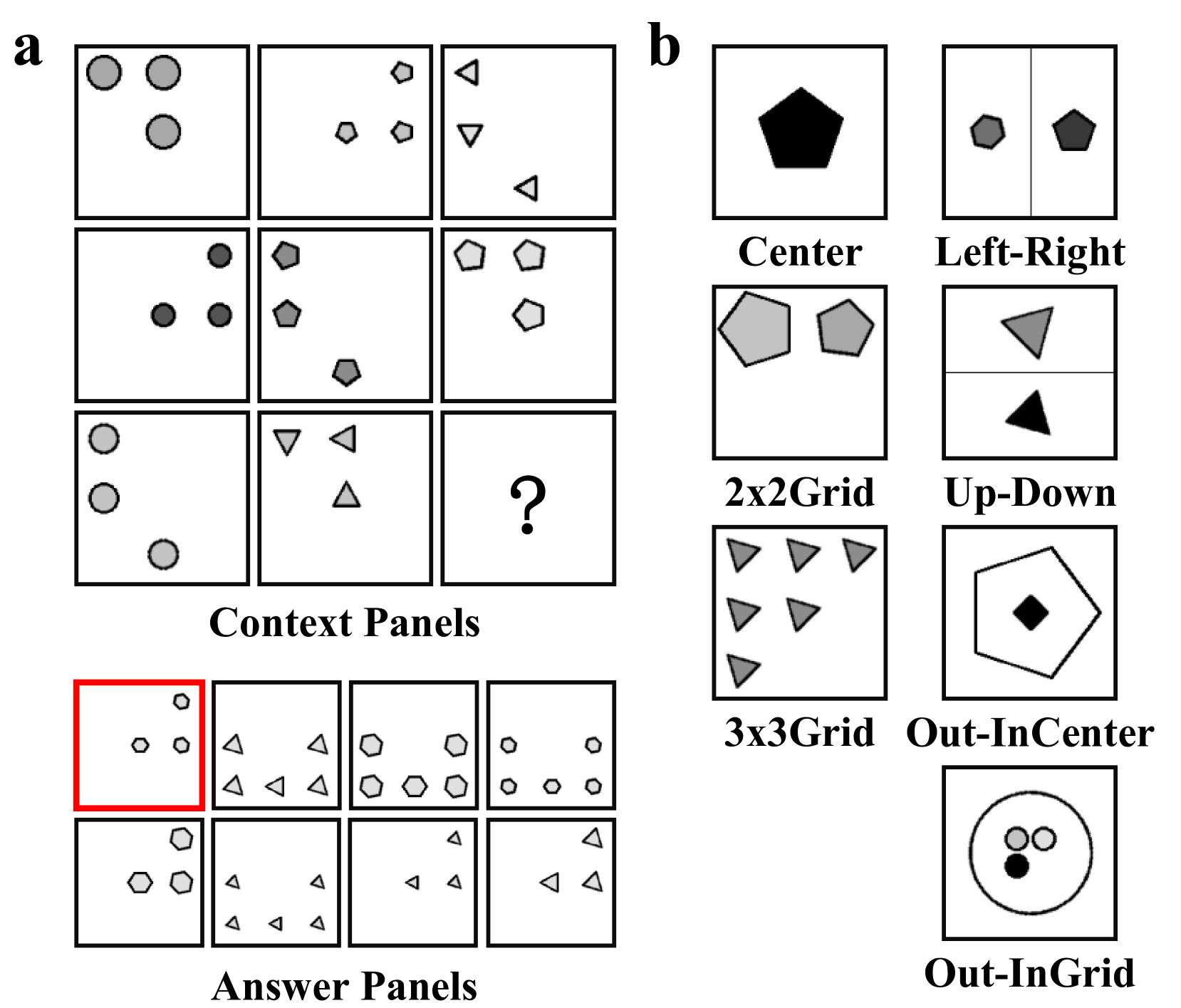
The image presents a visual problem similar to Raven's Progressive Matrices, a nonverbal intelligence test. It consists of two main sections: "Context Panels" (labeled 'a') and "Answer Panels" (labeled 'b'). The Context Panels display a 3x3 grid with eight filled cells and one missing cell (marked with a question mark). The Answer Panels provide eight possible options to fill the missing cell, arranged in a 2x4 grid. The diagram also includes labels for different pattern types.
### Components/Axes
* **Context Panels:** A 3x3 grid of cells containing geometric shapes (circles, squares, triangles, diamonds) with varying fills (solid, outlined).
* **Answer Panels:** A 2x4 grid of cells containing geometric shapes with varying fills.
* **Labels:**
* "Context Panels" - positioned below the 3x3 grid.
* "Answer Panels" - positioned below the 2x4 grid.
* "Center" - above the first image in the Answer Panels.
* "Left-Right" - above the second image in the Answer Panels.
* "2x2Grid" - above the first two images in the third row of the Answer Panels.
* "Up-Down" - above the second image in the third row of the Answer Panels.
* "3x3Grid" - above the first two images in the fourth row of the Answer Panels.
* "Out-InCenter" - above the second image in the fourth row of the Answer Panels.
* "Out-InGrid" - above the last image in the fourth row of the Answer Panels.
* **Red Box:** A red rectangle highlights one of the Answer Panels.
### Detailed Analysis / Content Details
**Context Panels (a):**
* **Row 1:**
* Cell 1: Three solid circles, one outlined circle.
* Cell 2: Two outlined diamonds, two outlined triangles.
* Cell 3: Empty.
* **Row 2:**
* Cell 1: Two solid circles, one outlined circle.
* Cell 2: One outlined square, one outlined diamond.
* Cell 3: Empty.
* **Row 3:**
* Cell 1: Two outlined circles, one solid circle.
* Cell 2: Two outlined triangles, one solid triangle.
* Cell 3: Question mark (missing cell).
**Answer Panels (b):**
The Answer Panels display various combinations of shapes and fills. The red box highlights the following:
* One outlined circle, one outlined square, one solid triangle.
The other Answer Panels contain:
* A solid pentagon with a solid pentagon inside.
* A solid pentagon with an outlined circle inside.
* An outlined triangle pointing up, with a solid triangle pointing down.
* A solid triangle pointing down, with an outlined triangle pointing up.
* A 3x3 grid of outlined triangles.
* A diamond shape with a square inside.
* Two outlined circles.
### Key Observations
The Context Panels demonstrate a pattern involving the number and fill of geometric shapes. The missing cell needs to follow the established pattern. The Answer Panels provide potential solutions, and the red box indicates a selected answer. The labels suggest different types of patterns being tested (e.g., Center, Left-Right, Grid patterns).
### Interpretation
This diagram represents a problem-solving task that requires identifying visual patterns and applying them to determine the missing element. The task assesses abstract reasoning and the ability to perceive relationships between visual elements. The labels indicate that the test is designed to evaluate different types of pattern recognition skills. The red box suggests that the selected answer is the one that best fits the established pattern in the Context Panels. The patterns seem to involve changes in shape fill (solid vs. outlined) and the number of shapes present. The question mark represents the unknown, and the goal is to deduce the correct answer based on the information provided in the surrounding cells. The diagram is a classic example of a non-verbal reasoning test.