## Flowchart: AI-Infused Application Development Ecosystem
### Overview
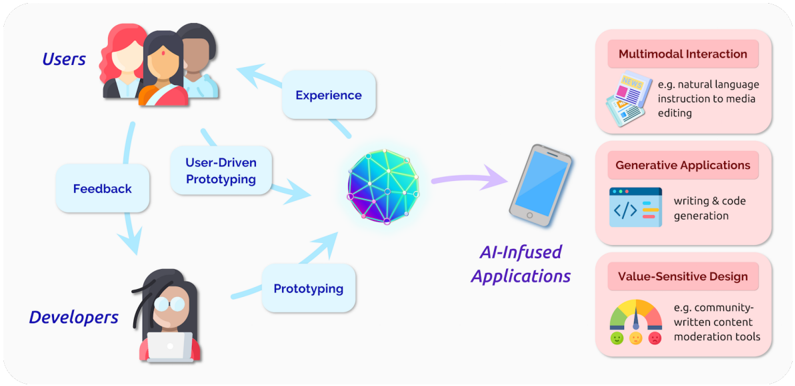
The diagram illustrates a cyclical ecosystem connecting Users, Developers, and AI-Infused Applications. It emphasizes feedback loops, prototyping processes, and the output modalities of AI systems. Three core components are interconnected through bidirectional relationships, with explicit examples of AI application capabilities.
### Components/Axes
**Key Elements:**
1. **Users** (Top-left cluster)
- Represented by three stylized human figures
- Outputs: Experience, Feedback
2. **Developers** (Bottom-left figure)
- Single figure with laptop
- Outputs: Prototyping
3. **AI-Infused Applications** (Central node)
- Connected to all components
- Outputs: Multimodal Interaction, Generative Applications, Value-Sensitive Design
4. **Flow Arrows**
- Blue directional arrows indicate process flow
- Purple arrow connects central node to smartphone icon
**Textual Labels:**
- "User-Driven Prototyping" (between Users and central node)
- "Prototyping" (between Developers and central node)
- "Experience" (User output)
- "Feedback" (User output)
### Detailed Analysis
**User-Developer Interaction:**
- Users provide "Experience" and "Feedback" to the central AI node
- Developers receive "Prototyping" input from the central node
- Reciprocal relationship shown through bidirectional arrows
**AI Application Outputs:**
1. **Multimodal Interaction** (Top-right)
- Example: Natural language instruction to media editing
- Visual: Text document with editing tools
2. **Generative Applications** (Middle-right)
- Example: Writing & code generation
- Visual: Code editor interface
3. **Value-Sensitive Design** (Bottom-right)
- Example: Community-written content moderation tools
- Visual: Circular gauge with emoji indicators
**Spatial Relationships:**
- Users and Developers positioned at diagram edges
- Central AI node acts as processing hub
- Output modalities arranged in vertical column on right
- Smartphone icon connects AI node to real-world application
### Key Observations
1. **Cyclical Nature:** Feedback from users directly informs developer prototyping
2. **AI as Mediator:** Central node serves as transformation point between human input and application output
3. **Modality Diversity:** Three distinct output types shown with concrete examples
4. **Human-Centric Design:** Emphasis on user experience and community involvement
### Interpretation
This diagram demonstrates a participatory AI development model where:
- User feedback creates a continuous improvement loop
- Developers act as intermediaries between raw user input and technical implementation
- AI applications manifest in three critical domains:
1. **Interaction Design:** Enabling natural human-computer communication
2. **Content Generation:** Automating code and text production
3. **Ethical Frameworks:** Incorporating community values through moderation tools
The smartphone icon suggests mobile deployment as a primary use case. The absence of quantitative metrics implies this is a conceptual rather than empirical model, focusing on process relationships rather than performance metrics. The color coding (blue for process, purple for output) helps distinguish between developmental stages and final applications.