## Geometric Diagram: Shape Composition
### Overview
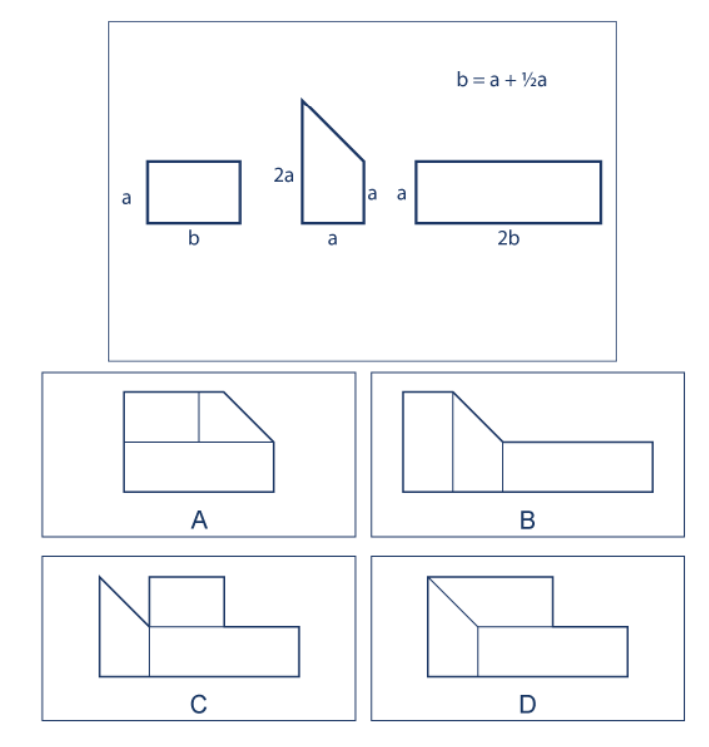
The image presents a geometric problem involving the composition of shapes. It shows three initial shapes with labeled dimensions and an equation relating 'b' and 'a'. Below these are four options (A, B, C, D), each depicting a combination of these shapes. The task likely involves identifying which of the options correctly combines the initial shapes according to the given equation.
### Components/Axes
* **Initial Shapes (Top):**
* Rectangle 1: Labeled with sides 'a' and 'b'.
* Trapezoid: One side labeled '2a', and two sides labeled 'a'.
* Rectangle 2: Labeled with sides 'a' and '2b'.
* **Equation:** "b = a + 1/2a" (or b = 1.5a)
* **Options (Bottom):** Four different arrangements of the shapes, labeled A, B, C, and D.
### Detailed Analysis or ### Content Details
* **Equation Analysis:** The equation "b = a + 1/2a" simplifies to "b = 1.5a". This means the length 'b' is 1.5 times the length 'a'.
* **Shape Dimensions:**
* Rectangle 1: Sides are 'a' and 'b' (where b = 1.5a).
* Trapezoid: Height is 'a', one base is 'a', and the other base is '2a'.
* Rectangle 2: Sides are 'a' and '2b' (where 2b = 3a).
* **Option A:** A rectangle with sides 'a' and 'b' is placed next to a trapezoid.
* **Option B:** A rectangle with sides 'a' and 'a' is placed next to a rectangle with sides 'a' and '2b'.
* **Option C:** A trapezoid is placed next to a rectangle with sides 'a' and 'a'. This is placed next to a rectangle with sides 'a' and '2b'.
* **Option D:** A trapezoid is placed next to a rectangle with sides 'a' and 'a'. This is placed next to a rectangle with sides 'a' and 'b'.
### Key Observations
* The equation "b = 1.5a" is crucial for understanding the relationship between the shapes.
* The trapezoid's dimensions are consistent with the 'a' and '2a' labels.
* The options A, B, C, and D present different arrangements of the initial shapes.
### Interpretation
The image presents a spatial reasoning problem. The goal is to determine which of the options (A, B, C, or D) correctly combines the initial shapes, taking into account their dimensions and the relationship defined by the equation "b = a + 1/2a". The correct answer would likely involve a combination where the shapes fit together logically based on their side lengths.