## Diagram: Geometric Shape Composition Puzzle
### Overview
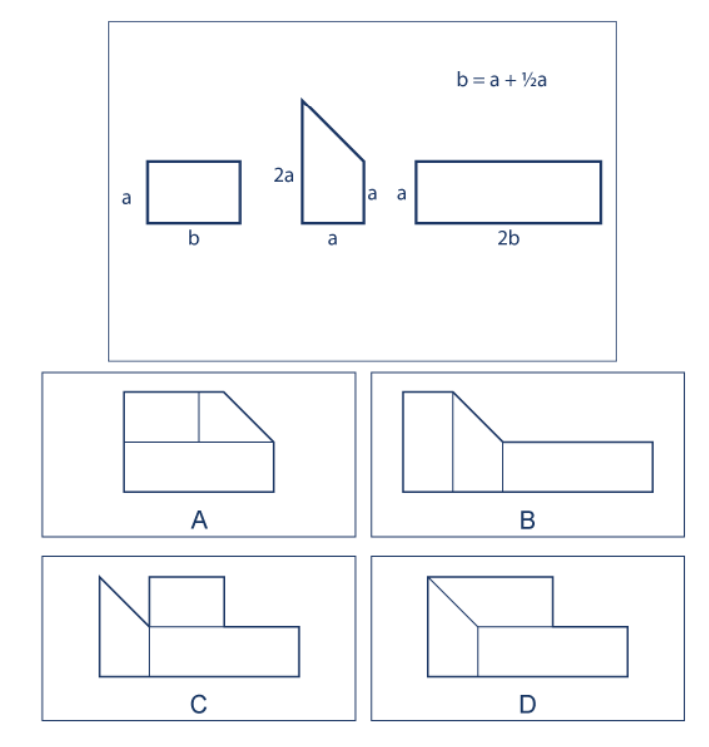
The image is a geometric logic puzzle consisting of two distinct sections. The top section displays three individual geometric shapes defined by algebraic variables ('a' and 'b') and an equation relating them. The bottom section presents four multiple-choice options (labeled A, B, C, and D), each containing a composite shape formed by combining various geometric elements. The objective is likely to identify which composite shape in the bottom section corresponds to a specific combination or transformation of the shapes provided in the top section.
### Components/Axes
**Top Section (The "Given" Shapes):**
* **Shape 1 (Left):** A rectangle.
* Vertical side labeled: **a**
* Horizontal side labeled: **b**
* **Shape 2 (Middle):** A right trapezoid.
* Left vertical side labeled: **2a**
* Right vertical side labeled: **a**
* Bottom horizontal base labeled: **a**
* **Shape 3 (Right):** A rectangle.
* Vertical side labeled: **a**
* Horizontal side labeled: **2b**
* **Equation (Top Right):** **b = a + ½a** (This indicates that the variable 'b' is equal to 1.5 times 'a').
**Bottom Section (The Options):**
* **Option A:** A composite shape consisting of a rectangular base with a square and a right triangle on top.
* **Option B:** A composite shape consisting of a tall rectangle on the left, a right trapezoid in the middle, and a long rectangle on the right.
* **Option C:** A composite shape consisting of a right triangle on the far left, a square in the middle, and a long rectangle on the right.
* **Option D:** A composite shape consisting of a right trapezoid on the left, a square in the middle, and a long rectangle on the right.
### Detailed Analysis
**Top Section Analysis:**
* The shapes are presented in a horizontal row.
* The equation **b = a + ½a** is positioned in the top-right corner of the top box.
* The trapezoid (Shape 2) can be geometrically decomposed into a square of size **a x a** and a right triangle with a base of **a** and a height of **a** (since the left side is **2a** and the right side is **a**, the difference is **a**).
**Bottom Section Analysis (Options):**
* **Option A:** Features a base rectangle. On top of the base, there is a vertical line dividing the upper section into a square (left) and a right triangle (right).
* **Option B:** Features a tall rectangle on the far left (height **2a**), followed by a right trapezoid, and a long rectangle on the right.
* **Option C:** Features a right triangle on the far left, a square in the middle, and a long rectangle on the right.
* **Option D:** Features a right trapezoid on the far left, a square in the middle, and a long rectangle on the right.
### Key Observations
* **Variable Relationship:** The equation **b = a + ½a** is the key to solving the puzzle. It implies that any length labeled 'b' is 1.5 times the length of 'a'.
* **Visual Consistency:** All shapes in the options (A, B, C, D) are constructed using the same geometric primitives (rectangles, squares, and right triangles) found in the top section.
* **Structural Differences:** The options differ primarily in the arrangement and sequence of these primitives. For example, Option B places the tall rectangle on the far left, whereas Option D places the trapezoid on the far left.
### Interpretation
This image is a standard geometric reasoning test item. The data demonstrates the concept of **geometric decomposition and synthesis**.
* **Mathematical Logic:** The puzzle requires the viewer to understand that complex shapes can be broken down into simpler, fundamental units (rectangles and triangles). By defining the dimensions of these units using variables 'a' and 'b', the puzzle forces the viewer to consider the proportional relationships between the parts.
* **Peircean Investigative Perspective:** The diagram functions as an icon (the shapes look like the objects they represent) and a symbol (the variables 'a' and 'b' represent abstract quantities). The "truth" of the puzzle lies in the spatial arrangement. The viewer must mentally manipulate the top shapes—perhaps rotating, flipping, or aligning them—to match the composite structures in the options. The presence of the equation **b = a + ½a** suggests that the solution may also require verifying that the total width or area of the composite shape matches the sum of the individual parts defined by the variables.