\n
## Diagram: Geometric Construction and Options
### Overview
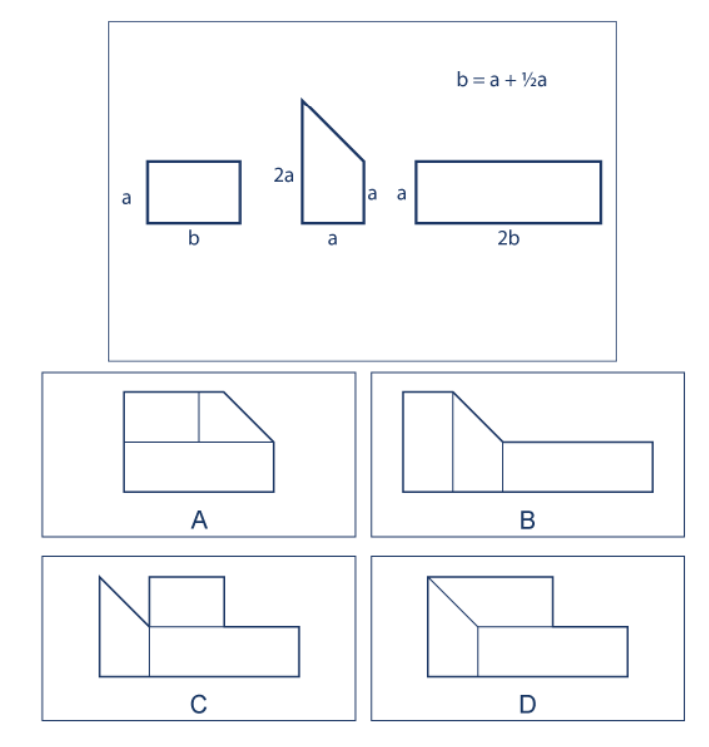
The image presents a geometric construction problem with a right triangle and several possible solutions represented as diagrams. The top section shows a right triangle with labeled sides and an equation relating two of the sides. The bottom section displays four options (A, B, C, and D) representing different geometric arrangements.
### Components/Axes
The diagram consists of:
* **Right Triangle:** A right triangle with sides labeled 'a', '2a', and 'a'. The hypotenuse is labeled 'a'.
* **Rectangles:** Four rectangles with varying internal divisions.
* **Equation:** "b = a + ½a" positioned in the top-right corner.
* **Labels:** 'a', '2a', 'b', '2b' labeling the sides of rectangles and the triangle.
* **Options:** Four options labeled A, B, C, and D.
### Detailed Analysis or Content Details
The top section illustrates a right triangle. The sides are defined as follows:
* Hypotenuse: 'a'
* Base: '2a'
* Height: 'a'
The equation provided is: b = a + ½a, which simplifies to b = 1.5a or b = 3a/2.
The bottom section presents four options, each consisting of a rectangle divided into smaller rectangles. These options likely represent attempts to construct a rectangle with dimensions related to 'a' and 'b' based on the triangle.
* **Option A:** A rectangle divided into two sections. The left section is a square, and the right section is a rectangle.
* **Option B:** A rectangle divided into two sections. The left section is a rectangle, and the right section is a rectangle.
* **Option C:** A rectangle divided into two sections. The left section is a rectangle, and the right section is a rectangle.
* **Option D:** A rectangle divided into two sections. The left section is a triangle, and the right section is a rectangle.
There are no numerical values associated with the dimensions of the rectangles in options A, B, C, and D.
### Key Observations
The equation b = a + ½a suggests a relationship between 'a' and 'b'. The right triangle with sides 'a', '2a', and 'a' is likely used to derive this relationship. The options A, B, C, and D are visual representations of possible solutions or constructions based on this relationship.
### Interpretation
The diagram likely presents a geometric problem where the goal is to construct a rectangle with dimensions related to the sides of the given right triangle. The equation b = a + ½a provides the key relationship between the dimensions. The options A, B, C, and D are potential solutions, and the task is likely to identify the correct construction based on the given equation and triangle. The diagram is a visual aid for understanding and solving a geometric construction problem. The problem is likely to determine which of the options correctly represents a rectangle with dimensions 'a' and 'b' where b = 1.5a. Without further context, it's impossible to determine which option is the correct solution.