## Diagram: Geometric Relationship Illustration
### Overview
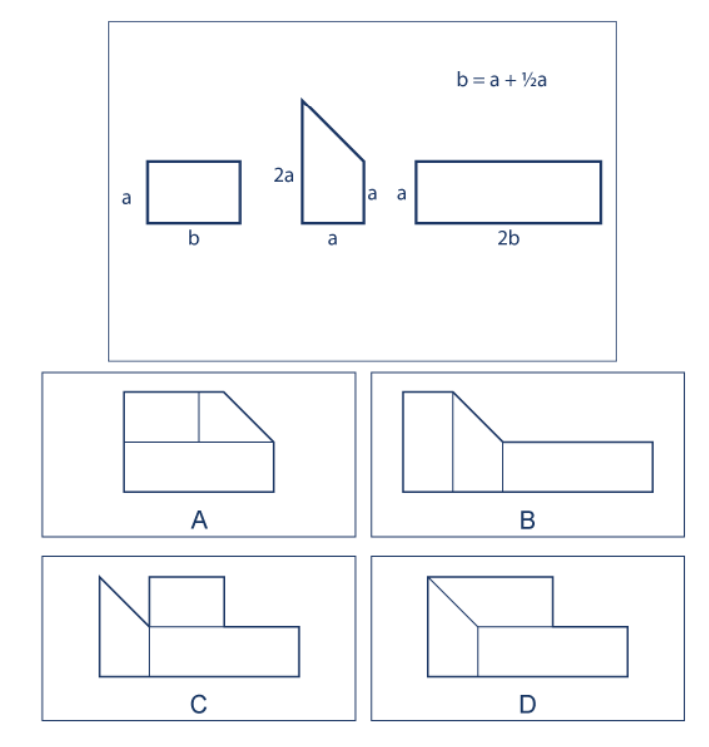
The image presents a geometric diagram with labeled components and four alternative configurations (A, B, C, D) below. The main diagram includes a rectangle divided into sections with algebraic relationships, while the options depict variations of stepped or angular shapes.
### Components/Axes
- **Main Diagram Labels**:
- Top-left: "a" (horizontal line)
- Bottom-left: "b" (horizontal line)
- Center: "2a" (vertical line) and "a" (horizontal line)
- Top-right: "b = a + ½a" (equation)
- Bottom-right: "2b" (horizontal line)
- **Options A-D**:
- **A**: Stepped shape with a horizontal top segment, vertical drop, and horizontal base.
- **B**: Vertical segment on the left, diagonal slope, and horizontal base.
- **C**: Diagonal slope on the left, horizontal segment, and stepped base.
- **D**: Diagonal slope on the left, horizontal segment, and stepped base (similar to C but with a different slope angle).
### Detailed Analysis
1. **Main Diagram**:
- The rectangle is divided into sections with labeled lengths:
- Left side: "a" (height) and "2a" (height).
- Bottom: "b" (width) and "2b" (width).
- Equation: "b = a + ½a" (top-right corner), indicating a proportional relationship between "a" and "b".
- Spatial grounding: Labels are positioned adjacent to their respective lines (e.g., "a" above the left vertical line).
2. **Options A-D**:
- All options share a common structure: a diagonal slope on the left, a horizontal segment, and a stepped base.
- Differences:
- **A**: Horizontal top segment aligns with the main diagram’s "2a" height.
- **B**: Vertical segment matches the main diagram’s "a" height.
- **C** and **D**: Stepped bases vary in width and slope angle.
### Key Observations
- The equation "b = a + ½a" suggests a dependency of "b" on "a", with "b" being 1.5 times "a".
- Options A-D likely represent alternative configurations of the main diagram’s components, with variations in slope angles and segment lengths.
- No numerical values or units are provided, leaving relationships abstract.
### Interpretation
The diagram illustrates a geometric relationship where "b" is derived from "a" via the equation. The options (A-D) may represent practical applications or variations of this relationship, such as different ways to partition or construct shapes based on the proportional rule. The absence of units implies a theoretical or schematic purpose, possibly for educational or design contexts. The stepped configurations in A-D could symbolize iterative adjustments or optimizations of the base relationship.