## Scatter Plot: Perceived vs. Intended Angle
### Overview
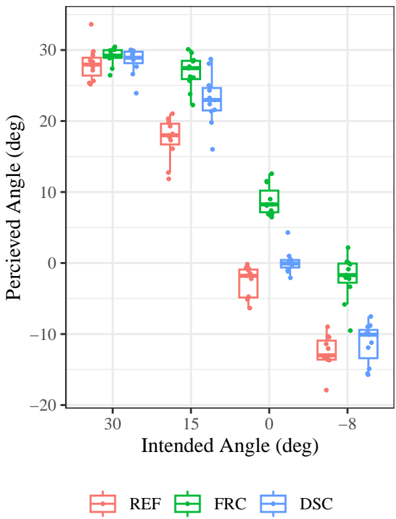
This image presents a scatter plot comparing the intended angle of a stimulus to the perceived angle by a subject. The data is presented as box-and-whisker plots for three different conditions: REF, FRC, and DSC. Individual data points are also plotted as dots. The plot aims to visualize any systematic biases or distortions in angle perception.
### Components/Axes
* **X-axis:** "Intended Angle (deg)" - Ranges from approximately -8 to 30 degrees. Marked at -8, 0, 15, and 30.
* **Y-axis:** "Perceived Angle (deg)" - Ranges from approximately -20 to 30 degrees.
* **Legend:** Located at the bottom-center of the image.
* REF (Red): Represents one condition.
* FRC (Green): Represents another condition.
* DSC (Blue): Represents a third condition.
### Detailed Analysis
The plot displays box-and-whisker plots for each condition at several intended angles. Individual data points are scattered around these box plots.
**REF (Red):**
* At Intended Angle = 30 deg: Perceived Angle median is approximately 27 deg, with the box extending from roughly 23 to 31 deg. Several points are above 30 deg.
* At Intended Angle = 15 deg: Perceived Angle median is approximately 18 deg, with the box extending from roughly 12 to 22 deg.
* At Intended Angle = 0 deg: Perceived Angle median is approximately -3 deg, with the box extending from roughly -7 to 2 deg.
* At Intended Angle = -8 deg: Perceived Angle median is approximately -12 deg, with the box extending from roughly -16 to -8 deg.
**FRC (Green):**
* At Intended Angle = 30 deg: Perceived Angle median is approximately 30 deg, with the box extending from roughly 27 to 33 deg.
* At Intended Angle = 15 deg: Perceived Angle median is approximately 11 deg, with the box extending from roughly 8 to 15 deg.
* At Intended Angle = 0 deg: Perceived Angle median is approximately 8 deg, with the box extending from roughly 5 to 12 deg.
* At Intended Angle = -8 deg: Perceived Angle median is approximately -2 deg, with the box extending from roughly -5 to 2 deg.
**DSC (Blue):**
* At Intended Angle = 30 deg: Perceived Angle median is approximately 30 deg, with the box extending from roughly 26 to 33 deg.
* At Intended Angle = 15 deg: Perceived Angle median is approximately 22 deg, with the box extending from roughly 18 to 26 deg.
* At Intended Angle = 0 deg: Perceived Angle median is approximately 1 deg, with the box extending from roughly -2 to 4 deg.
* At Intended Angle = -8 deg: Perceived Angle median is approximately -10 deg, with the box extending from roughly -14 to -6 deg.
### Key Observations
* **Underestimation:** For all three conditions, there's a general trend of underestimation of the intended angle, particularly at positive angles. The perceived angle is consistently lower than the intended angle.
* **Condition Differences:** The REF condition shows the most significant underestimation at 30 degrees. The FRC and DSC conditions appear to have more accurate perception at 30 degrees.
* **Negative Angle Perception:** At -8 degrees, all three conditions show a tendency to perceive the angle as more negative than intended.
* **Data Spread:** The spread of data points (as indicated by the box-and-whisker plots) varies across conditions and intended angles, suggesting different levels of perceptual variability.
### Interpretation
The data suggests a systematic bias in angle perception, where individuals tend to underestimate positive angles and overestimate negative angles. This bias appears to be more pronounced in the REF condition compared to the FRC and DSC conditions. This could indicate that the REF condition involves a different perceptual mechanism or a greater susceptibility to distortion. The differences between the conditions might be related to the specific experimental setup or the type of stimulus used. The spread of data points suggests individual differences in perceptual accuracy. The consistent underestimation of positive angles could be related to a cognitive tendency to centralize perceptions or a specific characteristic of the visual system. Further investigation would be needed to determine the underlying causes of these perceptual biases.