## Bar Chart: Consistency Score vs. Density
### Overview
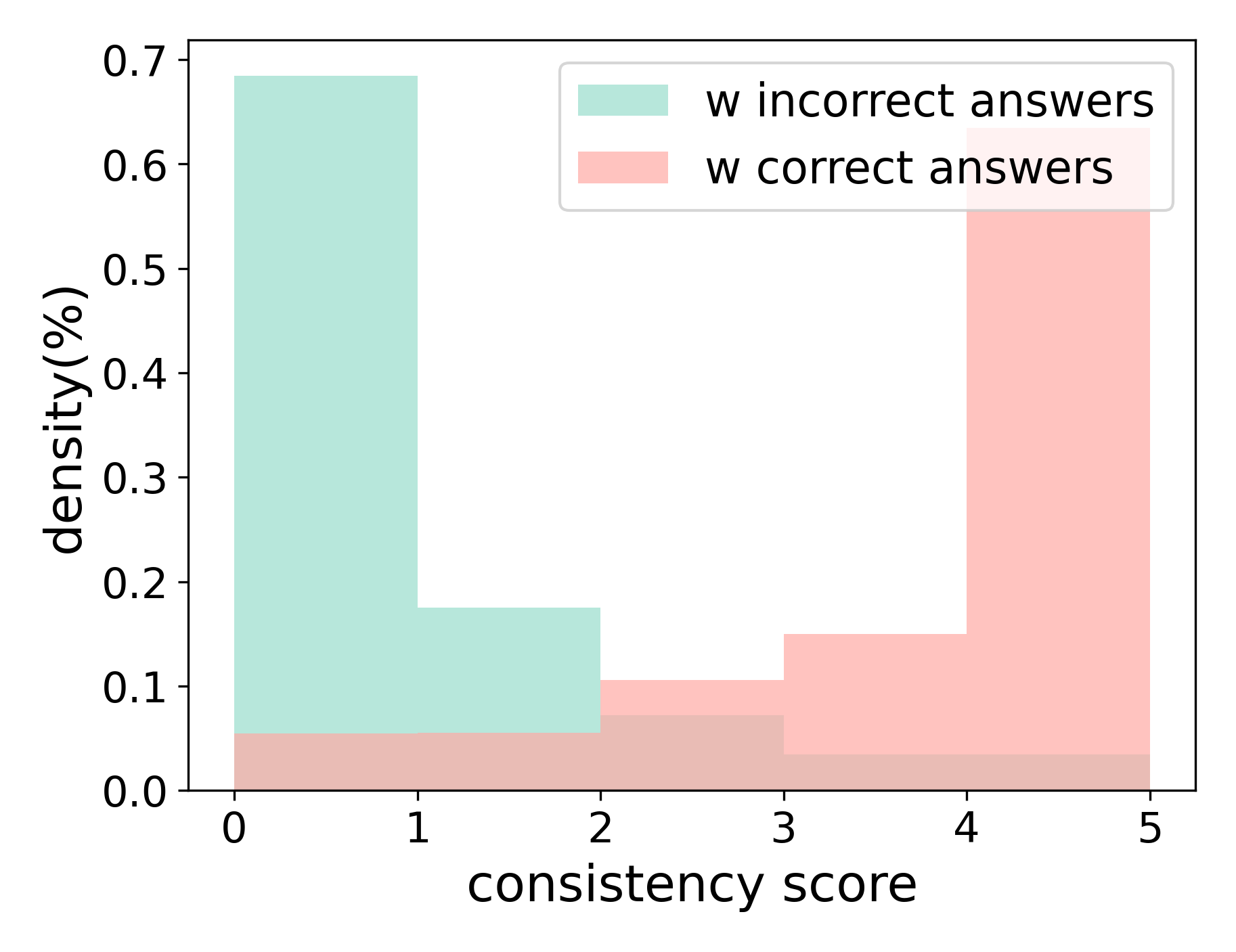
The image is a bar chart comparing the density (%) of incorrect and correct answers against a "consistency score" ranging from 0 to 5. The chart uses two distinct colors to differentiate between incorrect (light green) and correct (light red) answers.
### Components/Axes
* **X-axis:** "consistency score" with markers at 0, 1, 2, 3, 4, and 5.
* **Y-axis:** "density(%)" ranging from 0.0 to 0.7, with markers at 0.0, 0.1, 0.2, 0.3, 0.4, 0.5, 0.6, and 0.7.
* **Legend (top-right):**
* Light Green: "w incorrect answers"
* Light Red: "w correct answers"
### Detailed Analysis
* **"w incorrect answers" (Light Green):**
* Consistency Score 0-1: Density approximately 0.68
* Consistency Score 1-2: Density approximately 0.17
* Consistency Score 2-3: Density approximately 0.00
* Consistency Score 3-4: Density approximately 0.00
* Consistency Score 4-5: Density approximately 0.00
* **"w correct answers" (Light Red):**
* Consistency Score 0-1: Density approximately 0.05
* Consistency Score 1-2: Density approximately 0.06
* Consistency Score 2-3: Density approximately 0.10
* Consistency Score 3-4: Density approximately 0.15
* Consistency Score 4-5: Density approximately 0.55
### Key Observations
* For low consistency scores (0-1), the density of incorrect answers is significantly higher than correct answers.
* As the consistency score increases, the density of correct answers increases, becoming dominant at scores 4-5.
* The density of incorrect answers decreases as the consistency score increases.
### Interpretation
The chart suggests a strong correlation between the consistency score and the correctness of answers. Low consistency scores are associated with a higher proportion of incorrect answers, while high consistency scores are associated with a higher proportion of correct answers. This indicates that the "consistency score" is a good predictor of answer accuracy. The data implies that a higher consistency score reflects a better understanding or knowledge, leading to more correct answers.