## Diagram: LLM-Powered Node Communication Protocol
### Overview
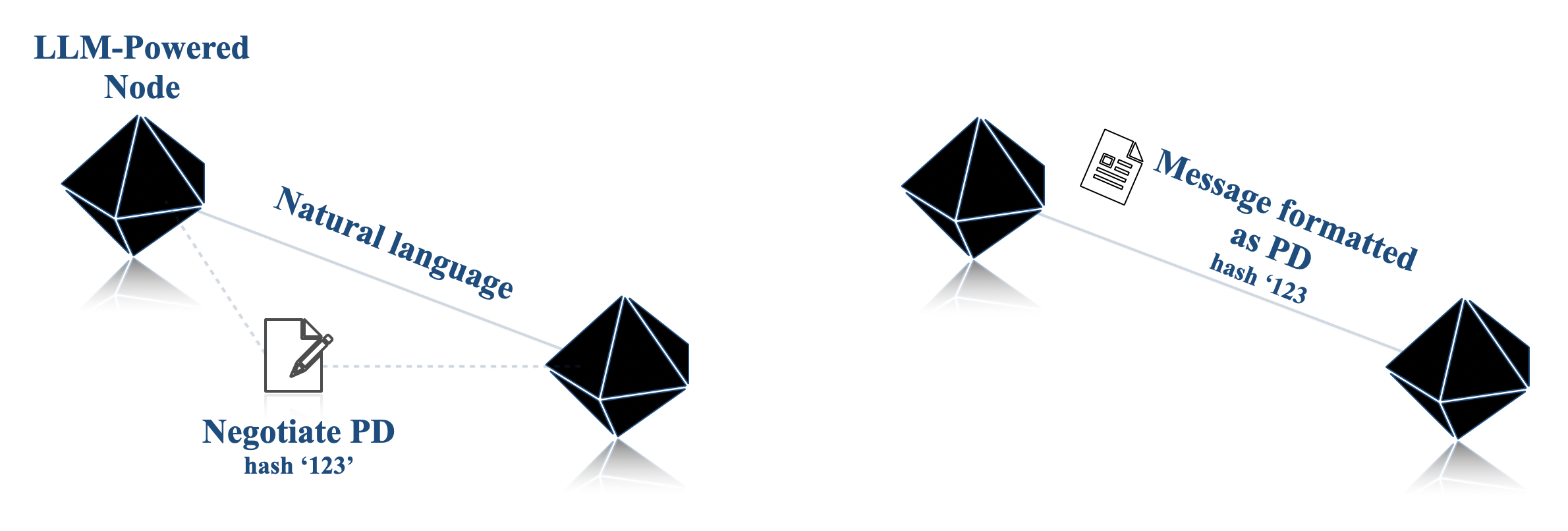
The image is a technical diagram illustrating a two-stage communication process between two "LLM-Powered Nodes." It depicts a protocol where nodes first negotiate a document using natural language and then exchange a message formatted according to that negotiated structure, identified by a specific hash. The diagram is split into two distinct panels, left and right, representing sequential phases of the interaction.
### Components/Axes
The diagram contains the following labeled components and visual elements:
**Nodes:**
* **Visual Representation:** Four identical black polyhedrons (appearing as icosahedrons or similar faceted shapes) with white edges, each casting a subtle reflection below.
* **Label:** The top-left node is explicitly labeled **"LLM-Powered Node"**. By implication, all four polyhedrons represent the same type of entity.
**Connections & Data Flow:**
* **Left Panel (Negotiation Phase):**
* A **solid grey line** connects the top-left node to the bottom-right node. This line is labeled with the text **"Natural language"**.
* A **dashed grey line** connects the top-left node to a document icon positioned below and between the two nodes. This line is also associated with the "Natural language" label.
* **Right Panel (Message Exchange Phase):**
* A **solid grey line** connects the top-left node to the bottom-right node. This line is labeled with the text **"Message formatted as PD hash '123'"**.
**Document Icons & Annotations:**
* **Left Panel Icon:** A document icon with a pencil, positioned below the "Natural language" line. It is annotated with the text **"Negotiate PD hash '123'"**.
* **Right Panel Icon:** A document icon with lines representing text, positioned above the connection line near the top-left node. It is annotated with the text **"Message formatted as PD hash '123'"**.
### Detailed Analysis
The diagram outlines a clear, two-step workflow:
1. **Stage 1: Negotiation (Left Panel)**
* **Actors:** Two LLM-Powered Nodes.
* **Action:** The initiating node (top-left) uses **"Natural language"** to communicate with the receiving node (bottom-right).
* **Purpose:** This communication is directed towards a specific goal, represented by the document icon with a pencil. The annotation **"Negotiate PD hash '123'"** indicates they are negotiating the structure or content of a "PD" (likely an acronym for a document type like "Protocol Document," "Payload Description," or "Package Definition").
* **Identifier:** The negotiated artifact is assigned a unique identifier: **hash '123'**.
2. **Stage 2: Formatted Message Exchange (Right Panel)**
* **Actors:** The same two LLM-Powered Nodes.
* **Action:** The initiating node now sends a message to the receiving node.
* **Format:** The message is no longer in raw natural language. It is now a **"Message formatted as PD"**.
* **Link to Negotiation:** The message is explicitly tied to the previous negotiation via the identifier **hash '123'**. This confirms the message adheres to the structure agreed upon in Stage 1.
* **Visual Cue:** The document icon near the sending node now shows formatted text lines, visually distinguishing it from the "negotiation" icon with a pencil.
### Key Observations
* **Sequential Process:** The left-to-right arrangement of panels implies a temporal sequence: negotiation must precede formatted exchange.
* **State Change:** The core transformation is from unstructured **"Natural language"** to a structured **"Message formatted as PD"**.
* **Persistent Identifier:** The hash **'123'** acts as a crucial link between the two stages, ensuring the formatted message corresponds to the previously negotiated contract.
* **Role of LLMs:** The nodes are specified as "LLM-Powered," suggesting the natural language negotiation and the subsequent formatting/parsing are performed by Large Language Models.
* **Visual Metaphor:** The polyhedron shape may symbolize a complex, multi-faceted processing unit or a secure, encapsulated node.
### Interpretation
This diagram illustrates a protocol for structured communication between AI agents (LLM-Powered Nodes). The process solves a key problem in distributed AI systems: how to move from flexible, human-like negotiation (using natural language) to efficient, unambiguous machine execution (using a predefined format).
* **The "PD"** represents a contract or schema. The negotiation phase allows the nodes to dynamically agree on this schema for a specific task or data exchange.
* **The hash '123'** is a content-addressable identifier. It ensures both parties are referencing the exact same negotiated schema, preventing versioning or reference errors.
* **The overall flow** suggests a system where tasks are first discussed and defined collaboratively in plain language, and then executed via strictly formatted messages that comply with the agreed-upon definition. This combines the adaptability of LLMs with the reliability of structured data exchange.
**Underlying Principle:** The diagram advocates for a hybrid communication model in AI systems, leveraging the strengths of both natural language (for flexibility and complex negotiation) and formal data structures (for precision and interoperability).