## Radar Chart: Performance Comparison of CoT, ToT, and GoT
### Overview
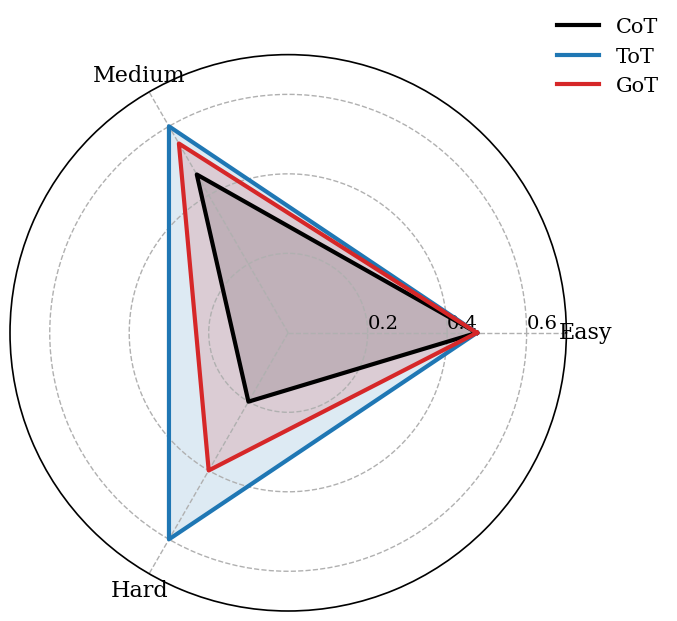
The image is a radar chart comparing the performance of three methods: CoT (Chain of Thought), ToT (Tree of Thoughts), and GoT (Graph of Thoughts) across three difficulty levels: Easy, Medium, and Hard. The chart visualizes the relative performance of each method on each difficulty level, with higher values indicating better performance.
### Components/Axes
* **Chart Type:** Radar Chart (also known as a spider chart or star chart)
* **Axes:** Three axes radiating from the center, representing the difficulty levels: Easy, Medium, and Hard.
* **Scale:** The radial scale ranges from 0 to 0.6, with concentric dashed circles indicating values of 0.2, 0.4, and 0.6.
* **Legend:** Located in the top-right corner:
* Black line: CoT
* Blue line: ToT
* Red line: GoT
### Detailed Analysis
* **CoT (Chain of Thought):** (Black Line)
* Easy: Approximately 0.4
* Medium: Approximately 0.45
* Hard: Approximately 0.3
* **ToT (Tree of Thoughts):** (Blue Line)
* Easy: Approximately 0.4
* Medium: Approximately 0.5
* Hard: Approximately 0.5
* **GoT (Graph of Thoughts):** (Red Line)
* Easy: Approximately 0.4
* Medium: Approximately 0.4
* Hard: Approximately 0.35
### Key Observations
* ToT (Tree of Thoughts) consistently outperforms CoT (Chain of Thought) and GoT (Graph of Thoughts) on Medium and Hard difficulty levels.
* All three methods have similar performance on Easy difficulty.
* The performance of CoT and GoT decreases as the difficulty increases, while ToT maintains a relatively high performance even on Hard difficulty.
### Interpretation
The radar chart suggests that Tree of Thoughts (ToT) is a more robust method for handling complex problems compared to Chain of Thought (CoT) and Graph of Thoughts (GoT). While all three methods perform similarly on easy tasks, ToT's performance remains high even as the difficulty increases, indicating its ability to explore and evaluate multiple solution paths effectively. The decline in performance of CoT and GoT on harder tasks suggests that these methods may struggle with the increased complexity and branching possibilities of more challenging problems. The chart highlights the potential benefits of using a tree-based approach for problem-solving, especially in scenarios where the solution space is large and complex.