## Screenshot: Live Debate Interface
### Overview
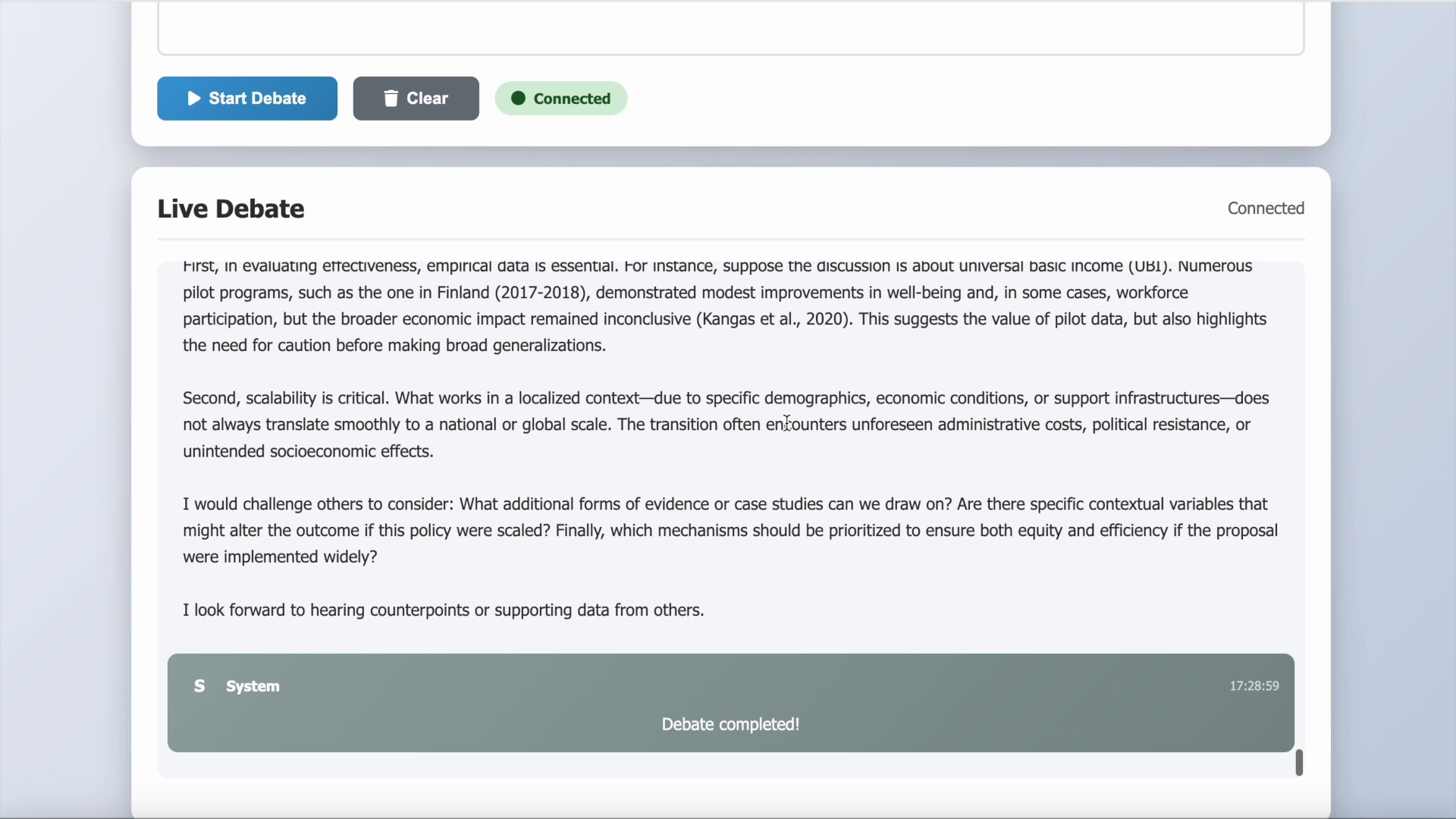
The image is a screenshot of a web-based user interface for a "Live Debate" application. It displays a completed debate session with a single, lengthy argumentative text block and system status messages. The interface is clean, with a light gray background and white content panels.
### Components/Axes
The interface is composed of several distinct UI elements:
1. **Top Control Bar (Partial View):**
* A blue button labeled **"Start Debate"** with a play icon.
* A gray button labeled **"Clear"** with a trash can icon.
* A green status pill labeled **"Connected"** with a filled circle icon.
* These elements are positioned at the top of the visible frame, partially cut off.
2. **Main Content Panel:**
* **Header:** The title **"Live Debate"** is in bold, large font on the left. On the far right, the status **"Connected"** is displayed in a smaller, regular font.
* **Debate Text Area:** A large white panel containing the main textual content of the debate. The text is left-aligned in a standard sans-serif font.
* **System Message Bar:** A dark gray bar at the bottom of the panel. It contains:
* An icon and the label **"S System"** on the left.
* A timestamp **"17:28:59"** on the right.
* The centered message **"Debate completed!"**.
### Content Details
The primary content is the transcribed text from the debate panel. The language is English.
**Full Transcription of Debate Text:**
> First, in evaluating effectiveness, empirical data is essential. For instance, suppose the discussion is about universal basic income (UBI). Numerous pilot programs, such as the one in Finland (2017-2018), demonstrated modest improvements in well-being and, in some cases, workforce participation, but the broader economic impact remained inconclusive (Kangas et al., 2020). This suggests the value of pilot data, but also highlights the need for caution before making broad generalizations.
>
> Second, scalability is critical. What works in a localized context—due to specific demographics, economic conditions, or support infrastructures—does not always translate smoothly to a national or global scale. The transition often encounters unforeseen administrative costs, political resistance, or unintended socioeconomic effects.
>
> I would challenge others to consider: What additional forms of evidence or case studies can we draw on? Are there specific contextual variables that might alter the outcome if this policy were scaled? Finally, which mechanisms should be prioritized to ensure both equity and efficiency if the proposal were implemented widely?
>
> I look forward to hearing counterpoints or supporting data from others.
**System Message:**
* **Source:** System
* **Timestamp:** 17:28:59
* **Message:** Debate completed!
### Key Observations
1. **Structured Argument:** The text presents a structured, two-point argument followed by a series of rhetorical questions aimed at stimulating further discussion.
2. **Academic Tone:** The argument uses formal language and includes an academic citation `(Kangas et al., 2020)`, suggesting a research-informed perspective.
3. **Focus on Policy Analysis:** The content is centered on the methodological challenges of evaluating and scaling social policies, using Universal Basic Income (UBI) as a concrete example.
4. **Interface State:** The "Connected" status and the "Debate completed!" system message indicate this is a snapshot of a real-time or session-based application after a debate turn or session has concluded.
### Interpretation
This screenshot captures the output of a structured debate or deliberation platform. The interface is designed to facilitate formal, evidence-based discussion on complex topics.
The content itself is not raw data but a synthesized argument. It demonstrates a critical thinking framework that emphasizes:
* **Empiricism:** The need for data from pilot programs.
* **Contextual Limitation:** The caution required when scaling localized results.
* **Forward-Looking Inquiry:** The call for identifying variables and mechanisms for successful implementation.
The argument's core message is a plea for rigorous, nuanced policy analysis that balances optimism from pilot studies with skepticism about scalability. The platform appears to be a tool for capturing and displaying such reasoned discourse, potentially for educational, research, or collaborative decision-making purposes. The "Live" and "Connected" elements suggest it may support synchronous, multi-user participation.