## Diagram: Sony PlayStation Controller Layout
### Overview
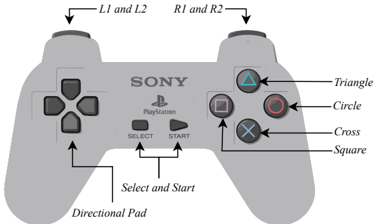
The image is a labeled diagram of a Sony PlayStation controller, highlighting the positions and functions of its buttons and components. The controller is depicted in grayscale with black text and arrows pointing to key elements.
### Components/Axes
- **Labels**:
- **L1 and L2**: Arrows point to the left analog stick buttons.
- **R1 and R2**: Arrows point to the right analog stick buttons.
- **Triangle, Circle, Cross, Square**: Arrows point to the four action buttons on the right side.
- **Select and Start**: Arrows point to the central buttons.
- **Directional Pad**: Arrow points to the four-directional buttons on the left.
- **Text**:
- "SONY" and "PlayStation" branding is centered at the top.
- Button symbols (△, ○, ×, □) are labeled with their names.
### Detailed Analysis
- **Button Placement**:
- **Left Side**:
- Directional Pad (up, down, left, right) at the bottom-left corner.
- L1 and L2 buttons above the left analog stick.
- **Right Side**:
- Action buttons (Triangle, Circle, Cross, Square) arranged in a diamond pattern.
- R1 and R2 buttons above the right analog stick.
- **Center**:
- Select and Start buttons between the analog sticks.
- **Spatial Grounding**:
- Labels are positioned directly above or adjacent to their corresponding components.
- No numerical data or scales are present.
### Key Observations
- The layout follows a standardized ergonomic design for gameplay efficiency.
- Action buttons (Triangle, Circle, Cross, Square) are grouped on the right for quick access.
- Analog sticks (L1/L2, R1/R2) are positioned for thumb control during gameplay.
### Interpretation
This diagram illustrates the functional organization of a PlayStation controller, emphasizing its modular design for intuitive use. The separation of directional inputs (left) and action buttons (right) optimizes hand placement for gaming. The inclusion of L1/L2 and R1/R2 buttons suggests additional functionality (e.g., shooting, menu navigation) beyond basic directional control. The absence of numerical data confirms this is a schematic representation rather than a performance metric.