\n
## Line Chart: Incorrect Steps (%) vs. Step Index for Five Datasets
### Overview
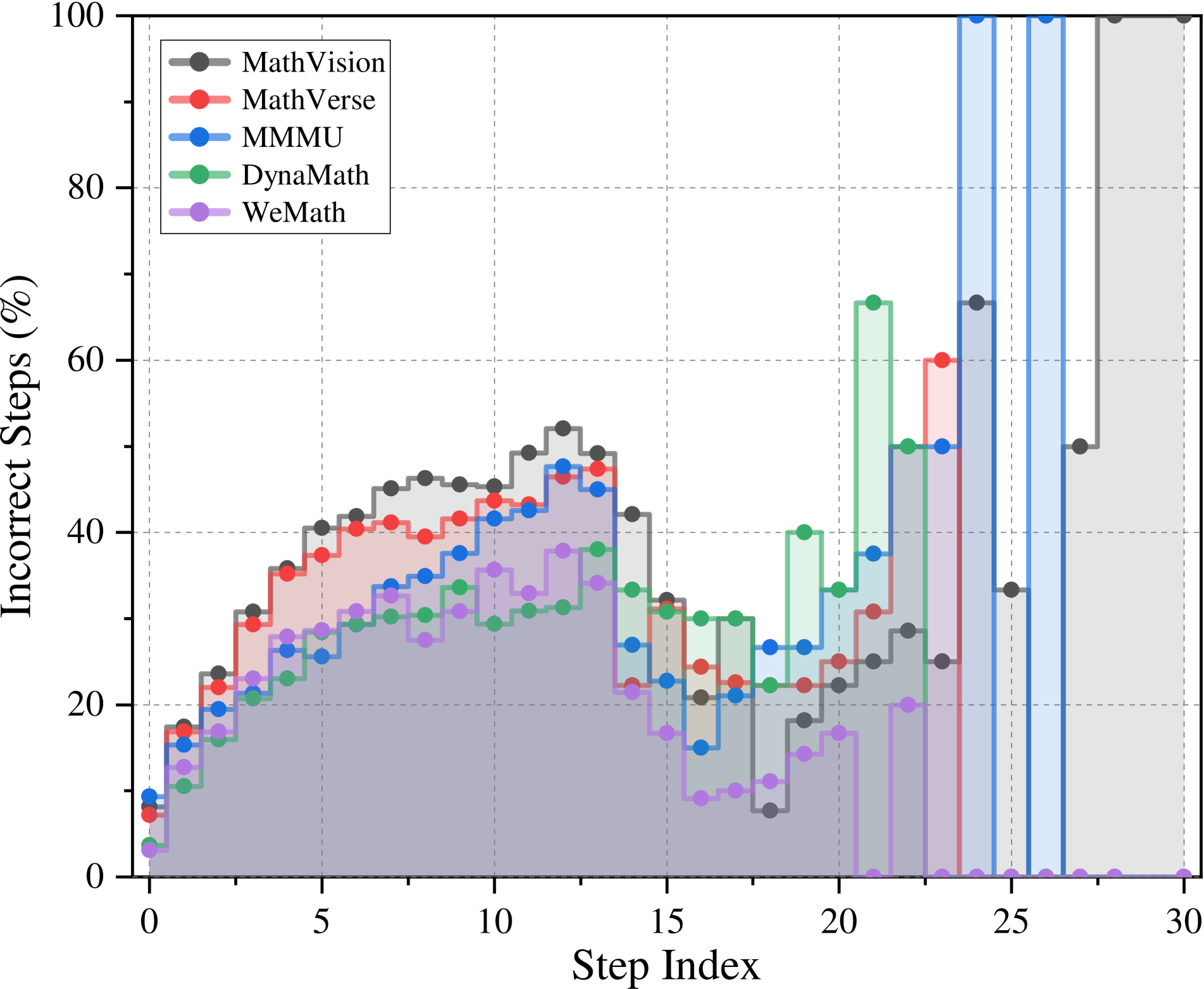
This is a line chart comparing the percentage of incorrect steps across a sequence of 30 steps for five different datasets or models. The chart illustrates how error rates evolve as the step index increases, showing distinct patterns of error accumulation and recovery for each series.
### Components/Axes
- **X-Axis**: Labeled "Step Index". It is a linear scale ranging from 0 to 30, with major tick marks every 5 units (0, 5, 10, 15, 20, 25, 30).
- **Y-Axis**: Labeled "Incorrect Steps (%)". It is a linear scale ranging from 0 to 100, with major tick marks every 20 units (0, 20, 40, 60, 80, 100).
- **Legend**: Positioned in the top-left corner of the chart area. It contains five entries, each with a colored line and circular marker:
- **MathVision**: Black line with black circular markers.
- **MathVerse**: Red line with red circular markers.
- **MMMU**: Blue line with blue circular markers.
- **DynaMath**: Green line with green circular markers.
- **WeMath**: Purple line with purple circular markers.
- **Data Series**: Each dataset is represented by a stepped line (showing discrete changes at each step index) with a semi-transparent shaded area beneath it, filling down to the x-axis.
### Detailed Analysis
**Trend Verification & Data Points (Approximate Values):**
1. **MathVision (Black Line):**
* **Trend**: Shows a steady, steep increase from step 0 to a peak around step 12-13, followed by a decline and high volatility with extreme spikes in the later steps.
* **Key Points**: Starts near 0%. Rises to ~52% at step 12. Declines to ~20% at step 18. Spikes dramatically to ~67% at step 23, then to ~100% at steps 24-26. Ends at ~50% at step 30.
2. **MathVerse (Red Line):**
* **Trend**: Follows a similar initial rise to MathVision but peaks slightly lower. It then declines and shows moderate volatility with one significant late spike.
* **Key Points**: Starts near 0%. Rises to ~48% at step 13. Declines to ~22% at step 18. Spikes to ~60% at step 23. Ends at ~50% at step 30.
3. **MMMU (Blue Line):**
* **Trend**: Rises steadily but remains below MathVision and MathVerse in the first half. It experiences a sharp drop, followed by volatility and the most extreme, sustained spike to 100%.
* **Key Points**: Starts near 10%. Rises to ~45% at step 13. Drops sharply to ~15% at step 16. Spikes to ~50% at step 22, then to 100% at steps 24-26. Ends at ~50% at step 30.
4. **DynaMath (Green Line):**
* **Trend**: Has the slowest initial rise. After a mid-chart decline, it exhibits a very sharp, isolated spike before returning to a moderate level.
* **Key Points**: Starts near 0%. Rises to ~38% at step 13. Declines to ~22% at step 18. Spikes sharply to ~66% at step 21. Ends at ~50% at step 30.
5. **WeMath (Purple Line):**
* **Trend**: Rises the least in the initial phase. After step 15, it shows a consistent and significant decline, ultimately achieving the lowest error rate.
* **Key Points**: Starts near 0%. Rises to ~35% at step 13. Declines steadily after step 15. Drops to near 0% from step 20 onward, remaining at ~0% through step 30.
**Spatial Grounding & Component Isolation:**
- The **legend** is anchored in the top-left quadrant, overlapping the grid lines but not the primary data trends in the early steps.
- The **shaded areas** under each line create a layered, overlapping visual in the first half of the chart (steps 0-15), making individual series harder to distinguish. The separation becomes clearer after step 15 as the lines diverge.
- The most dramatic visual elements are the **vertical spikes** in the MathVision (black), MMMU (blue), and DynaMath (green) series between steps 20-27, which dominate the right side of the chart.
### Key Observations
1. **Common Initial Phase**: All five series show a general trend of increasing incorrect steps from step 0 to approximately step 13, suggesting a common pattern of error accumulation in the early stages of the process being measured.
2. **Critical Divergence Point**: Around step 15, the behaviors of the series diverge significantly. This is a key inflection point in the data.
3. **Extreme Late-Stage Volatility**: MathVision, MMMU, and DynaMath exhibit extreme, sudden spikes in incorrect steps after step 20, with MathVision and MMMU reaching the maximum value of 100%. This indicates catastrophic failure modes at specific late steps for these models/datasets.
4. **WeMath's Anomalous Success**: WeMath is a clear outlier in the latter half. After step 15, its error rate plummets and stabilizes near 0%, indicating a fundamentally different and more robust performance profile in the later stages compared to the others.
5. **Convergence at the End**: Despite wildly different paths, MathVision, MathVerse, MMMU, and DynaMath all converge to a similar incorrect step percentage (~50%) at the final step (30).
### Interpretation
This chart likely visualizes the performance of different AI models or methods on a multi-step reasoning task (e.g., solving math problems). The "Step Index" represents sequential sub-problems or reasoning steps.
- **What the data suggests**: The initial rise in errors for all models indicates that early mistakes are common and may compound. The divergence after step 15 suggests that models handle mid-to-late stage complexity very differently. The extreme spikes imply that certain steps (around 21, 23, 24-26) are "killer steps" that cause total failure for some models. WeMath's performance suggests it either has a superior mechanism for error correction or is less susceptible to cascading failures in later stages.
- **Relationship between elements**: The shaded areas emphasize the cumulative burden of incorrect steps. The overlapping early phase shows shared difficulty, while the separated later phase highlights model-specific strengths and weaknesses. The final convergence at 50% is curious—it may indicate that for the very last step, models either succeed or fail in a balanced way, or it could be an artifact of the evaluation metric.
- **Notable anomalies**: The 100% incorrect steps for MathVision and MMMU are the most striking anomalies, representing complete breakdown. WeMath's drop to 0% is equally anomalous in the positive direction. The chart effectively tells a story of initial uniform struggle, followed by a crisis point where models either spectacularly fail, moderately persist, or brilliantly recover.