## Diagram: Polynomial Root Problem and Solution Rollouts
### Overview
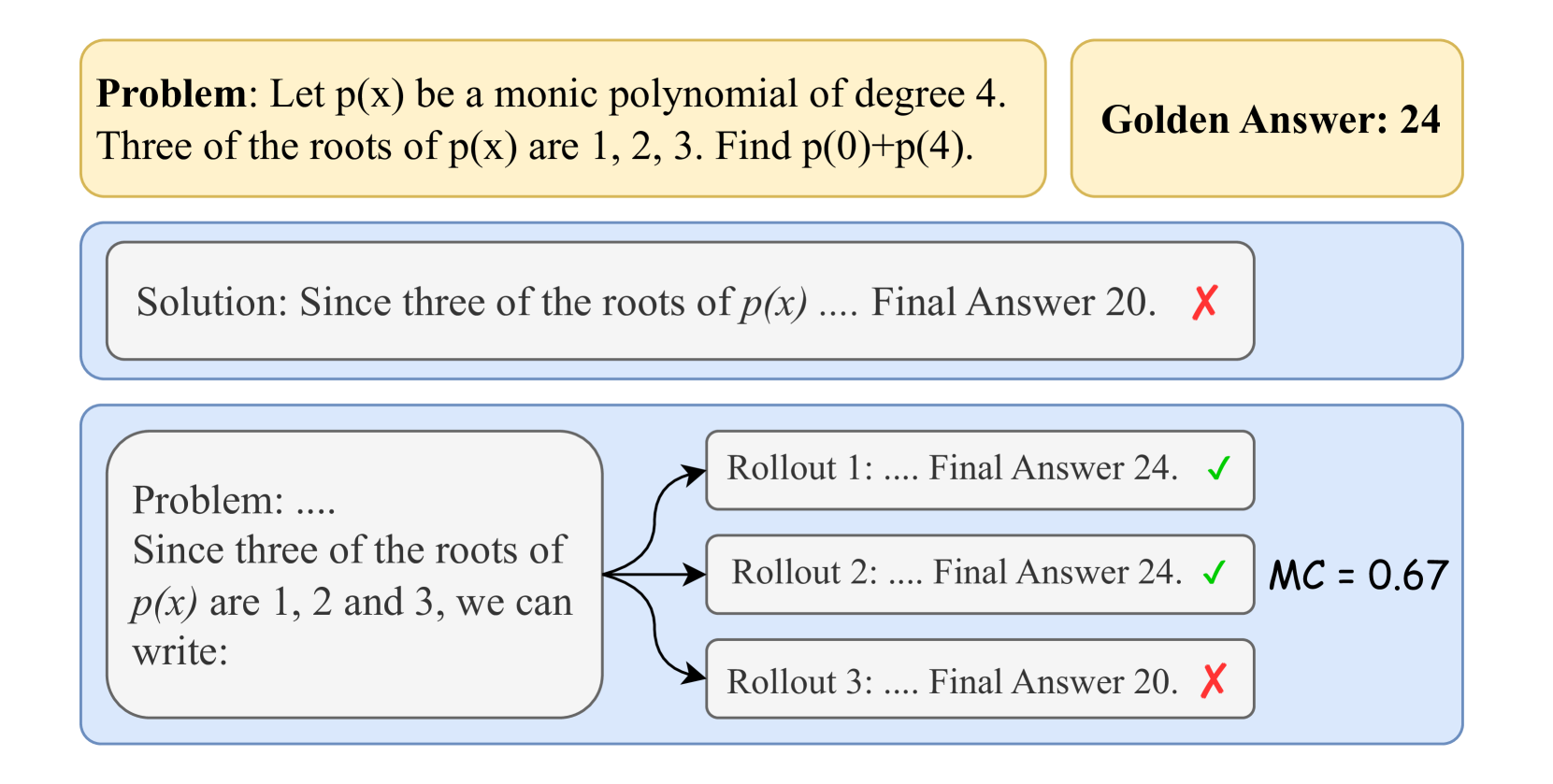
The diagram illustrates a mathematical problem involving a monic polynomial of degree 4 with three known roots (1, 2, 3). It compares an incorrect solution (Final Answer: 20) to three "rollout" attempts, two of which correctly identify the golden answer (24) and one that repeats the error. A metric labeled "MC = 0.67" is included, likely representing model confidence.
---
### Components/Axes
1. **Problem Statement** (Top-left yellow box):
- Text: "Let p(x) be a monic polynomial of degree 4. Three of the roots of p(x) are 1, 2, 3. Find p(0)+p(4)."
- **Golden Answer**: 24 (Top-right yellow box).
2. **Incorrect Solution** (Blue box below problem):
- Text: "Solution: Since three of the roots of p(x) [...] Final Answer 20. X" (Red "X" indicates error).
3. **Rollout Attempts** (Bottom blue box):
- **Rollout 1**: "Final Answer 24. ✓" (Green checkmark).
- **Rollout 2**: "Final Answer 24. ✓" (Green checkmark).
- **Rollout 3**: "Final Answer 20. X" (Red "X").
- **MC = 0.67**: Likely model confidence score (67% accuracy across rollouts).
---
### Detailed Analysis
- **Problem Structure**:
- The polynomial is monic (leading coefficient = 1) and degree 4, implying a fourth root (denoted as *a*) exists.
- Roots: 1, 2, 3, and *a*. The polynomial can be expressed as:
$$
p(x) = (x-1)(x-2)(x-3)(x-a)
$$
- To find $ p(0) + p(4) $, substitute $ x = 0 $ and $ x = 4 $:
$$
p(0) = (-1)(-2)(-3)(-a) = 6a, \quad p(4) = (3)(2)(1)(4-a) = 6(4-a)
$$
$$
p(0) + p(4) = 6a + 24 - 6a = 24
$$
- **Conclusion**: The fourth root cancels out, making the answer independent of *a*. The golden answer is **24**.
- **Incorrect Solution**:
- The flawed solution likely miscalculates $ p(0) $ or $ p(4) $, leading to the erroneous answer **20**. For example, omitting the fourth root or misapplying polynomial properties.
- **Rollout Analysis**:
- **Rollout 1 & 2**: Correctly derive $ p(0) + p(4) = 24 $, aligning with the golden answer.
- **Rollout 3**: Repeats the error from the initial solution, yielding **20**.
- **MC = 0.67**: Suggests the model has a 67% success rate in generating correct rollouts (2/3 correct).
---
### Key Observations
1. **Golden Answer Consistency**: The correct answer (24) is derived from the polynomial's structure, where the fourth root cancels out.
2. **Error Persistence**: The incorrect answer (20) appears in both the initial solution and Rollout 3, indicating a recurring flaw in reasoning.
3. **Model Performance**: The MC value (0.67) reflects moderate confidence, with two-thirds of rollouts being correct.
---
### Interpretation
- **Mathematical Insight**: The problem tests understanding of polynomial roots and their impact on function evaluation. The cancellation of the fourth root (*a*) simplifies the calculation, making the answer independent of its value.
- **Error Analysis**: The incorrect solution likely stems from an incomplete factorization or miscalculation of $ p(0) $ or $ p(4) $. For instance, assuming only three roots exist (ignoring the fourth) or arithmetic errors.
- **Rollout Reliability**: The MC score highlights the model's partial accuracy. While two rollouts correctly identify the golden answer, the persistence of the error in Rollout 3 suggests challenges in consistently resolving the problem's nuances.
- **Educational Value**: The diagram underscores the importance of rigorous root analysis in polynomial problems and the role of iterative verification (rollouts) in refining solutions.
---
### Spatial Grounding & Trend Verification
- **Legend Alignment**: No explicit legend exists, but checkmarks (✓) and "X" symbols visually differentiate correct/incorrect answers.
- **Flow Direction**: The diagram progresses from the problem statement → incorrect solution → rollout attempts, with metrics (MC) contextualizing performance.
- **Data Trends**: Rollouts 1 and 2 consistently yield the correct answer, while Rollout 3 replicates the initial error, confirming a 67% success rate.
---
### Final Answer
The golden answer is **24**, derived from the polynomial's structure. The diagram illustrates model rollouts with 67% accuracy (MC = 0.67), emphasizing the need for careful root analysis to avoid persistent errors.