## Workflow Diagram: Iterative Solution Refinement
### Overview
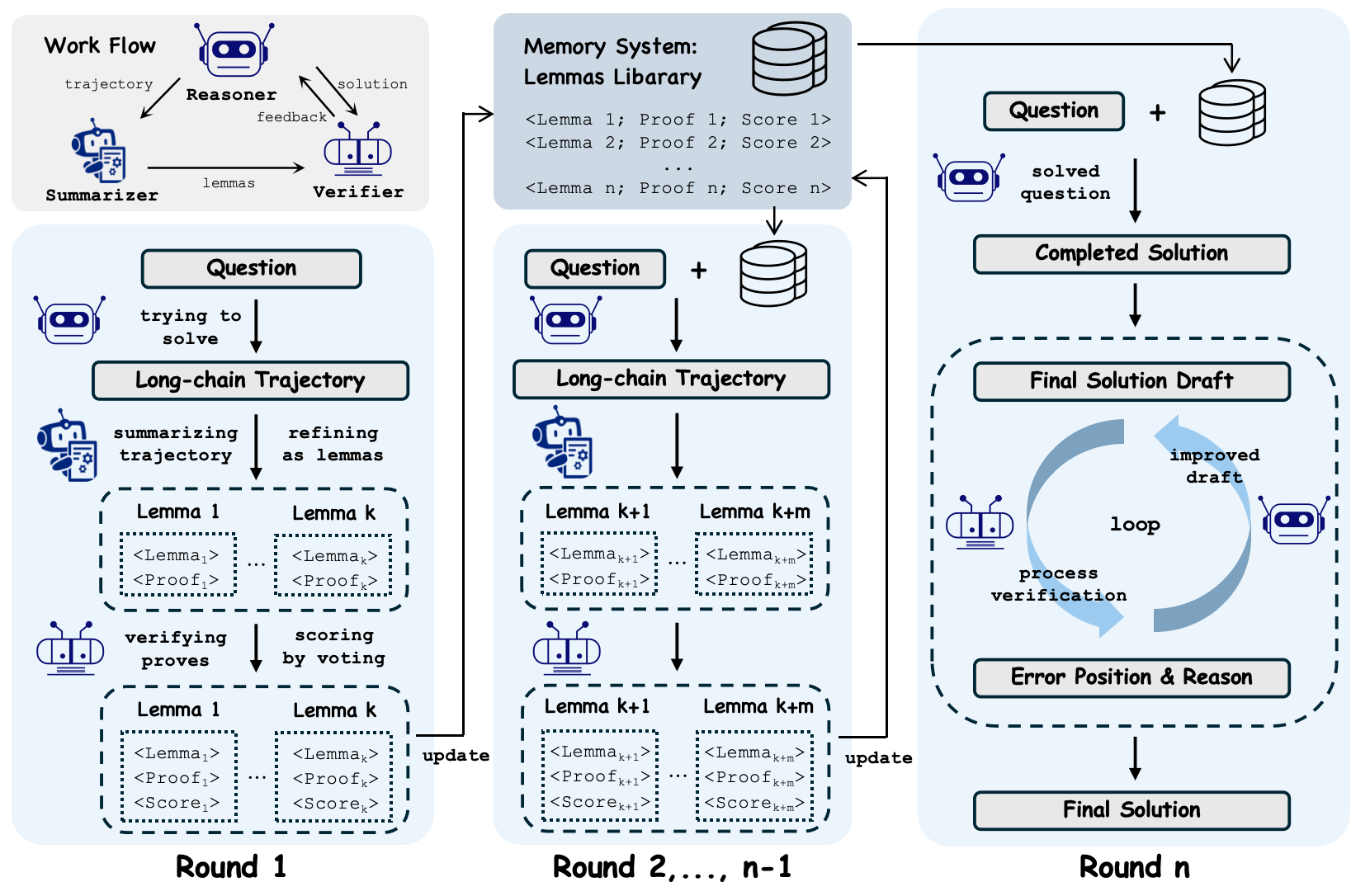
The image presents a workflow diagram illustrating an iterative process for solving a question through lemma generation, verification, and refinement. The process is divided into multiple rounds, with each round building upon the previous one to improve the solution.
### Components/Axes
* **Header:** Contains the title "Work Flow" and a description of the memory system.
* **Memory System:** A database labeled "Lemmas Libarary" containing lemmas, proofs, and scores. The entries are structured as `<Lemma i; Proof i; Score i>`, where 'i' ranges from 1 to n.
* **Workflow Agents:**
* **Reasoner:** Generates solutions and provides feedback.
* **Summarizer:** Summarizes trajectories and refines them as lemmas.
* **Verifier:** Verifies proofs and scores them by voting.
* **Rounds:** The workflow is divided into rounds: Round 1, Round 2 to n-1, and Round n.
* **Data Flow:** Arrows indicate the flow of information and processes between components.
* **Elements:**
* Question
* Long-chain Trajectory
* Lemmas (Lemma 1, Lemma k, Lemma k+1, Lemma k+m)
* Proofs (Proof 1, Proof k, Proof k+1, Proof k+m)
* Scores (Score 1, Score k, Score k+1, Score k+m)
* Final Solution Draft
* Error Position & Reason
* Final Solution
### Detailed Analysis
**Round 1:**
1. **Question:** A question is presented to the system. A robot icon labeled "trying to solve" is associated with the question.
2. **Long-chain Trajectory:** The system attempts to solve the question, resulting in a "Long-chain Trajectory."
3. **Summarization:** The Summarizer agent summarizes the trajectory and refines it into lemmas.
4. **Lemma Generation:** Lemmas are generated (Lemma 1 to Lemma k), each with a corresponding proof. The lemmas are represented as `<Lemma_i>`, and proofs as `<Proof_i>`.
5. **Verification:** The Verifier agent verifies the proofs and scores them by voting.
6. **Scoring:** Scores are assigned to each lemma (Lemma 1 to Lemma k), represented as `<Score_i>`.
**Round 2,..., n-1:**
1. **Memory System Interaction:** The question is combined with information from the "Lemmas Libarary."
2. **Long-chain Trajectory:** A new long-chain trajectory is generated.
3. **Lemma Generation:** New lemmas are generated (Lemma k+1 to Lemma k+m), each with a corresponding proof.
4. **Verification and Scoring:** The Verifier agent verifies the proofs and scores them.
5. **Update:** The lemmas, proofs, and scores are updated in the "Lemmas Libarary."
**Round n:**
1. **Question and Memory:** A "solved question" is combined with information from the "Lemmas Libarary."
2. **Completed Solution:** A completed solution is generated.
3. **Final Solution Draft:** A "Final Solution Draft" is created.
4. **Loop:** A loop involving "process verification" and "Error Position & Reason" refines the solution draft. The loop is labeled "improved draft."
5. **Final Solution:** The final solution is produced.
### Key Observations
* The process is iterative, with each round refining the lemmas and improving the solution.
* The "Lemmas Libarary" acts as a memory system, storing and updating lemmas, proofs, and scores.
* The workflow involves multiple agents (Reasoner, Summarizer, Verifier) that perform specific tasks.
* The final round focuses on refining the solution draft through a verification loop.
### Interpretation
The diagram illustrates a sophisticated problem-solving approach that leverages lemma generation, verification, and iterative refinement. The "Lemmas Libarary" serves as a knowledge base that grows and improves with each round. The iterative loop in the final round suggests a continuous improvement process, where errors are identified and corrected to produce a high-quality final solution. The use of multiple agents allows for specialization and efficient processing of information. The diagram suggests a system capable of learning and adapting to new information, ultimately leading to more accurate and reliable solutions.