\n
## Diagram: Reasoning and Memory System Workflow
### Overview
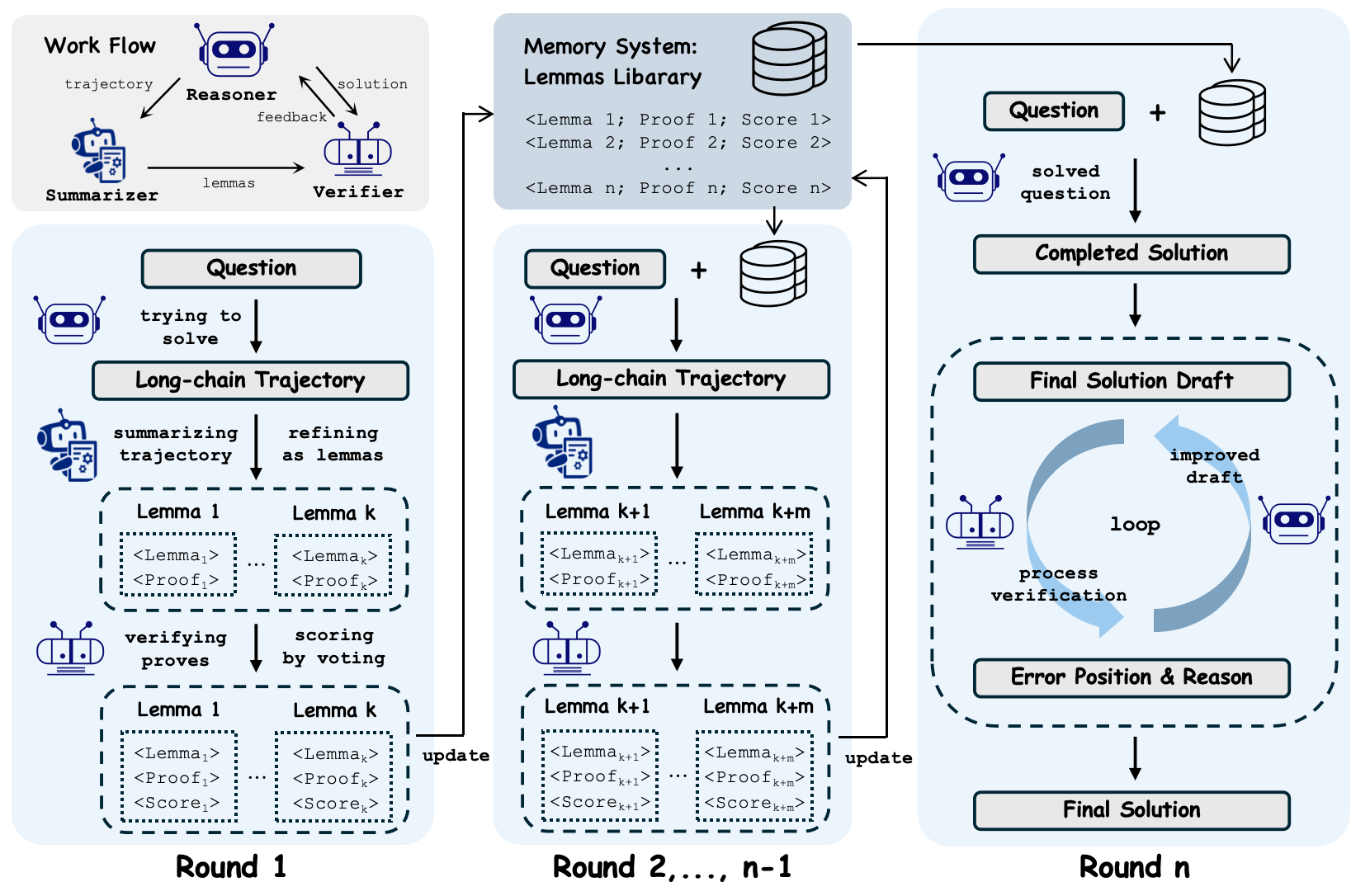
This diagram illustrates a workflow for a reasoning system that utilizes a memory system of lemmas to solve questions. The process involves a work flow section, a memory system section, and iterative rounds of trajectory refinement, verification, and scoring. The diagram depicts the flow of information between components, highlighting the iterative nature of the solution process.
### Components/Axes
The diagram is divided into three main sections: "Work Flow", "Memory System", and iterative "Round" stages. Key components include:
* **Work Flow:** Reasoner, Summarizer, Verifier, Question.
* **Memory System:** Lemmas Library (containing <Lemma n; Proof n; Score n> entries).
* **Round Stages:** Long-chain Trajectory (summarizing & refining as lemmas, verifying & scoring), Error Position & Reason, Final Solution.
* **Data Representation:** Lemmas are represented as <Lemma, Proof, Score> tuples.
* **Arrows:** Indicate the flow of information and feedback loops.
### Detailed Analysis or Content Details
**Work Flow Section (Top-Left):**
* A "Question" input is processed by a "Reasoner".
* The Reasoner generates a "trajectory" and a "solution".
* The trajectory is fed to a "Summarizer" which produces "lemmas".
* The solution is sent to a "Verifier" which provides "feedback".
**Memory System Section (Top-Right):**
* The "Lemmas Library" stores lemmas in the format: <Lemma 1; Proof 1; Score 1>, <Lemma 2; Proof 2; Score 2>, ..., <Lemma n; Proof n; Score n>.
* A "Question" is combined with a "solved question" from the library.
* This combination leads to a "Completed Solution" and a "Final Solution Draft".
**Round 1 (Bottom-Left):**
* The "Long-chain Trajectory" is split into two processes: "summarizing trajectory" and "refining as lemmas".
* Lemmas are represented as <Lemma₁, Proof₁, Score₁> to <Lemmaₖ, Proofₖ, Scoreₖ>.
* A "verifying proves" process scores the lemmas by "voting".
* The lemmas are updated based on the scoring.
**Round 2,..., n-1 (Center-Bottom):**
* Similar to Round 1, but with updated lemmas: <Lemmaₖ₊₁, Proofₖ₊₁, Scoreₖ₊₁> to <Lemmaₖ₋ₖ, Proofₖ₋ₖ, Scoreₖ₋ₖ>.
* Lemmas are updated again.
**Round n (Bottom-Right):**
* The "Final Solution Draft" is fed into a "process verification" component.
* This component identifies "Error Position & Reason".
* The process loops back to improve the draft, resulting in a "Final Solution".
### Key Observations
* The workflow is highly iterative, with multiple rounds of refinement and verification.
* The Memory System plays a crucial role in storing and retrieving relevant lemmas.
* The scoring mechanism appears to be based on a voting system.
* The diagram emphasizes the importance of error detection and correction.
* The representation of lemmas as <Lemma, Proof, Score> suggests a quantitative approach to evaluating the quality of reasoning steps.
### Interpretation
The diagram depicts a sophisticated reasoning system that combines deductive reasoning (through lemma verification) with a memory-augmented approach. The iterative nature of the process suggests a learning or refinement mechanism, where the system improves its ability to solve questions over time by incorporating new lemmas and refining existing ones. The scoring system and error detection component indicate a focus on ensuring the reliability and accuracy of the solutions. The use of <Lemma, Proof, Score> tuples suggests a formalization of the reasoning process, allowing for quantitative evaluation and comparison of different reasoning paths. The diagram highlights a system designed to not only find solutions but also to understand *why* those solutions are correct, and to learn from its mistakes. The flow of information is designed to create a feedback loop that improves the quality of the solution with each iteration. The diagram does not provide specific data or numerical values, but rather illustrates the *process* of reasoning and solution refinement.