## Flowchart: System Workflow for Problem Solving with Iterative Verification
### Overview
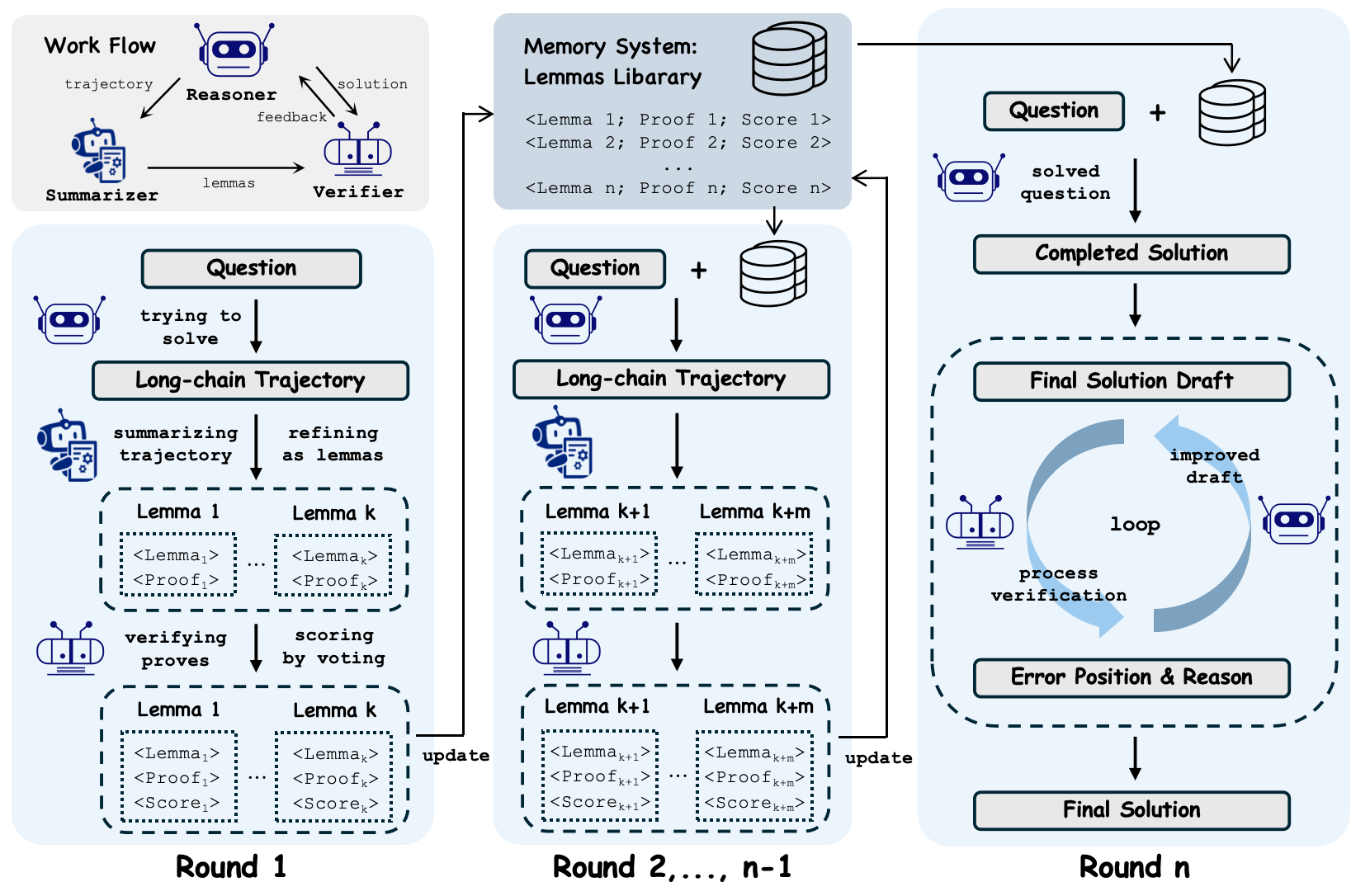
The image depicts a multi-stage workflow for solving a problem using a reasoning system with iterative verification and memory-based learning. It includes three primary components: **Work Flow**, **Memory System**, and **Process Rounds**. The diagram emphasizes iterative refinement, lemma-based reasoning, and error correction.
---
### Components/Axes
#### Work Flow
- **Components**:
- **Summarizer**: Processes input to generate a "trajectory" (e.g., a sequence of steps).
- **Reasoner**: Receives the trajectory and produces a "solution."
- **Verifier**: Validates the solution and provides "feedback."
- **Arrows**:
- `trajectory` → `Reasoner` → `solution`
- `feedback` → `Reasoner` (loop)
- `lemmas` → `Summarizer` (input)
#### Memory System: Lemmas Librarian
- **Structure**:
- A stack of disks representing stored lemmas.
- Entries: `<Lemma 1; Proof 1; Score 1>`, `<Lemma 2; Proof 2; Score 2>`, ..., `<Lemma n; Proof n; Score n>`.
- **Arrows**:
- Connects to the process rounds, indicating retrieval of lemmas for use.
#### Process Rounds
- **Rounds 1 to n-1**:
- **Input**: Question + Memory System (lemmas).
- **Output**: Long-chain trajectory, lemmas with proofs/scores, and updates.
- **Round n**:
- **Input**: Completed solution.
- **Output**: Final solution draft, error verification, and final solution.
---
### Detailed Analysis
#### Work Flow
- **Summarizer**:
- Takes a question and generates a "long-chain trajectory" (e.g., a sequence of steps to solve the problem).
- Refines the trajectory into "lemmas" (sub-proofs or intermediate steps).
- **Reasoner**:
- Uses lemmas to derive a "solution."
- Receives feedback from the Verifier to refine the solution.
- **Verifier**:
- Validates proofs of lemmas and scores them (e.g., `<Lemma 1; Proof 1; Score 1>`).
- Updates lemma scores iteratively.
#### Memory System
- **Lemmas Librarian**:
- Stores lemmas with associated proofs and scores.
- Acts as a knowledge base for the reasoning process.
- Updates lemma scores during iterations (e.g., `<Lemma k+1; Proof k+1; Score k+1>`).
#### Process Rounds
- **Rounds 1 to n-1**:
- **Question + Memory System**:
- The system retrieves lemmas from the Memory System to build a long-chain trajectory.
- Lemmas are refined, verified, and scored.
- **Updates**:
- Lemma scores are adjusted based on verification (e.g., `<Lemma k; Proof k; Score k>` → `<Lemma k; Proof k; Score k+1>`).
- **Round n**:
- **Completed Solution**:
- The final solution is validated through a loop of error verification.
- Errors are identified (e.g., "Error Position & Reason") and addressed to produce an "Improved Draft."
- **Final Solution**:
- The loop terminates when no errors are found, resulting in a "Final Solution."
---
### Key Observations
1. **Iterative Refinement**:
- The process involves multiple rounds of lemma verification and score updates, ensuring incremental improvement.
2. **Memory Integration**:
- The Memory System acts as a persistent knowledge base, enabling the system to reuse and refine lemmas across rounds.
3. **Error Handling**:
- The final round includes a feedback loop to correct errors, ensuring robustness.
4. **Component Roles**:
- **Summarizer**: Breaks down the problem into manageable steps.
- **Reasoner**: Synthesizes solutions using lemmas.
- **Verifier**: Ensures correctness through scoring and feedback.
---
### Interpretation
The diagram illustrates a **systematic, iterative approach to problem-solving** where:
- **Lemmas** serve as building blocks for reasoning, validated and refined through verification.
- **Memory** ensures that learned knowledge (lemmas) is retained and reused, improving efficiency over time.
- **Feedback loops** (e.g., Verifier → Reasoner) enable continuous improvement, critical for complex or ambiguous problems.
- The **final solution** is achieved only after rigorous error checking, emphasizing reliability.
This workflow mirrors **machine learning pipelines** or **formal verification systems**, where iterative refinement and knowledge reuse are central to achieving accurate outcomes. The absence of numerical data suggests the focus is on **process structure** rather than quantitative metrics.