## Diagram: LLM Reasoning Pipeline
### Overview
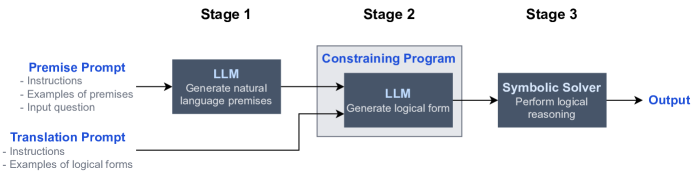
The image is a diagram illustrating a three-stage process for reasoning using Large Language Models (LLMs) and symbolic solvers. The process involves generating natural language premises, converting them into logical forms, and then performing logical reasoning to produce an output.
### Components/Axes
* **Stages:** The diagram is divided into three stages, labeled "Stage 1", "Stage 2", and "Stage 3" horizontally across the top.
* **Blocks:** Each stage contains a rectangular block representing a specific component or process.
* **Arrows:** Arrows indicate the flow of information between the stages.
* **Premise Prompt:** Located on the left side, provides instructions, examples of premises, and an input question.
* **Translation Prompt:** Located on the left side, provides instructions and examples of logical forms.
* **LLM (Stage 1):** Generates natural language premises.
* **Constraining Program (Stage 2):** Contains an LLM that generates logical forms.
* **LLM (Stage 2):** Generates logical forms.
* **Symbolic Solver (Stage 3):** Performs logical reasoning.
* **Output:** The final result of the process.
### Detailed Analysis
* **Stage 1:**
* Input: Premise Prompt (Instructions, Examples of premises, Input question)
* Process: LLM generates natural language premises.
* Output: Natural language premises are passed to Stage 2.
* **Stage 2:**
* Input: Natural language premises from Stage 1 and Translation Prompt (Instructions, Examples of logical forms).
* Process: Constraining Program uses an LLM to generate logical forms.
* Output: Logical forms are passed to Stage 3.
* **Stage 3:**
* Input: Logical forms from Stage 2.
* Process: Symbolic Solver performs logical reasoning.
* Output: Final output.
### Key Observations
* The diagram shows a sequential process, with each stage building upon the previous one.
* LLMs are used in both Stage 1 and Stage 2, indicating their central role in generating premises and logical forms.
* The Constraining Program in Stage 2 appears to refine the output of the first LLM using the Translation Prompt.
* The Symbolic Solver in Stage 3 performs the final logical reasoning step.
### Interpretation
The diagram illustrates a hybrid approach to reasoning, combining the strengths of LLMs (natural language generation) and symbolic solvers (logical reasoning). The LLMs are used to translate natural language into a formal logical representation, which can then be processed by a symbolic solver to arrive at a conclusion. The use of a "Constraining Program" suggests an attempt to improve the quality and accuracy of the logical forms generated by the LLM in Stage 2. This architecture likely aims to leverage the flexibility of LLMs while maintaining the rigor and reliability of symbolic reasoning.