\n
## Diagram: Three-Stage Reasoning Process
### Overview
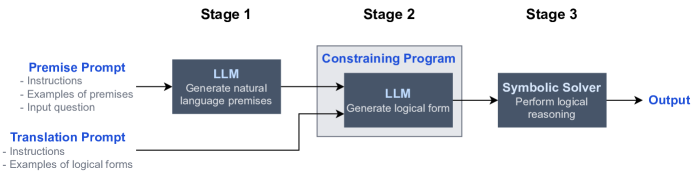
The image depicts a three-stage process for reasoning, utilizing Large Language Models (LLMs) and a Symbolic Solver. The process begins with prompt engineering, moves through LLM-based natural language and logical form generation, and culminates in symbolic reasoning to produce an output.
### Components/Axes
The diagram is divided into three stages, labeled "Stage 1", "Stage 2", and "Stage 3" horizontally across the top. Each stage contains one or more rectangular boxes representing components. There are two input prompts: "Premise Prompt" and "Translation Prompt". The output is labeled "Output".
### Detailed Analysis or Content Details
**Stage 1:**
* **Premise Prompt:** This input is associated with three sub-components: "Instructions", "Examples of premises", and "Input question". An arrow points from "Premise Prompt" to the next component.
* **LLM (Generate natural language premises):** A blue rectangular box labeled "LLM" with the text "Generate natural language premises" inside. An arrow points from the LLM to Stage 2.
**Stage 2:**
* **Constraining Program:** A larger, light-blue rectangular box labeled "Constraining Program".
* **LLM (Generate logical form):** A darker-blue rectangular box nested within the "Constraining Program" box, labeled "LLM" with the text "Generate logical form" inside. Arrows point from the LLM in Stage 1 and the "Translation Prompt" (which has sub-components "Instructions" and "Examples of logical forms") to this LLM. An arrow points from this LLM to Stage 3.
**Stage 3:**
* **Symbolic Solver (Perform logical reasoning):** A blue rectangular box labeled "Symbolic Solver" with the text "Perform logical reasoning" inside. An arrow points from the Symbolic Solver to the "Output".
### Key Observations
The diagram illustrates a pipeline architecture. The "Translation Prompt" feeds directly into the second LLM, suggesting it's used to refine or guide the logical form generation. The "Constraining Program" appears to act as a framework or environment for the second LLM. The process is sequential, with each stage building upon the output of the previous one.
### Interpretation
This diagram represents a method for enhancing the reasoning capabilities of LLMs by combining them with a symbolic solver. The initial stage focuses on formulating the problem using a "Premise Prompt". The second stage leverages another LLM to translate the natural language premises into a logical form, potentially constrained by a "Constraining Program" to ensure validity or adherence to specific rules. Finally, the "Symbolic Solver" performs formal logical reasoning on the logical form, producing a definitive "Output". This approach aims to overcome the limitations of LLMs in tasks requiring precise logical deduction by offloading that aspect to a dedicated symbolic reasoning engine. The use of two LLMs suggests a separation of concerns: one for understanding and generating natural language, and another for translating that understanding into a formal representation. The "Translation Prompt" suggests a mechanism for controlling the type of logical form generated. This is a hybrid approach, combining the strengths of neural and symbolic AI.