## Diagram: Three-Stage LLM-Symbolic Reasoning Pipeline
### Overview
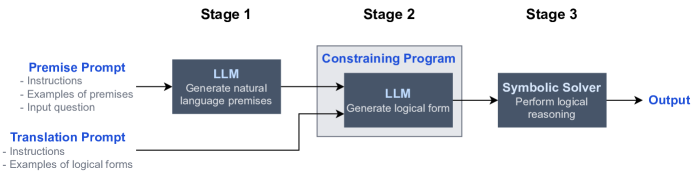
The image displays a technical flowchart illustrating a three-stage pipeline for processing natural language prompts into logical outputs. The system combines Large Language Models (LLMs) with a symbolic reasoning solver. The diagram is structured horizontally, flowing from left to right, with clear stage demarcations.
### Components/Axes
The diagram is segmented into three distinct stages, labeled at the top:
* **Stage 1** (Left)
* **Stage 2** (Center)
* **Stage 3** (Right)
**Input Prompts (Far Left):**
Two distinct input blocks are shown, both feeding into Stage 1.
1. **Premise Prompt** (Top-left):
* Contains the following bullet points:
* Instructions
* Examples of premises
* Input question
2. **Translation Prompt** (Bottom-left):
* Contains the following bullet points:
* Instructions
* Examples of logical forms
**Processing Blocks:**
* **Stage 1 - LLM Block:** A dark grey rectangle labeled "LLM" with the sub-text "Generate natural language premises". It receives input from the "Premise Prompt".
* **Stage 2 - Constraining Program:** A larger, light grey outlined box labeled "Constraining Program". Inside it is another dark grey "LLM" block with the sub-text "Generate logical form".
* **Stage 3 - Symbolic Solver:** A dark grey rectangle labeled "Symbolic Solver" with the sub-text "Perform logical reasoning".
**Output (Far Right):**
* A final arrow points to the label "Output".
**Flow Arrows:**
* An arrow flows from the "Premise Prompt" to the Stage 1 LLM.
* An arrow flows from the Stage 1 LLM to the Stage 2 LLM (inside the Constraining Program).
* An arrow flows from the "Translation Prompt" directly to the Stage 2 LLM.
* An arrow flows from the Stage 2 LLM to the Stage 3 Symbolic Solver.
* An arrow flows from the Symbolic Solver to the final "Output".
### Detailed Analysis
The pipeline describes a specific workflow:
1. **Stage 1 (Premise Generation):** A Large Language Model (LLM) takes a "Premise Prompt" (containing instructions, examples, and a question) and generates natural language premises.
2. **Stage 2 (Logical Form Generation):** A second LLM, constrained within a "Constraining Program," receives two inputs: the natural language premises from Stage 1 and a separate "Translation Prompt" (containing instructions and examples of logical forms). Its task is to generate a structured logical form.
3. **Stage 3 (Reasoning):** The generated logical form is passed to a "Symbolic Solver," which performs formal logical reasoning on it.
4. **Output:** The final result of the symbolic reasoning is produced as the system's output.
### Key Observations
* **Hybrid Architecture:** The system explicitly combines neural (LLM) and symbolic (Solver) AI components.
* **Constrained Generation:** The LLM in Stage 2 operates within a "Constraining Program," suggesting its output is restricted or guided to ensure it produces a valid logical form suitable for the symbolic solver.
* **Dual-Prompt Input:** The system uses two separate, specialized prompts to guide different parts of the process: one for generating premises and another for guiding the translation to logical form.
* **Sequential Dependency:** The process is strictly sequential; the output of Stage 1 is a necessary input for Stage 2.
### Interpretation
This diagram represents a method for bridging the gap between flexible natural language understanding and rigorous formal reasoning. The LLMs handle the ambiguous, human-like tasks of interpreting questions and translating them into a structured format. The symbolic solver then performs reliable, verifiable logic on that structure. The "Constraining Program" is a critical component, acting as a translator or guardrail to ensure the LLM's output is compatible with the strict requirements of the symbolic system. This architecture aims to leverage the strengths of both AI paradigms: the LLM's language proficiency and the symbolic system's reasoning precision. The separation of "Premise Prompt" and "Translation Prompt" indicates a deliberate design to decouple the problem understanding phase from the formalization phase.