## Problem Solving Approaches in Geometry
### Overview
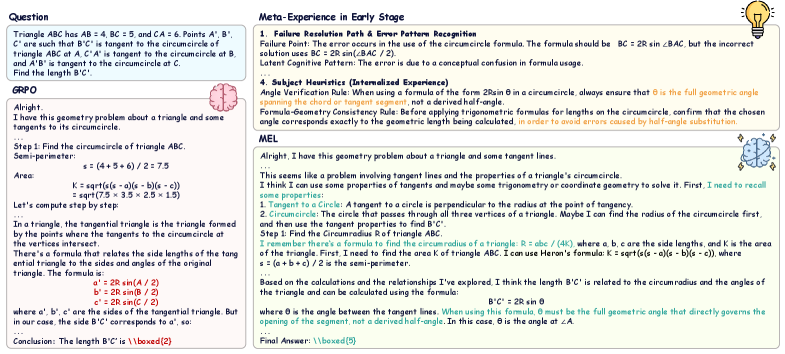
The image presents a geometry problem involving a triangle, its circumcircle, and tangents. It showcases three different approaches (GRPO, Meta-Experience, and MEL) to solving the problem, along with the initial problem statement.
### Components/Axes
* **Question (Top-Left)**: Defines the geometry problem.
* Triangle ABC has AB = 4, BC = 5, and CA = 6.
* Points A', B', C' are such that B'C' is tangent to the circumcircle of triangle ABC at A, C'A' is tangent to the circumcircle at B, and A'B' is tangent to the circumcircle at C.
* Find the length B'C'.
* **GRPO (Bottom-Left)**: Represents one approach to solving the problem.
* Begins with an initial statement of understanding the problem.
* Step 1: Find the circumcircle of triangle ABC.
* Semi-perimeter: s = (4 + 5 + 6) / 2 = 7.5
* Area: K = sqrt(s(s-a)(s-b)(s-c)) = sqrt(7.5 * 3.5 * 2.5 * 1.5)
* States a formula relating side lengths of the tangential triangle to the sides and angles of the original triangle:
* a' = 2R sin(A/2)
* b' = 2R sin(B/2)
* c' = 2R sin(C/2)
* Conclusion: The length B'C' is \boxed(2)
* **Meta-Experience in Early Stage (Top-Right)**: Describes meta-cognitive aspects of problem-solving.
* Failure Resolution Path & Error Pattern Recognition:
* Failure Point: The error occurs in the use of the circumcircle formula. The formula should be BC = 2R sin ∠BAC, but the incorrect solution uses BC = 2R sin(∠BAC / 2).
* Latent Cognitive Pattern: The error is due to a conceptual confusion in formula usage.
* Subject Heuristics (Internalized Experience):
* Angle Verification Rule: When using a formula of the form 2Rsin θ in a circumcircle, always ensure that θ is the full geometric angle spanning the chord or tangent segment, not a derived half-angle.
* Formula-Geometry Consistency Rule: Before applying trigonometric formulas for lengths on the circumcircle, confirm that the chosen angle corresponds exactly to the geometric length being calculated, in order to avoid errors caused by half-angle substitution.
* **MEL (Bottom-Right)**: Represents another approach to solving the problem.
* Begins with an initial statement of understanding the problem.
* Lists properties:
* Tangent to a Circle: A tangent to a circle is perpendicular to the radius at the point of tangency.
* Circumcircle: The circle that passes through all three vertices of a triangle.
* Step 1: Find the Circumradius R of triangle ABC.
* States a formula to find the circumradius of a triangle: R = abc / (4K), where a, b, c are the side lengths, and K is the area of the triangle.
* Uses Heron's formula: K = sqrt(s(s-a)(s-b)(s-c)), where s = (a+b+c)/2 is the semi-perimeter.
* States the length B'C' is related to the circumradius and the angles of the triangle and can be calculated using the formula: B'C' = 2R sin θ
* Final Answer: \boxed(5)
### Detailed Analysis or ### Content Details
* **GRPO Approach**:
* Calculates the semi-perimeter (s) as 7.5.
* Calculates the area (K) as sqrt(7.5 * 3.5 * 2.5 * 1.5).
* Applies formulas relating tangential triangle side lengths to the original triangle.
* Concludes that the length B'C' is 2.
* **Meta-Experience**:
* Identifies a common error in using the circumcircle formula, specifically halving the angle.
* Emphasizes the importance of using the full geometric angle in calculations.
* **MEL Approach**:
* Recalls properties of tangents and circumcircles.
* States the formula for circumradius (R) and Heron's formula for area (K).
* Relates B'C' to circumradius and angles using the formula B'C' = 2R sin θ.
* Concludes that the final answer is 5.
### Key Observations
* The GRPO approach arrives at an answer of 2, while the MEL approach arrives at an answer of 5.
* The Meta-Experience section highlights a common error in using the circumcircle formula, which might explain the discrepancy in the answers.
### Interpretation
The image illustrates different problem-solving strategies in geometry. The GRPO and MEL approaches represent direct attempts to solve the problem, while the Meta-Experience section provides a higher-level reflection on potential errors and heuristics. The discrepancy in the final answers suggests that one or both approaches contain errors, and the Meta-Experience section points to a potential source of error in the use of the circumcircle formula. The image demonstrates the importance of not only applying formulas but also understanding the underlying concepts and potential pitfalls.