## Line Chart: Per-Period Regret vs. Time Period for Different Agents
### Overview
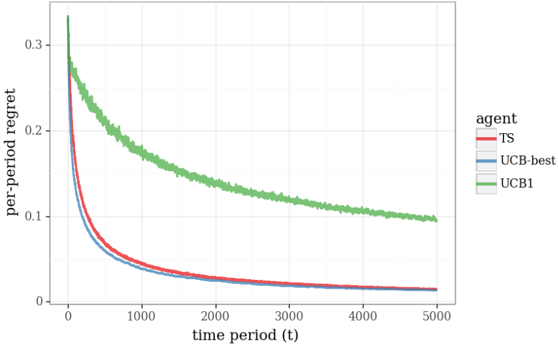
The image is a line chart comparing the per-period regret of three different agents (TS, UCB-best, and UCB1) over a time period ranging from 0 to 5000. The chart displays how the regret changes over time for each agent.
### Components/Axes
* **X-axis:** "time period (t)" with a scale from 0 to 5000, incrementing by 1000.
* **Y-axis:** "per-period regret" with a scale from 0 to 0.3, incrementing by 0.1.
* **Legend (top-right):**
* Red line: TS (Thompson Sampling)
* Blue line: UCB-best (Upper Confidence Bound - best)
* Green line: UCB1 (Upper Confidence Bound 1)
### Detailed Analysis
* **TS (Red):** The red line represents the Thompson Sampling agent. It starts at approximately 0.28 regret and rapidly decreases, stabilizing around 0.02 after approximately 2000 time periods.
* **UCB-best (Blue):** The blue line represents the UCB-best agent. It starts at approximately 0.25 regret and also rapidly decreases, closely following the TS agent and stabilizing around 0.02 after approximately 2000 time periods.
* **UCB1 (Green):** The green line represents the UCB1 agent. It starts at approximately 0.32 regret and decreases at a slower rate compared to TS and UCB-best. It stabilizes around 0.10 after approximately 4000 time periods.
### Key Observations
* Both TS and UCB-best agents exhibit significantly lower regret compared to the UCB1 agent, especially after 2000 time periods.
* The regret for TS and UCB-best converges to a similar low value.
* UCB1's regret decreases more slowly and stabilizes at a higher value than the other two agents.
### Interpretation
The chart demonstrates that Thompson Sampling (TS) and UCB-best algorithms perform significantly better in terms of minimizing per-period regret compared to the UCB1 algorithm in this scenario. The rapid decrease in regret for TS and UCB-best suggests faster learning and adaptation to the environment. The higher and slower-decreasing regret of UCB1 indicates a less efficient exploration-exploitation strategy in this context. The convergence of TS and UCB-best suggests that, given enough time, they achieve similar levels of performance. The data suggests that for this specific problem, TS and UCB-best are more effective algorithms for minimizing regret over time.