## Document: Research Article Example
### Overview
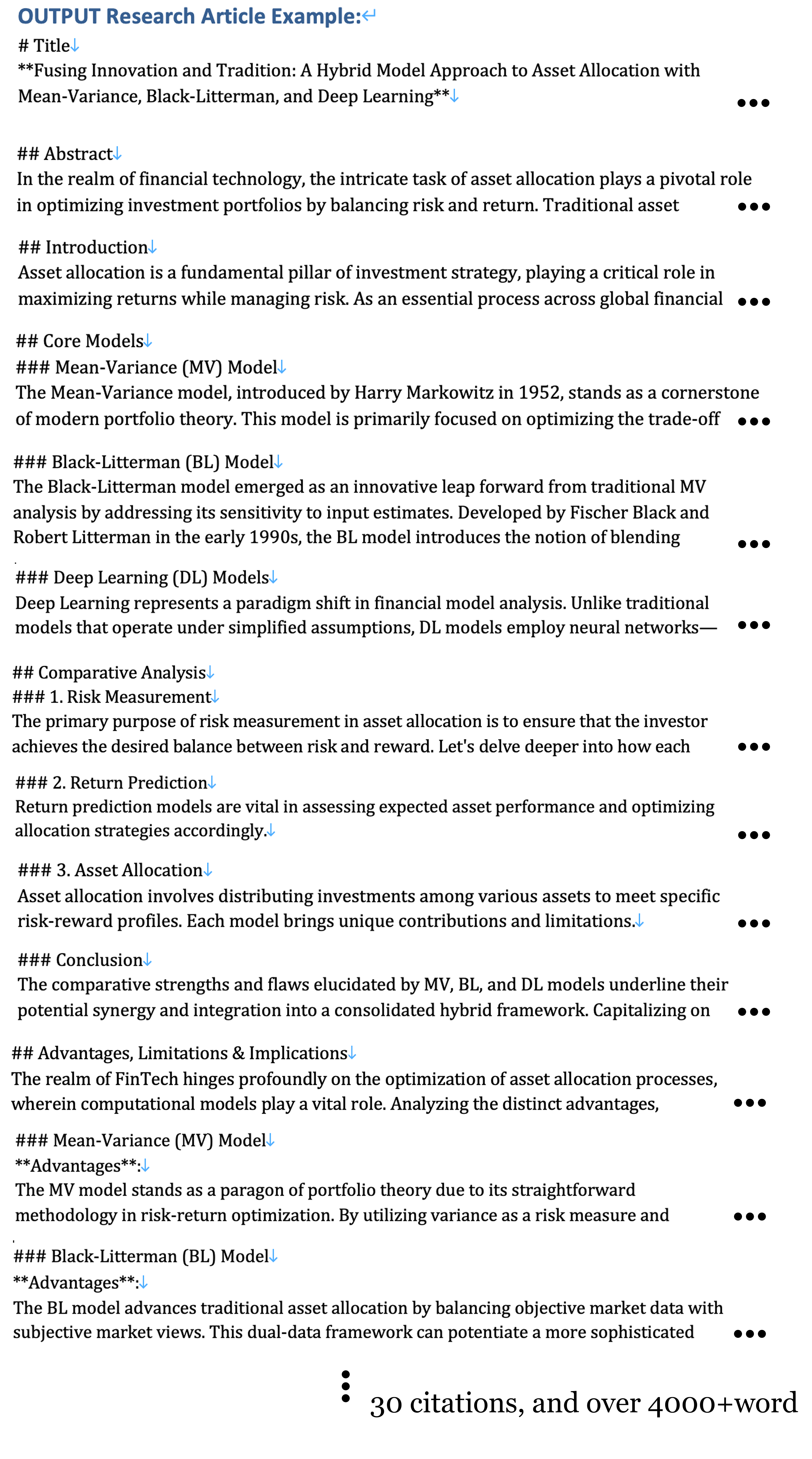
The image presents an example of a research article outline, covering topics related to asset allocation using Mean-Variance, Black-Litterman, and Deep Learning models. It includes sections for abstract, introduction, core models, comparative analysis, advantages, limitations, and implications.
### Components/Axes
* **Title:** "Fusing Innovation and Tradition: A Hybrid Model Approach to Asset Allocation with Mean-Variance, Black-Litterman, and Deep Learning"
* **Abstract:** A brief overview of the article's focus on asset allocation in financial technology.
* **Introduction:** Establishes the importance of asset allocation in investment strategy.
* **Core Models:**
* Mean-Variance (MV) Model: Describes the model introduced by Harry Markowitz.
* Black-Litterman (BL) Model: Explains the model's innovative approach to traditional MV analysis.
* Deep Learning (DL) Models: Introduces the use of deep learning in financial model analysis.
* **Comparative Analysis:**
* Risk Measurement: Discusses the purpose of risk measurement in asset allocation.
* Return Prediction: Highlights the importance of return prediction models.
* Asset Allocation: Explains the distribution of investments to meet specific risk-reward profiles.
* **Conclusion:** Summarizes the comparative strengths and flaws of the models.
* **Advantages, Limitations & Implications:** Discusses the optimization of asset allocation processes in FinTech.
* Mean-Variance (MV) Model: Highlights the advantages of the MV model.
* Black-Litterman (BL) Model: Highlights the advantages of the BL model.
* **Additional Information:** "30 citations, and over 4000+word"
### Detailed Analysis or Content Details
The document is structured as a research article outline. It begins with a title and abstract, followed by an introduction that sets the stage for the article's topic. The "Core Models" section delves into three specific models: Mean-Variance (MV), Black-Litterman (BL), and Deep Learning (DL). Each model is briefly described, highlighting its key features and contributions.
The "Comparative Analysis" section examines risk measurement, return prediction, and asset allocation, likely comparing the three models in these areas. The "Conclusion" section summarizes the strengths and weaknesses of each model, suggesting potential integration into a hybrid framework.
Finally, the "Advantages, Limitations & Implications" section discusses the broader implications of these models in the context of FinTech, with specific subsections dedicated to the advantages of the MV and BL models.
### Key Observations
* The article focuses on a hybrid approach to asset allocation, combining traditional and modern techniques.
* The outline covers a comprehensive range of topics, from model descriptions to comparative analysis and implications.
* The inclusion of "30 citations, and over 4000+word" suggests a substantial and well-researched article.
### Interpretation
The document outlines a research article that aims to explore and compare different asset allocation models, including traditional methods like Mean-Variance and Black-Litterman, as well as modern techniques using Deep Learning. The article likely seeks to identify the strengths and weaknesses of each model and propose a hybrid approach that leverages the benefits of all three. The emphasis on comparative analysis and implications suggests a practical focus, aiming to provide insights for optimizing asset allocation strategies in the financial technology landscape.