## Research Article: Fusing Innovation and Model: A Hybrid Model Approach to Asset Allocation with Mean-Variance, Black-Litterman, and Deep Learning
### Overview
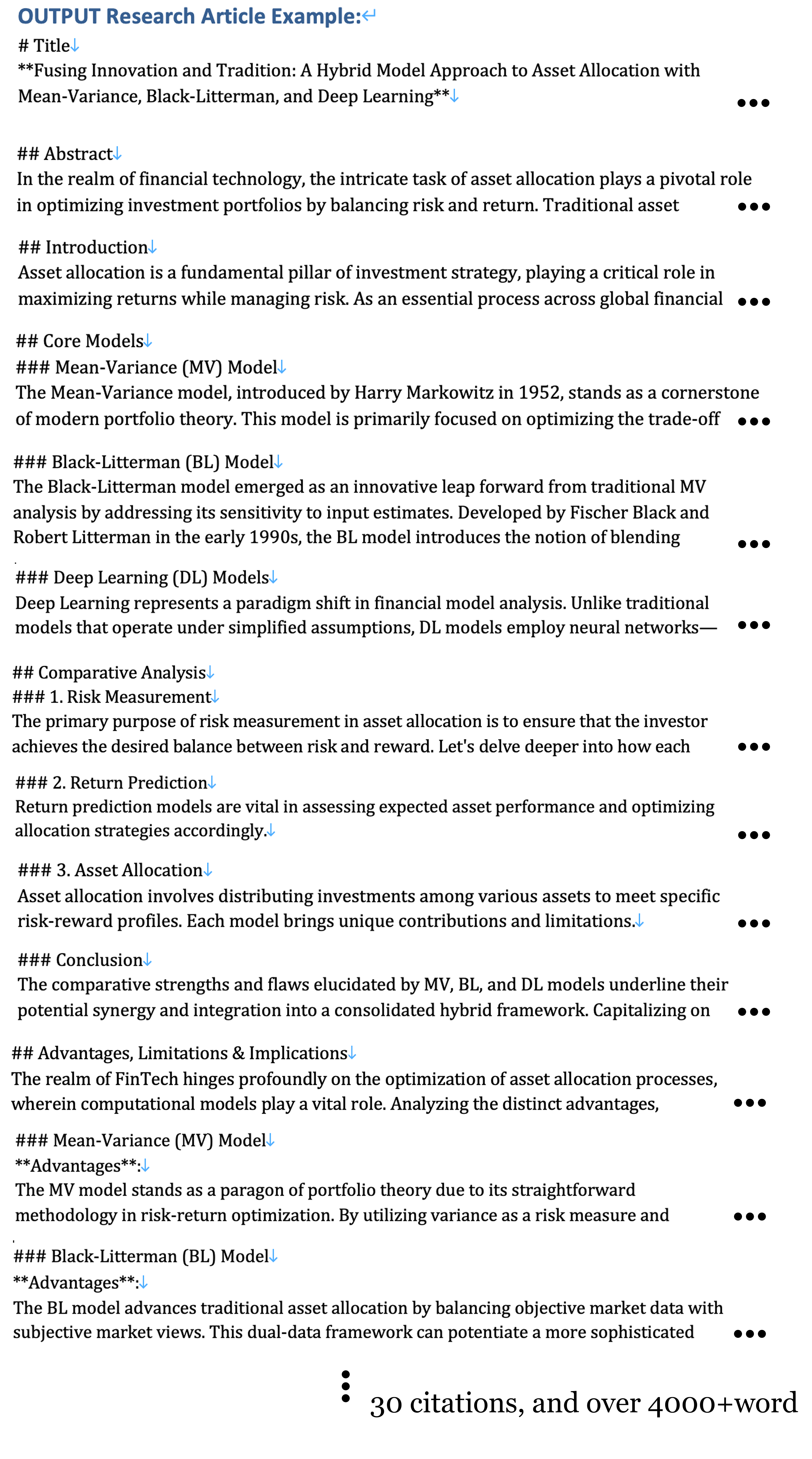
This document is a research article discussing a hybrid model approach to asset allocation, combining Mean-Variance, Black-Litterman, and Deep Learning techniques. It appears to be a structured academic paper with sections dedicated to core models, comparative analysis, and conclusions.
### Components/Axes
The document is structured into sections denoted by headings (e.g., "Core Models", "Comparative Analysis"). It uses a hierarchical structure with sub-headings (e.g., "Mean-Variance (MV) Model", "Risk Measurement"). The text is formatted with bullet points and numbered lists. There are also links (denoted by the "↓" symbol) within the text, presumably for navigation or referencing.
### Detailed Analysis or Content Details
**# Title:** Fusing Innovation and Model: A Hybrid Model Approach to Asset Allocation with Mean-Variance, Black-Litterman, and Deep Learning
**# Abstract:**
The abstract states that asset allocation is a pivotal role in optimizing investment portfolios by balancing risk and return. Traditional asset allocation in maximizing returns while managing risk. As an essential process across global financial markets, the intricate task of asset allocation plays a pivotal role.
**# Introduction:**
Asset allocation is a fundamental pillar of investment strategy, playing a critical role in maximizing returns while managing risk. As an essential process across global financial markets.
**# Core Models:**
* **# Mean-Variance (MV) Model:**
The Mean-Variance model, introduced by Harry Markowitz in 1952, stands as a cornerstone of modern portfolio theory. This model is primarily focused on optimizing the trade-off between risk and return.
* **# Black-Litterman (BL) Model:**
The Black-Litterman model emerged as an innovative leap forward from traditional MV analysis by addressing its sensitivity to input estimates. Developed by Fischer Black and Robert Litterman in the early 1990s, the BL model introduces the notion of blending
* **# Deep Learning (DL) Models:**
Deep Learning represents a paradigm shift in financial model analysis. Unlike traditional models that operate under simplified assumptions, DL models employ neural networks.
**# Comparative Analysis:**
* **# 1. Risk Measurement:**
The primary purpose of risk measurement in asset allocation is to ensure that the investor achieves the desired balance between risk and reward. Let's delve deeper into how each achieves this.
* **# 2. Return Prediction:**
Return prediction models are vital in assessing expected asset performance and optimizing allocation strategies accordingly.
* **# 3. Asset Allocation:**
Asset allocation involves distributing investments among various assets to meet specific risk-reward profiles. Each model brings unique contributions and limitations.
**# Conclusion:**
The comparative strengths and flaws elucidated by MV, BL, and DL models underline their potential synergy and integration into a consolidated hybrid framework. Capitalizing on the advantages, limitations & implications.
**# Advantages, Limitations & Implications:**
The realm of Fintech hinges profoundly on the optimization of asset allocation processes, wherein computational models play a vital role. Analyzing the distinct advantages.
* **# Mean-Variance (MV) Models:**
The MV model stands as a paragon of portfolio theory due to its straightforward methodology in risk-return optimization. By utilizing variance as a risk measure and expected returns.
* **# Black-Litterman (BL) Model:**
The BL model enhances the MV framework by incorporating investor views, thereby mitigating the sensitivity to input estimates.
* **# Deep Learning (DL) Models:**
DL models excel in capturing non-linear relationships and complex patterns within financial data, offering a potential advantage over traditional models.
The document states "30 citations, and over 4000 words".
### Key Observations
The document presents a comparative analysis of three asset allocation models: Mean-Variance, Black-Litterman, and Deep Learning. It highlights the strengths and weaknesses of each model and suggests a potential hybrid approach. The document is highly structured and uses academic language.
### Interpretation
This research article explores the evolution of asset allocation modeling, moving from the classical Mean-Variance approach to the more sophisticated Black-Litterman and Deep Learning techniques. The author argues that a hybrid model, leveraging the strengths of each approach, could offer the most robust and effective solution for optimizing investment portfolios. The emphasis on computational models and Fintech suggests a forward-looking perspective on the future of asset allocation. The mention of a large number of citations and words indicates a comprehensive and in-depth analysis of the topic. The document is likely intended for an audience of financial professionals and academics.