TECHNICAL ASSET FINGERPRINT
1fe0e0a1b076e8901b923f27
Click to view fullscreen
Press ESC or click to close
FOUND IN PAPERS
EXPERT: healer-alpha-free VERSION 1
RUNTIME: free/openrouter/healer-alpha
INTEL_VERIFIED
\n
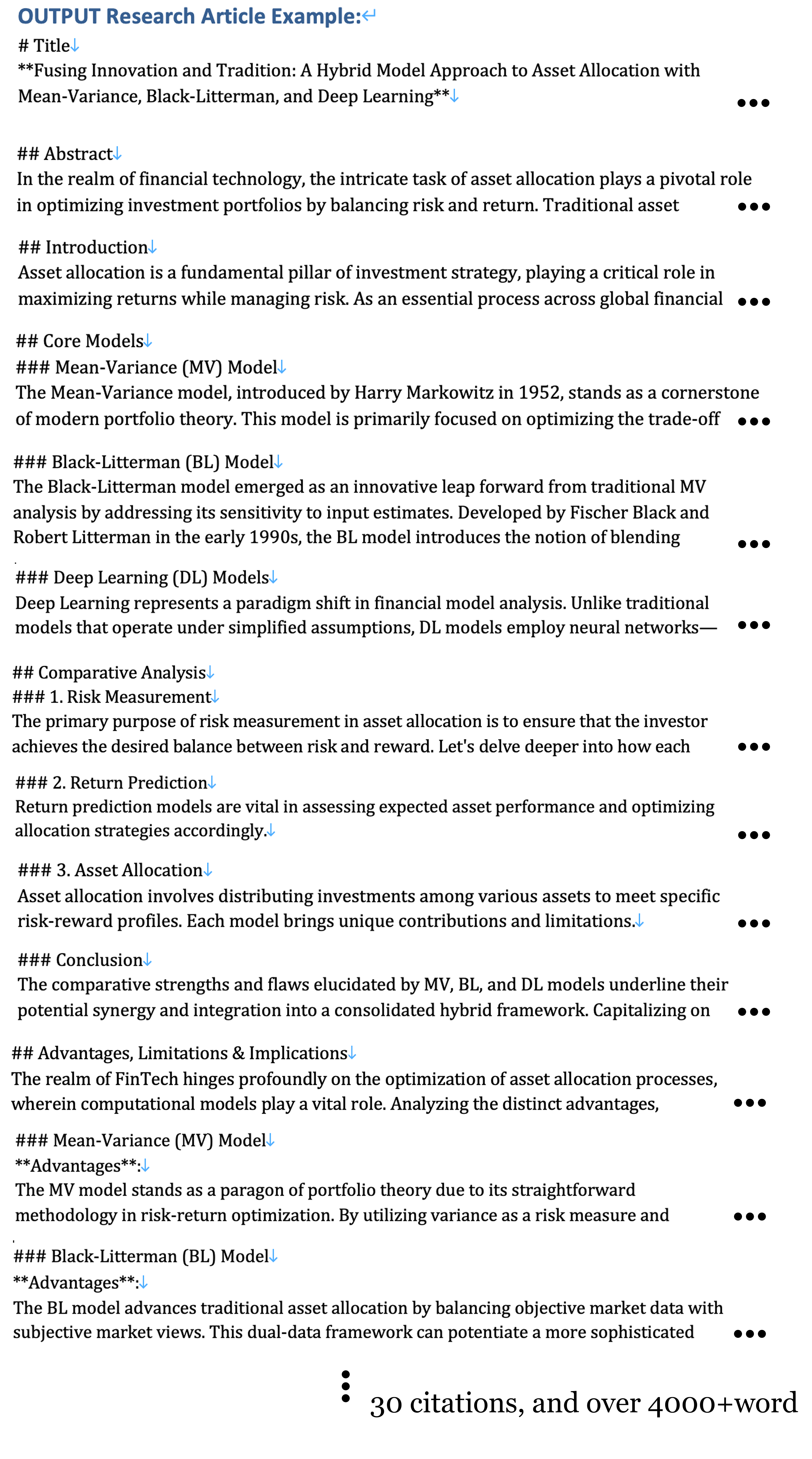
## Screenshot: Research Article Example Outline
### Overview
The image is a screenshot of a digital document or webpage displaying an example outline for a research article. The document is structured with hierarchical headings (using `#` symbols) and contains truncated paragraphs, indicated by ellipses (`...`). The content focuses on a hybrid financial model combining Mean-Variance, Black-Litterman, and Deep Learning for asset allocation. The text is in English. A note at the bottom indicates the full article would contain "30 citations, and over 4000+word".
### Components/Axes
This is not a chart or diagram with axes. The components are textual and structural:
* **Header/Title:** "OUTPUT Research Article Example:" followed by a left-pointing arrow symbol (`←`).
* **Document Structure:** A series of headings and subheadings formatted with Markdown-style `#` symbols, indicating a hierarchical outline.
* **Text Blocks:** Paragraphs of text following each heading, most of which are truncated with ellipses (`...`).
* **Formatting Symbols:** Downward-pointing arrows (`↓`) appear at the end of many heading lines. Ellipses (`...`) appear at the end of truncated text lines.
* **Footer Note:** A standalone line at the bottom of the image.
### Content Details
The following is a precise transcription of all visible text in the image, preserving formatting symbols.
**Top Line:**
`OUTPUT Research Article Example:←`
**Document Body:**
`# Title↓`
`**Fusing Innovation and Tradition: A Hybrid Model Approach to Asset Allocation with Mean-Variance, Black-Litterman, and Deep Learning**↓`
`...`
`## Abstract↓`
`In the realm of financial technology, the intricate task of asset allocation plays a pivotal role in optimizing investment portfolios by balancing risk and return. Traditional asset`
`...`
`## Introduction↓`
`Asset allocation is a fundamental pillar of investment strategy, playing a critical role in maximizing returns while managing risk. As an essential process across global financial`
`...`
`## Core Models↓`
`### Mean-Variance (MV) Model↓`
`The Mean-Variance model, introduced by Harry Markowitz in 1952, stands as a cornerstone of modern portfolio theory. This model is primarily focused on optimizing the trade-off`
`...`
`### Black-Litterman (BL) Model↓`
`The Black-Litterman model emerged as an innovative leap forward from traditional MV analysis by addressing its sensitivity to input estimates. Developed by Fischer Black and Robert Litterman in the early 1990s, the BL model introduces the notion of blending`
`...`
`### Deep Learning (DL) Models↓`
`Deep Learning represents a paradigm shift in financial model analysis. Unlike traditional models that operate under simplified assumptions, DL models employ neural networks—`
`...`
`## Comparative Analysis↓`
`### 1. Risk Measurement↓`
`The primary purpose of risk measurement in asset allocation is to ensure that the investor achieves the desired balance between risk and reward. Let's delve deeper into how each`
`...`
`### 2. Return Prediction↓`
`Return prediction models are vital in assessing expected asset performance and optimizing allocation strategies accordingly.↓`
`...`
`### 3. Asset Allocation↓`
`Asset allocation involves distributing investments among various assets to meet specific risk-reward profiles. Each model brings unique contributions and limitations.↓`
`...`
`### Conclusion↓`
`The comparative strengths and flaws elucidated by MV, BL, and DL models underline their potential synergy and integration into a consolidated hybrid framework. Capitalizing on`
`...`
`## Advantages, Limitations & Implications↓`
`The realm of FinTech hinges profoundly on the optimization of asset allocation processes, wherein computational models play a vital role. Analyzing the distinct advantages,`
`...`
`### Mean-Variance (MV) Model↓`
`**Advantages**:↓`
`The MV model stands as a paragon of portfolio theory due to its straightforward methodology in risk-return optimization. By utilizing variance as a risk measure and`
`...`
`### Black-Litterman (BL) Model↓`
`**Advantages**:↓`
`The BL model advances traditional asset allocation by balancing objective market data with subjective market views. This dual-data framework can potentiate a more sophisticated`
`...`
**Footer Note (Centered at bottom):**
`•`
`•`
`•`
`30 citations, and over 4000+word`
### Key Observations
1. **Structured Outline:** The document presents a clear, hierarchical outline for a lengthy research paper, moving from introduction to core models, comparative analysis, and implications.
2. **Truncated Content:** Every paragraph of body text is incomplete, ending with ellipses. This indicates the image shows a template or preview, not the full article.
3. **Consistent Formatting:** The use of `↓` after headings and `...` for truncation is consistent throughout, suggesting a specific document preparation or preview system.
4. **Hybrid Model Focus:** The title and section headings consistently emphasize the integration of three distinct financial modeling approaches (MV, BL, DL).
5. **Scale Indicator:** The footer note explicitly states the intended scale of the full document: substantial (4000+ words) and well-referenced (30 citations).
### Interpretation
This image serves as a **template or structural blueprint** for a comprehensive academic or technical review article in the field of financial technology (FinTech). It is not the article itself but a detailed outline demonstrating how such a paper would be organized.
* **Purpose:** The outline is designed to guide the creation of a paper that argues for a synergistic, hybrid approach to asset allocation. It systematically introduces foundational models (MV), an evolved model (BL), and a modern computational approach (DL) before comparing them and proposing their integration.
* **Logical Flow:** The structure follows a classic research paper format: Abstract -> Introduction -> Literature Review/Core Models -> Comparative Analysis -> Discussion (Advantages/Limitations) -> Conclusion. This flow is intended to build a logical case for the hybrid model.
* **Target Audience:** The content assumes reader familiarity with financial portfolio theory and quantitative models, targeting academics, financial engineers, or sophisticated quantitative analysts.
* **Implied Argument:** By placing "Deep Learning" alongside established financial models and dedicating sections to comparative analysis and hybrid frameworks, the outline strongly implies that the full article will advocate for the enhanced performance or robustness gained by combining traditional financial theory with modern machine learning techniques.
* **Nature of the Image:** The presence of truncation markers (`...`) and the "OUTPUT" label suggests this might be a preview generated by a document processing system, an AI writing assistant, or a template from a academic writing platform, showcasing the potential structure and depth of a generated or planned article.
DECODING INTELLIGENCE...