## Line Chart: 1-NN Accuracy vs. Representation Size
### Overview
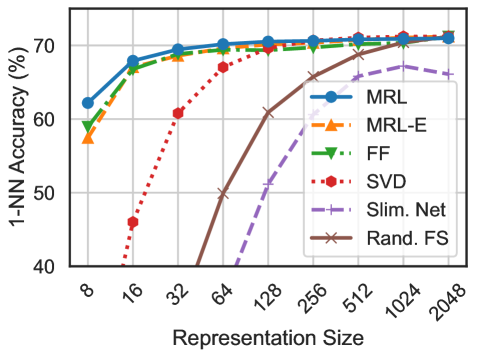
The image is a line chart comparing the 1-Nearest Neighbor (1-NN) accuracy of different methods (MRL, MRL-E, FF, SVD, Slim. Net, and Rand. FS) across varying representation sizes. The x-axis represents the representation size, while the y-axis represents the 1-NN accuracy in percentage.
### Components/Axes
* **Title:** There is no explicit title on the chart.
* **X-axis:**
* Label: "Representation Size"
* Scale: 8, 16, 32, 64, 128, 256, 512, 1024, 2048
* **Y-axis:**
* Label: "1-NN Accuracy (%)"
* Scale: 40, 50, 60, 70
* **Legend:** Located on the right side of the chart, listing the methods and their corresponding line styles and colors:
* MRL (Blue line with circle markers)
* MRL-E (Orange dashed line with triangle markers)
* FF (Green dash-dot line with inverted triangle markers)
* SVD (Red dotted line with circle markers)
* Slim. Net (Purple dashed line with plus markers)
* Rand. FS (Brown solid line with x markers)
### Detailed Analysis
* **MRL (Blue line with circle markers):** The line starts at approximately 62% accuracy at a representation size of 8, increases to about 67% at 16, reaches approximately 69% at 32, and then plateaus around 71-72% for larger representation sizes.
* (8, 62%)
* (16, 67%)
* (32, 69%)
* (64, 70%)
* (128, 71%)
* (256, 71%)
* (512, 71%)
* (1024, 72%)
* (2048, 72%)
* **MRL-E (Orange dashed line with triangle markers):** The line starts at approximately 58% accuracy at a representation size of 8, increases to about 66% at 16, reaches approximately 69% at 32, and then plateaus around 70-71% for larger representation sizes.
* (8, 58%)
* (16, 66%)
* (32, 69%)
* (64, 70%)
* (128, 70%)
* (256, 71%)
* (512, 71%)
* (1024, 71%)
* (2048, 71%)
* **FF (Green dash-dot line with inverted triangle markers):** The line starts at approximately 59% accuracy at a representation size of 8, increases to about 67% at 16, reaches approximately 69% at 32, and then plateaus around 70-71% for larger representation sizes.
* (8, 59%)
* (16, 67%)
* (32, 69%)
* (64, 70%)
* (128, 70%)
* (256, 70%)
* (512, 71%)
* (1024, 71%)
* (2048, 71%)
* **SVD (Red dotted line with circle markers):** The line starts at approximately 42% accuracy at a representation size of 8, increases to about 47% at 16, reaches approximately 60% at 32, and then plateaus around 69-70% for larger representation sizes.
* (8, 42%)
* (16, 47%)
* (32, 60%)
* (64, 67%)
* (128, 69%)
* (256, 70%)
* (512, 70%)
* (1024, 70%)
* (2048, 71%)
* **Slim. Net (Purple dashed line with plus markers):** The line starts at approximately 40% accuracy at a representation size of 64, increases to about 58% at 128, reaches approximately 64% at 256, and then plateaus around 65-66% for larger representation sizes.
* (64, 40%)
* (128, 58%)
* (256, 64%)
* (512, 65%)
* (1024, 65%)
* (2048, 66%)
* **Rand. FS (Brown solid line with x markers):** The line starts at approximately 40% accuracy at a representation size of 64, increases to about 61% at 128, reaches approximately 67% at 256, and then plateaus around 70-71% for larger representation sizes.
* (64, 40%)
* (128, 61%)
* (256, 67%)
* (512, 70%)
* (1024, 71%)
* (2048, 72%)
### Key Observations
* MRL, MRL-E, and FF methods achieve relatively high accuracy even with small representation sizes.
* SVD, Slim. Net, and Rand. FS methods show a more gradual increase in accuracy as the representation size increases.
* All methods tend to converge to a similar accuracy range (70-72%) as the representation size becomes larger.
* Slim. Net consistently underperforms compared to the other methods.
### Interpretation
The chart demonstrates the relationship between representation size and 1-NN accuracy for different methods. MRL, MRL-E, and FF appear to be more efficient in utilizing smaller representation sizes to achieve high accuracy, while SVD, Slim. Net, and Rand. FS require larger representation sizes to reach comparable performance. The convergence of all methods at larger representation sizes suggests that there may be a limit to the accuracy achievable with these methods, regardless of the representation size. The consistently lower performance of Slim. Net indicates that it may be less effective than the other methods in this context.