## Network Diagram: Entity Interactions in Ukraine (2014)
### Overview
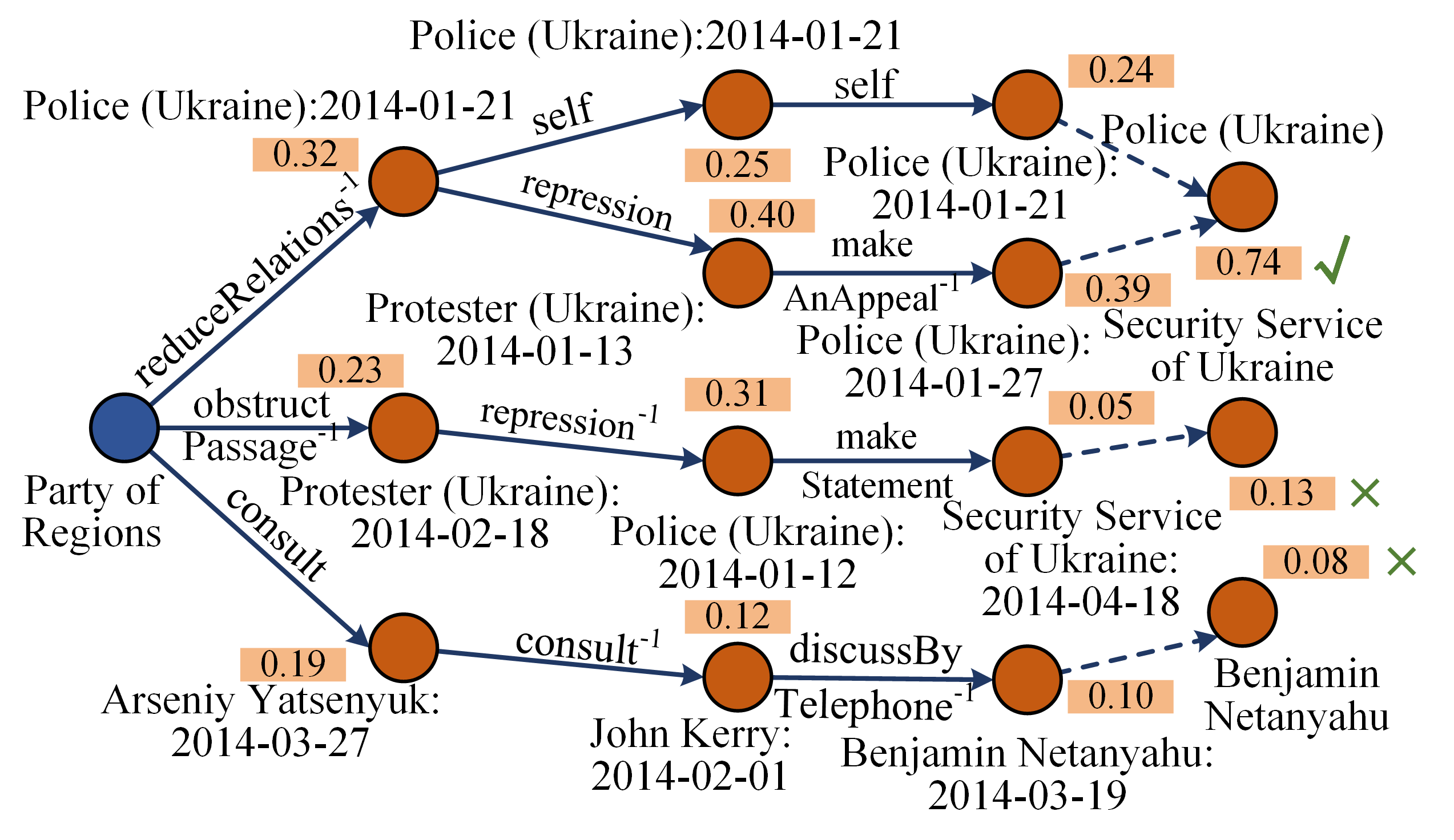
The diagram illustrates a network of interactions between political entities in Ukraine during early 2014, focusing on dates between January and April. Nodes represent entities (e.g., "Police (Ukraine)", "Protester (Ukraine)"), while edges depict directional relationships with labeled actions and numerical weights. Symbols (✅, ❌) indicate status, and dates contextualize temporal relevance.
---
### Components/Axes
- **Nodes**:
- Labeled with entity names and dates (e.g., "Police (Ukraine):2014-01-21").
- Colors:
- Orange for most nodes.
- Blue for "Party of Regions".
- Green checkmark (✅) on "Security Service of Ukraine" node.
- Red X (❌) on two nodes.
- **Edges**:
- Directed arrows with labels (e.g., "reduceRelations", "consult").
- Numerical weights (0.05–0.74) on edges.
- Dashed lines for some connections (e.g., "Security Service of Ukraine" to "Benjamin Netanyahu").
- **Legend**:
- ✅: Approved/Successful interaction.
- ❌: Rejected/Failed interaction.
---
### Detailed Analysis
#### Nodes
1. **Police (Ukraine)**:
- Multiple instances with dates (2014-01-21, 2014-01-12, 2014-01-27).
- Self-loop on 2014-01-21 (weight: 0.24).
- Connections to "An Appeal" (0.39) and "Security Service of Ukraine" (0.74 ✅).
2. **Protester (Ukraine)**:
- Dates: 2014-01-13, 2014-02-18.
- Connections to "Police (Ukraine)" (0.23 "obstruct", 0.31 "repression").
3. **Party of Regions**:
- Connects to "Protester (Ukraine)" (0.19 "consult").
4. **Arseniy Yatsenyuk**:
- Date: 2014-03-27.
- Connects to "Protester (Ukraine)" (0.12 "consult").
5. **John Kerry**:
- Date: 2014-02-01.
- Connects to "Protester (Ukraine)" (0.10 "discussBy").
6. **Benjamin Netanyahu**:
- Date: 2014-03-19.
- Connects to "Security Service of Ukraine" (0.08 ❌).
#### Edges
- **Highest Weight**: 0.74 ✅ between "Police (Ukraine):2014-01-21" and "Security Service of Ukraine".
- **Lowest Weight**: 0.05 between "Protester (Ukraine):2014-01-27" and "Security Service of Ukraine".
- **Rejected Interactions**:
- 0.13 ❌ between "Police (Ukraine):2014-01-27" and "Security Service of Ukraine".
- 0.08 ❌ between "Security Service of Ukraine" and "Benjamin Netanyahu".
---
### Key Observations
1. **Dominant Entity**: "Police (Ukraine)" has the most connections and highest interaction weights.
2. **Security Service of Ukraine**:
- Strong internal connection (0.74 ✅) but weak/failed external ties (0.05, 0.08 ❌).
3. **Protester (Ukraine)**:
- Multiple repressive actions toward Police (0.23–0.31).
4. **Temporal Spread**:
- Interactions span January–April 2014, suggesting escalating tensions.
---
### Interpretation
The diagram reflects a polarized network during Ukraine's 2014 political crisis. The **Police (Ukraine)** acts as a central hub, with strong self-referential interactions (0.24 self-loop) and a critical alliance with the **Security Service of Ukraine** (0.74 ✅). However, the Security Service struggles with external engagement, evidenced by low weights and rejections (0.05, 0.08 ❌).
The **Protester (Ukraine)** node shows adversarial relations with Police (0.23–0.31), while the **Party of Regions** and **John Kerry** engage in consultative roles (0.12–0.19). The **Benjamin Netanyahu** connection (0.08 ❌) highlights international involvement but with limited success.
The ✅ and ❌ symbols suggest a system where interactions are evaluated for legitimacy, with internal entities (Police, Security Service) maintaining higher approval rates. The timeline (January–April 2014) aligns with real-world events like the Euromaidan protests and geopolitical tensions, underscoring the diagram's relevance to historical conflict dynamics.