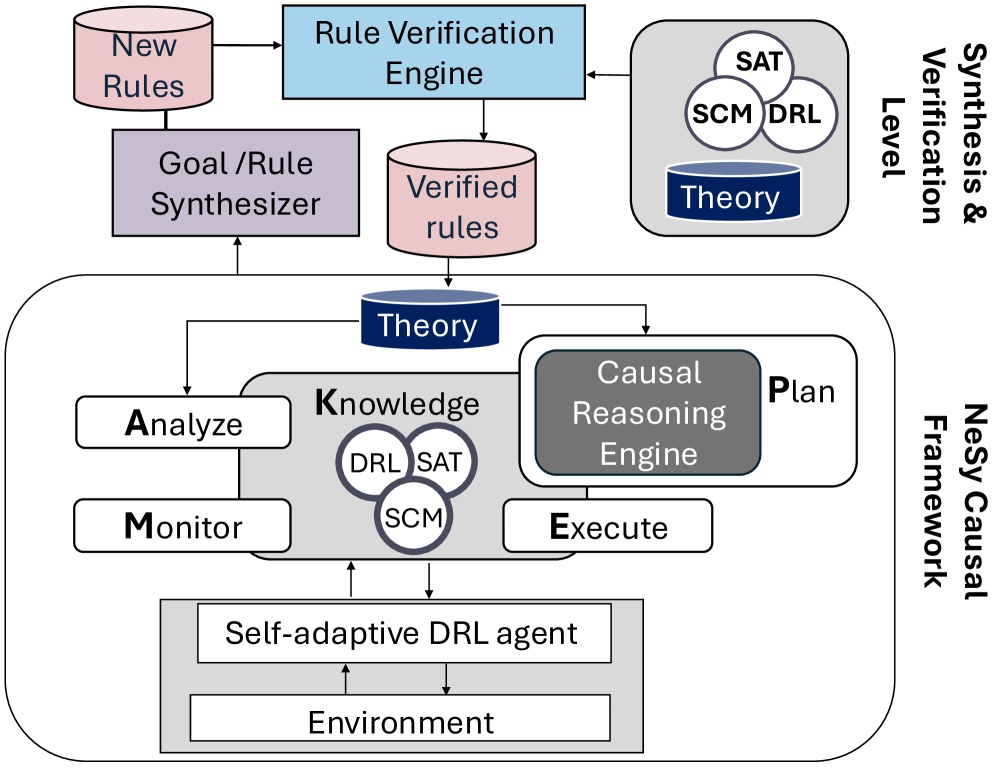
## Diagram: NeSy Causal Framework Architecture
### Overview
The image presents a high-level system architecture diagram for a "NeSy Causal Framework" (Neural-Symbolic Causal Framework). The diagram is vertically bifurcated into two primary functional levels: the "Synthesis & Verification Level" at the top and the "NeSy Causal Framework" at the bottom. It illustrates the data flow and logical relationships between rule synthesis, verification, causal reasoning, and environmental interaction, utilizing components like Deep Reinforcement Learning (DRL), Satisfiability (SAT), and Structural Causal Models (SCM).
### Components/Axes
**1. Synthesis & Verification Level (Top Section)**
* **New Rules:** A database icon (light red) located at the top-left.
* **Rule Verification Engine:** A blue rectangle located at the top-center.
* **Goal/Rule Synthesizer:** A purple rectangle located below "New Rules".
* **Verified rules:** A database icon (light red) located below the "Rule Verification Engine".
* **Theory (Top-Right):** A grey box containing a database icon labeled "Theory" and three overlapping circles labeled "SAT", "SCM", and "DRL".
* **Label:** "Synthesis & Verification Level" is written vertically on the far right.
**2. NeSy Causal Framework (Bottom Section)**
* **Theory (Top-Center):** A database icon (dark blue) located at the top of the main framework box.
* **Knowledge:** A central grey box containing three overlapping circles labeled "DRL", "SAT", and "SCM".
* **Analyze:** A white rectangle to the left of the "Knowledge" box.
* **Monitor:** A white rectangle below "Analyze".
* **Causal Reasoning Engine:** A dark grey rectangle to the right of the "Knowledge" box.
* **Plan:** A label positioned to the right of the "Causal Reasoning Engine".
* **Execute:** A white rectangle below the "Causal Reasoning Engine".
* **Self-adaptive DRL agent:** A white rectangle in the bottom-center.
* **Environment:** A white rectangle at the very bottom.
* **Label:** "NeSy Causal Framework" is written vertically on the far right.
### Detailed Analysis
**Flow and Connectivity:**
* **Synthesis Path:** "New Rules" flows into the "Rule Verification Engine" and the "Goal/Rule Synthesizer". The "Goal/Rule Synthesizer" feeds back into the "Rule Verification Engine".
* **Verification Path:** The "Rule Verification Engine" interacts with the top-right "Theory" block. It outputs to "Verified rules".
* **Integration Path:** "Verified rules" feeds into the central "Theory" database icon (top of the bottom section).
* **Operational Path (AKPE):** The central "Theory" database feeds into the "Analyze" component and the "Causal Reasoning Engine".
* The "Knowledge" block acts as the central hub for "Analyze", "Monitor", "Causal Reasoning Engine", and "Execute".
* The "Self-adaptive DRL agent" has a bidirectional relationship with the "Knowledge" block and the "Environment".
**Acronym Definitions (Inferred from context):**
* **DRL:** Deep Reinforcement Learning
* **SAT:** Satisfiability (Boolean Satisfiability Problem)
* **SCM:** Structural Causal Model
### Key Observations
* **Modularity:** The architecture clearly separates the *creation* of rules (Synthesis & Verification) from the *application* of rules (NeSy Causal Framework).
* **Centrality of Theory:** The "Theory" component appears twice, acting as the bridge between the verification level and the operational framework.
* **The AKPE Pattern:** The central framework is organized around four key functions: **A**nalyze, **K**nowledge (central hub), **P**lan (associated with Causal Reasoning), and **E**xecute.
* **Feedback Loops:** The "Self-adaptive DRL agent" is the only component with direct, bidirectional interaction with the "Environment," suggesting it is the active controller of the system.
### Interpretation
This diagram illustrates a **Neural-Symbolic (NeSy) architecture** designed to make AI agents more robust and explainable.
* **The Problem Solved:** Pure Deep Reinforcement Learning (DRL) is often a "black box" and can behave unpredictably. By introducing a "Synthesis & Verification Level," the system ensures that the rules governing the agent are mathematically verified (using SAT/SCM) before they are deployed.
* **The Mechanism:** The system uses "Theory" as a grounding mechanism. The "Knowledge" block serves as the repository where neural learning (DRL) is constrained or guided by symbolic logic (SAT/SCM).
* **Peircean/Logical Flow:** The system follows a logical progression:
1. **Abduction/Induction:** "New Rules" are synthesized.
2. **Deduction/Verification:** Rules are verified against "Theory."
3. **Execution:** The "Self-adaptive DRL agent" applies this verified knowledge to the "Environment," monitors the results, and potentially updates its strategy via the "Causal Reasoning Engine."
* **Significance:** This architecture is likely intended for high-stakes environments (e.g., robotics, autonomous systems) where the agent must adhere to strict safety or operational rules while still benefiting from the adaptive capabilities of reinforcement learning.