## Flowchart: NeSy Causal Framework Architecture
### Overview
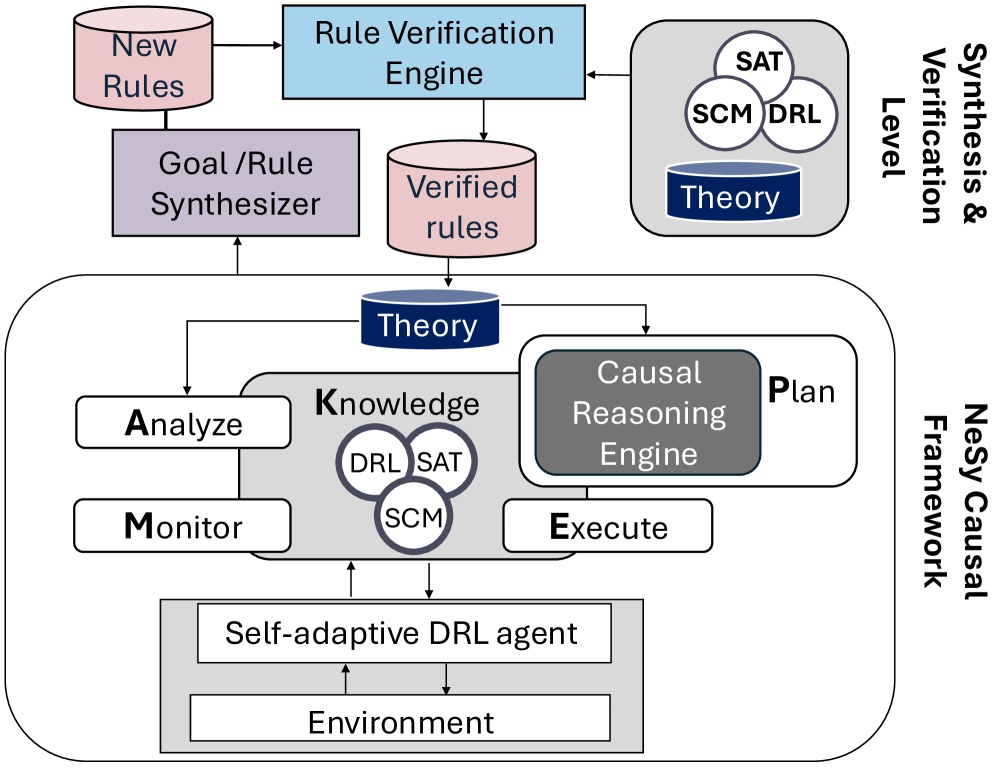
The diagram illustrates a hierarchical system architecture for a NeSy (Neuro-Symbolic) Causal Framework, integrating rule-based reasoning, causal inference, and self-adaptive deep reinforcement learning (DRL). The system is divided into three levels: **Synthesis & Verification Level** (top), **NeSy Causal Framework** (middle), and **Environment** (bottom). Components are interconnected via bidirectional and unidirectional flows, emphasizing iterative learning and execution.
---
### Components/Axes
#### Labels and Connections:
1. **Top Section (Synthesis & Verification Level)**:
- **New Rules** (pink cylinder) → **Rule Verification Engine** (blue rectangle) → **Verified rules** (pink cylinder).
- **Goal/Rule Synthesizer** (purple rectangle) feeds into the Rule Verification Engine.
- **Theory** (blue cylinder) aggregates **SAT**, **SCM**, and **DRL** (white circles).
2. **Middle Section (NeSy Causal Framework)**:
- **Knowledge** (gray rectangle) contains **DRL**, **SAT**, and **SCM** (white circles).
- **Causal Reasoning Engine** (dark gray rectangle) connects to **Plan** (white rectangle).
- **Analyze**, **Monitor**, and **Execute** (white rectangles) form a feedback loop with the **Self-adaptive DRL agent** (gray rectangle).
3. **Bottom Section (Environment)**:
- **Self-adaptive DRL agent** interacts with the **Environment** (gray rectangle), with bidirectional feedback.
#### Spatial Grounding:
- **Legend**: No explicit legend, but color coding is used:
- **Pink**: Rule-related components (New Rules, Verified rules).
- **Blue**: Theory and Rule Verification Engine.
- **Gray**: Knowledge, Causal Reasoning Engine, and Environment.
- **White**: Analyze, Monitor, Execute, Plan.
- **Purple**: Goal/Rule Synthesizer.
---
### Detailed Analysis
#### Synthesis & Verification Level:
- **New Rules** are input into the **Rule Verification Engine**, which outputs **Verified rules**.
- The **Goal/Rule Synthesizer** generates goals/rules that are cross-validated by the Rule Verification Engine.
- **Theory** synthesizes **SAT** (satisfiability), **SCM** (structural causal models), and **DRL** (deep reinforcement learning) into a unified framework.
#### NeSy Causal Framework:
- **Knowledge** integrates DRL, SAT, and SCM, acting as a central repository for causal and learning-based rules.
- **Causal Reasoning Engine** processes inputs from **Analyze**, **Monitor**, and **Execute** to generate **Plans**.
- **Self-adaptive DRL agent** in the **Environment** dynamically adjusts its policies based on feedback from the Causal Reasoning Engine and environmental interactions.
#### Environment:
- The **Self-adaptive DRL agent** operates within the **Environment**, with continuous monitoring and execution loops to refine its behavior.
---
### Key Observations
1. **Bidirectional Feedback**: The **Environment** and **Self-adaptive DRL agent** share a feedback loop, enabling real-time adaptation.
2. **Modularity**: Components like **SAT**, **SCM**, and **DRL** are modular within the **Knowledge** and **Theory** sections, suggesting interoperability.
3. **Causal Focus**: The **Causal Reasoning Engine** bridges rule-based planning (**Plan**) and learning-based execution (**Execute**), emphasizing causality as a unifying principle.
---
### Interpretation
This architecture demonstrates a **Neuro-Symbolic Causal Framework** designed for complex decision-making systems. Key insights:
- **Rule Verification**: Ensures reliability of generated rules before integration into the system.
- **Causal Inference**: The **Causal Reasoning Engine** and **SCM** enable the system to model cause-effect relationships, critical for robust planning.
- **Self-Adaptation**: The DRL agent’s adaptability to the **Environment** highlights the system’s capacity for continuous learning and improvement.
- **Integration**: The fusion of symbolic reasoning (SAT, SCM) and deep learning (DRL) suggests a hybrid approach to handle both structured and unstructured data.
The diagram emphasizes **iterative learning** (via feedback loops) and **causal grounding** (via SCM and reasoning engine), positioning the system for applications in dynamic, real-world environments requiring both precision and adaptability.