## Diagram: Evaluation Framework
### Overview
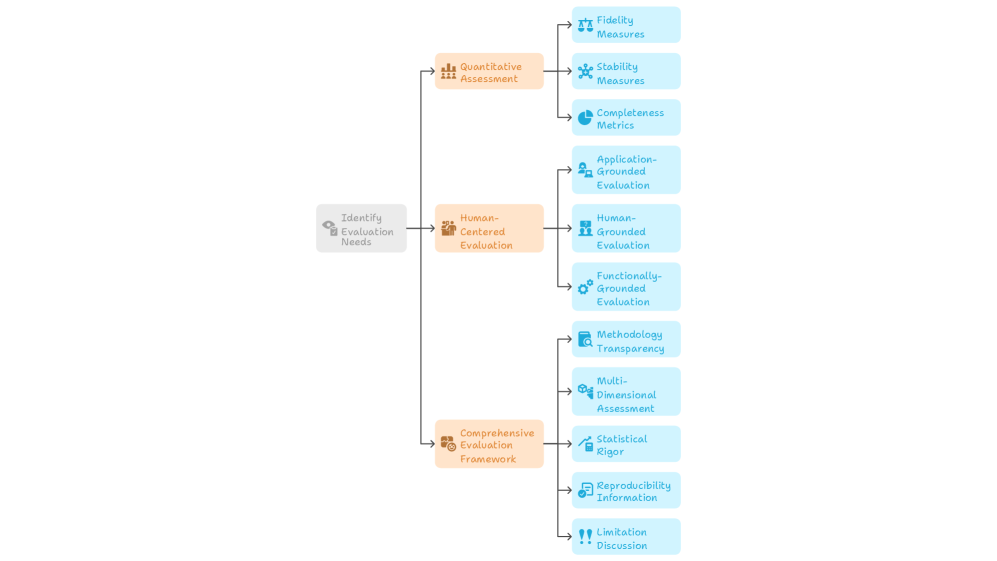
The image presents a hierarchical diagram outlining an evaluation framework. It starts with "Identify Evaluation Needs" and branches into three main categories: "Quantitative Assessment," "Human-Centered Evaluation," and "Comprehensive Evaluation Framework." Each of these categories further branches into specific measures or aspects to consider during evaluation.
### Components/Axes
* **Root Node:** "Identify Evaluation Needs" (gray box)
* **Primary Branches:**
* "Quantitative Assessment" (orange box)
* "Human-Centered Evaluation" (orange box)
* "Comprehensive Evaluation Framework" (orange box)
* **Secondary Branches (light blue boxes):**
* Under "Quantitative Assessment":
* "Fidelity Measures"
* "Stability Measures"
* "Completeness Metrics"
* Under "Human-Centered Evaluation":
* "Application-Grounded Evaluation"
* "Human-Grounded Evaluation"
* "Functionally-Grounded Evaluation"
* Under "Comprehensive Evaluation Framework":
* "Methodology Transparency"
* "Multi-Dimensional Assessment"
* "Statistical Rigor"
* "Reproducibility Information"
* "Limitation Discussion"
### Detailed Analysis
The diagram uses a tree-like structure to illustrate the breakdown of evaluation considerations. The root node, "Identify Evaluation Needs," serves as the starting point. From there, the evaluation process can be approached through three distinct lenses: quantitative, human-centered, or comprehensive. Each lens then directs attention to specific metrics, aspects, or information that should be considered.
* **Quantitative Assessment:** Focuses on measurable aspects like fidelity, stability, and completeness.
* **Human-Centered Evaluation:** Emphasizes the user experience and practical application, considering application, human factors, and functionality.
* **Comprehensive Evaluation Framework:** Takes a broader approach, encompassing methodology, dimensionality, statistical rigor, reproducibility, and limitations.
### Key Observations
* The diagram provides a structured approach to evaluation, ensuring that different aspects are considered.
* The three primary branches represent different philosophical approaches to evaluation.
* The secondary branches offer specific, actionable items to consider within each approach.
### Interpretation
The diagram serves as a guide for designing and conducting evaluations. It highlights the importance of first identifying the evaluation needs and then selecting an appropriate framework (quantitative, human-centered, or comprehensive) based on those needs. The framework then guides the selection of specific measures, aspects, or information to collect and analyze. The diagram suggests that a thorough evaluation should consider a combination of these approaches to provide a holistic understanding.