## Diagram: Evolution of Inductive Logic
### Overview
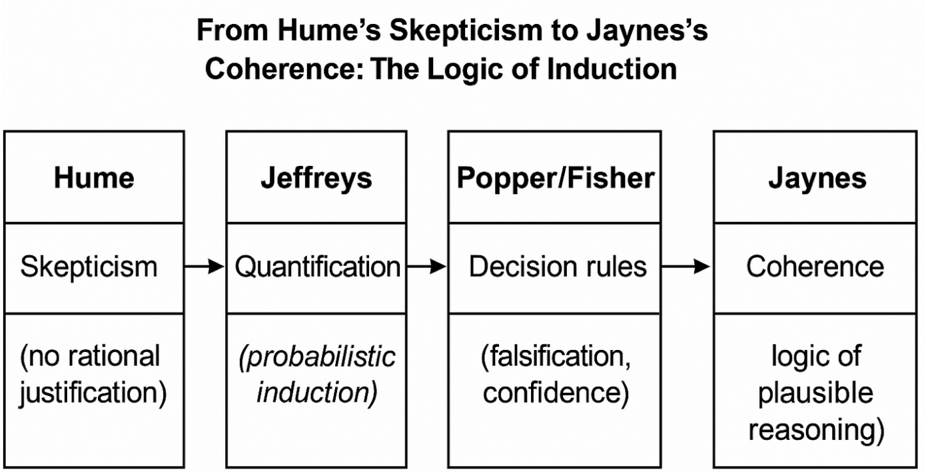
The image is a diagram illustrating the evolution of inductive logic from Hume's skepticism to Jaynes's coherence theory. It presents a linear progression through four key figures: Hume, Jeffreys, Popper/Fisher, and Jaynes, each associated with a specific concept and a brief description.
### Components/Axes
* **Title:** "From Hume's Skepticism to Jaynes's Coherence: The Logic of Induction"
* **Nodes:** Four rectangular boxes representing the key figures and their associated concepts.
* **Hume:** Associated with "Skepticism" and "(no rational justification)".
* **Jeffreys:** Associated with "Quantification" and "(probabilistic induction)".
* **Popper/Fisher:** Associated with "Decision rules" and "(falsification, confidence)".
* **Jaynes:** Associated with "Coherence" and "logic of plausible reasoning)".
* **Arrows:** Right-pointing arrows connecting the boxes, indicating the flow of ideas and the progression of inductive logic.
### Detailed Analysis
The diagram consists of four vertical stacks, each representing a stage in the development of inductive logic. Each stack is divided into three sections:
1. **Top Section:** Contains the name of the philosopher or group of philosophers (Hume, Jeffreys, Popper/Fisher, Jaynes).
2. **Middle Section:** Contains the key concept associated with that philosopher (Skepticism, Quantification, Decision rules, Coherence).
3. **Bottom Section:** Contains a brief description or explanation of the concept.
The arrows indicate the progression of ideas from Hume to Jeffreys, then to Popper/Fisher, and finally to Jaynes.
* **Hume:** The starting point, characterized by skepticism and the lack of rational justification for induction.
* **Jeffreys:** Builds upon Hume by introducing quantification and probabilistic induction.
* **Popper/Fisher:** Focuses on decision rules, falsification, and confidence.
* **Jaynes:** Represents the culmination of this progression with the concept of coherence and the logic of plausible reasoning.
### Key Observations
* The diagram presents a simplified linear progression of ideas.
* Each stage builds upon the previous one, representing an evolution of thought.
* The diagram highlights the key concepts associated with each philosopher.
### Interpretation
The diagram illustrates a historical progression in the philosophy of inductive logic. It starts with Hume's skeptical view, which questions the rational basis of induction. Subsequent thinkers, like Jeffreys, Popper/Fisher, and Jaynes, attempted to address this problem by introducing concepts like quantification, decision rules, and coherence. The diagram suggests that Jaynes's coherence theory represents a culmination of these efforts, providing a framework for plausible reasoning. The diagram simplifies a complex intellectual history, but it effectively conveys the key stages in the development of inductive logic.