\n
## Diagram: From Hume's Skepticism to Jaynes's Coherence: The Logic of Induction
### Overview
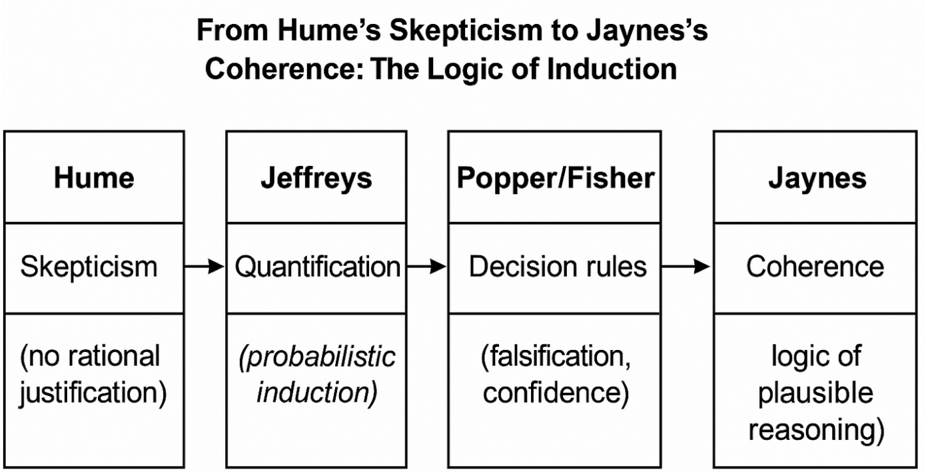
The image is a diagram illustrating a progression of thought from David Hume's skepticism to Julian Jaynes's coherence theory, outlining the logic of induction. It presents four stages, each associated with a key figure and a corresponding concept, connected by arrows indicating a flow of development.
### Components/Axes
The diagram consists of four rectangular boxes arranged horizontally from left to right. Each box contains:
* A name of a philosopher/thinker (Hume, Jeffreys, Popper/Fisher, Jaynes) – positioned at the top of the box.
* A key concept associated with that thinker (Skepticism, Quantification, Decision rules, Coherence) – positioned in the center of the box.
* A brief explanatory phrase (no rational justification, probabilistic induction, falsification, confidence, logic of plausible reasoning) – positioned at the bottom of the box.
Arrows connect the boxes, indicating a sequential progression of ideas.
The overall title is "From Hume's Skepticism to Jaynes's Coherence: The Logic of Induction" and is positioned at the top center of the image.
### Detailed Analysis or Content Details
The diagram presents a linear progression of ideas:
1. **Hume:** Associated with "Skepticism" and "(no rational justification)".
2. **Jeffreys:** Linked to "Quantification" and "(probabilistic induction)". An arrow points from Hume to Jeffreys.
3. **Popper/Fisher:** Connected to "Decision rules" and "(falsification, confidence)". An arrow points from Jeffreys to Popper/Fisher.
4. **Jaynes:** Associated with "Coherence" and "(logic of plausible reasoning)". An arrow points from Popper/Fisher to Jaynes.
The arrows are consistently positioned in the center-right of each box, pointing towards the next box in the sequence.
### Key Observations
The diagram highlights a historical development of thought regarding induction. It suggests a movement from a position of complete skepticism (Hume) towards a more structured and reasoned approach culminating in Jaynes's coherence theory. The inclusion of both Popper and Fisher suggests a combined influence on the "Decision rules" stage.
### Interpretation
The diagram illustrates a shift in how humans approach the problem of induction – how we draw general conclusions from specific observations. Hume's skepticism challenges the very basis of inductive reasoning, arguing there's no rational justification for believing that the future will resemble the past. Jeffreys attempts to address this by introducing quantification, using probability to assess the likelihood of future events. Popper and Fisher then focus on decision-making under uncertainty, emphasizing falsification and confidence levels. Finally, Jaynes proposes coherence as a framework for plausible reasoning, suggesting that beliefs are justified by their consistency within a broader system of knowledge.
The diagram implies a building upon previous ideas. Each stage doesn't necessarily *disprove* the previous one, but rather expands or refines it. The progression suggests a growing sophistication in our understanding of induction, moving from a purely philosophical challenge to a more practical and mathematically informed approach. The diagram is a conceptual map, not a quantitative one, and does not contain numerical data. It is a visual representation of a historical and philosophical argument.