## Flowchart: From Hume’s Skepticism to Jaynes’s Coherence: The Logic of Induction
### Overview
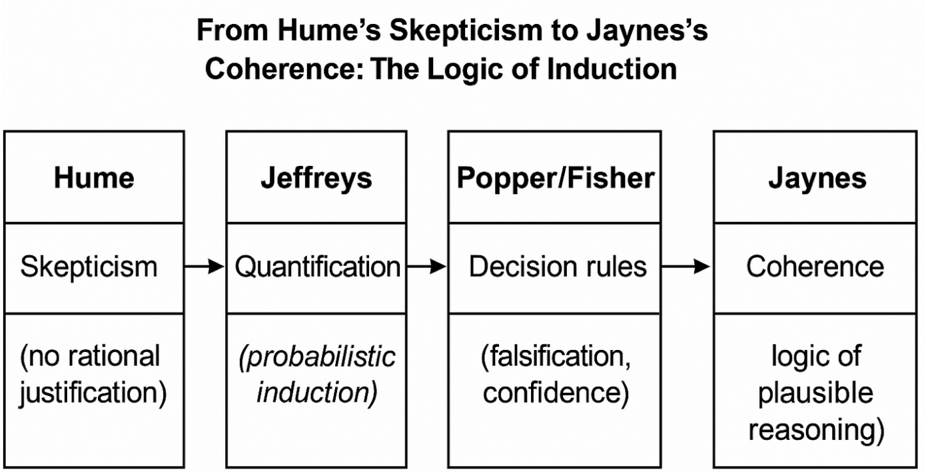
The flowchart illustrates the evolution of inductive reasoning frameworks, starting with Hume’s skepticism and progressing through Jeffreys’ quantification, Popper/Fisher’s decision rules, and culminating in Jaynes’ coherence. Each stage introduces a methodological shift to address limitations in prior approaches.
### Components/Axes
- **Nodes**:
1. **Hume**:
- Label: "Skepticism"
- Description: "(no rational justification)"
2. **Jeffreys**:
- Label: "Quantification"
- Description: "(probabilistic induction)"
3. **Popper/Fisher**:
- Label: "Decision rules"
- Description: "(falsification, confidence)"
4. **Jaynes**:
- Label: "Coherence"
- Description: "(logic of plausible reasoning)"
- **Arrows**:
- Directed edges connect nodes sequentially: Hume → Jeffreys → Popper/Fisher → Jaynes.
### Detailed Analysis
- **Hume’s Skepticism**:
- Positions skepticism as the foundational critique of induction, rejecting rational justification for inductive inferences.
- **Jeffreys’ Quantification**:
- Introduces probabilistic induction to address Hume’s skepticism, assigning degrees of belief to hypotheses.
- **Popper/Fisher’s Decision Rules**:
- Focuses on falsification (rejecting hypotheses) and confidence (statistical thresholds) as pragmatic tools for decision-making.
- **Jaynes’ Coherence**:
- Advocates for a logic of plausible reasoning, emphasizing internal consistency and coherence over probabilistic or falsificationist approaches.
### Key Observations
- The flowchart represents a historical and philosophical progression, with each stage responding to the limitations of its predecessor.
- Hume’s skepticism is the starting point, with subsequent frameworks attempting to resolve its challenges.
- Jaynes’ coherence is positioned as the most advanced stage, integrating plausibility and logical consistency.
### Interpretation
The flowchart demonstrates the iterative refinement of inductive reasoning in response to philosophical and practical challenges. Hume’s skepticism highlights the problem of justifying induction, which Jeffreys addresses through probabilistic methods. Popper/Fisher further refine this by prioritizing falsification and confidence, while Jaynes’ coherence represents a shift toward holistic, logically consistent reasoning. This progression reflects a move from foundational critique to pragmatic and ultimately integrative approaches to induction.