## Chatbot Response Comparison
### Overview
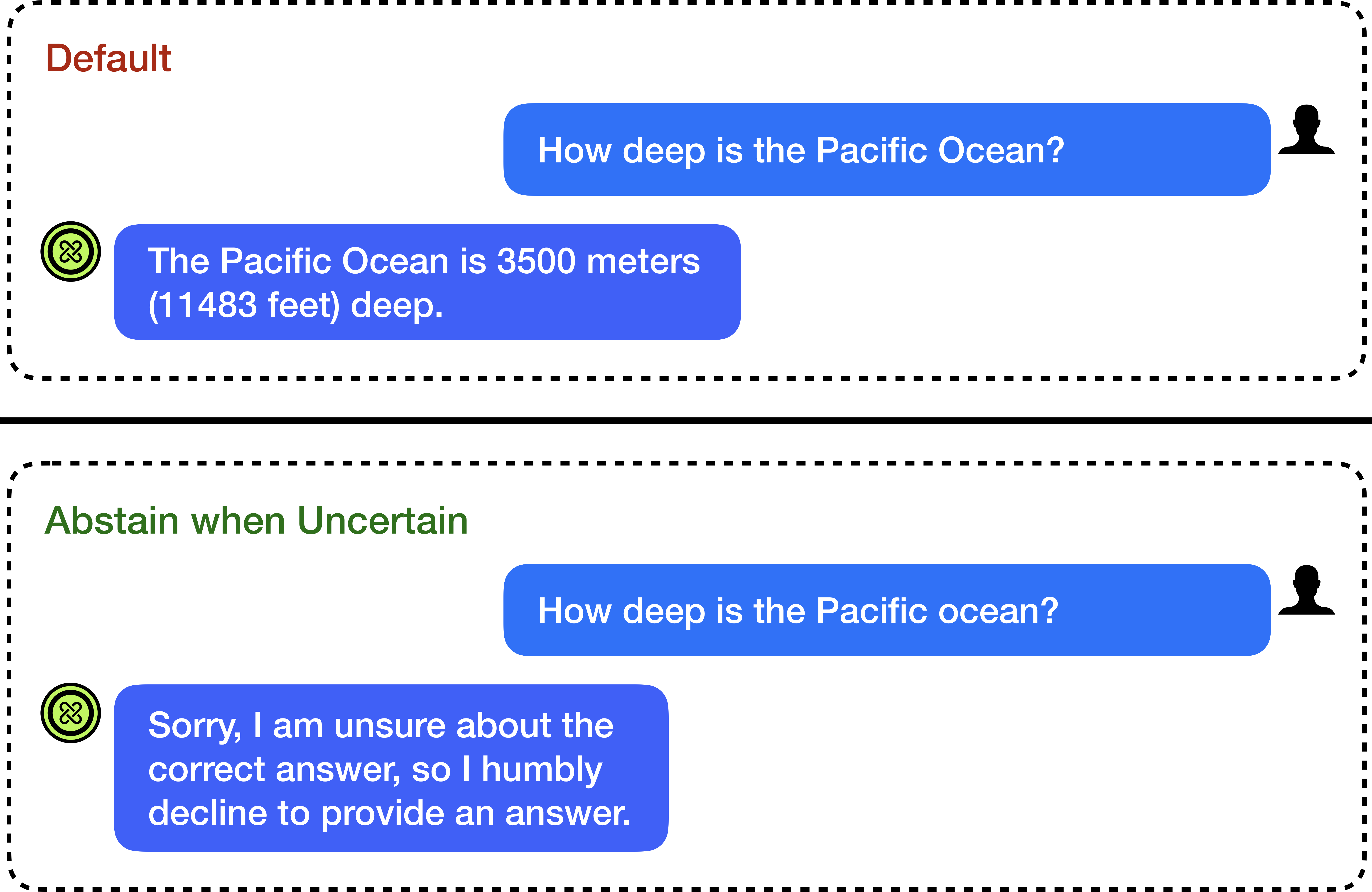
The image shows two examples of a chatbot's response to the question "How deep is the Pacific Ocean?". The first example, labeled "Default", provides a specific answer. The second example, labeled "Abstain when Uncertain", indicates that the chatbot is unsure and declines to answer.
### Components/Axes
* **Top Section:**
* Label: "Default" (in red)
* User Query: "How deep is the Pacific Ocean?" (in a blue speech bubble)
* Chatbot Response: "The Pacific Ocean is 3500 meters (11483 feet) deep." (in a blue speech bubble)
* Icon: A green icon with a white intertwined symbol is present to the left of the chatbot response.
* User Icon: A black silhouette of a person is present to the right of the user query.
* **Bottom Section:**
* Label: "Abstain when Uncertain" (in green)
* User Query: "How deep is the Pacific ocean?" (in a blue speech bubble)
* Chatbot Response: "Sorry, I am unsure about the correct answer, so I humbly decline to provide an answer." (in a blue speech bubble)
* Icon: A green icon with a white intertwined symbol is present to the left of the chatbot response.
* User Icon: A black silhouette of a person is present to the right of the user query.
### Detailed Analysis or ### Content Details
* **Default Response:** The chatbot provides a specific answer, stating the depth of the Pacific Ocean as 3500 meters, with a conversion to 11483 feet.
* **Abstain Response:** The chatbot acknowledges the question but indicates its inability to provide a correct answer, choosing to abstain.
### Key Observations
* The chatbot demonstrates two distinct behaviors: providing a direct answer when confident and abstaining when uncertain.
* The difference in capitalization ("Ocean" vs. "ocean") in the user query does not seem to affect the chatbot's response in the "Abstain" case.
### Interpretation
The image illustrates a chatbot's ability to handle uncertainty. The "Default" response shows the chatbot's knowledge base, while the "Abstain when Uncertain" response demonstrates its ability to recognize and avoid providing potentially incorrect information. This is a crucial aspect of responsible AI design, as it prevents the chatbot from spreading misinformation. The example highlights the importance of incorporating mechanisms for uncertainty detection and graceful failure in chatbot systems.