## Line Chart: Delta Accuracy vs. Reward Model Accuracy for Different Tasks
### Overview
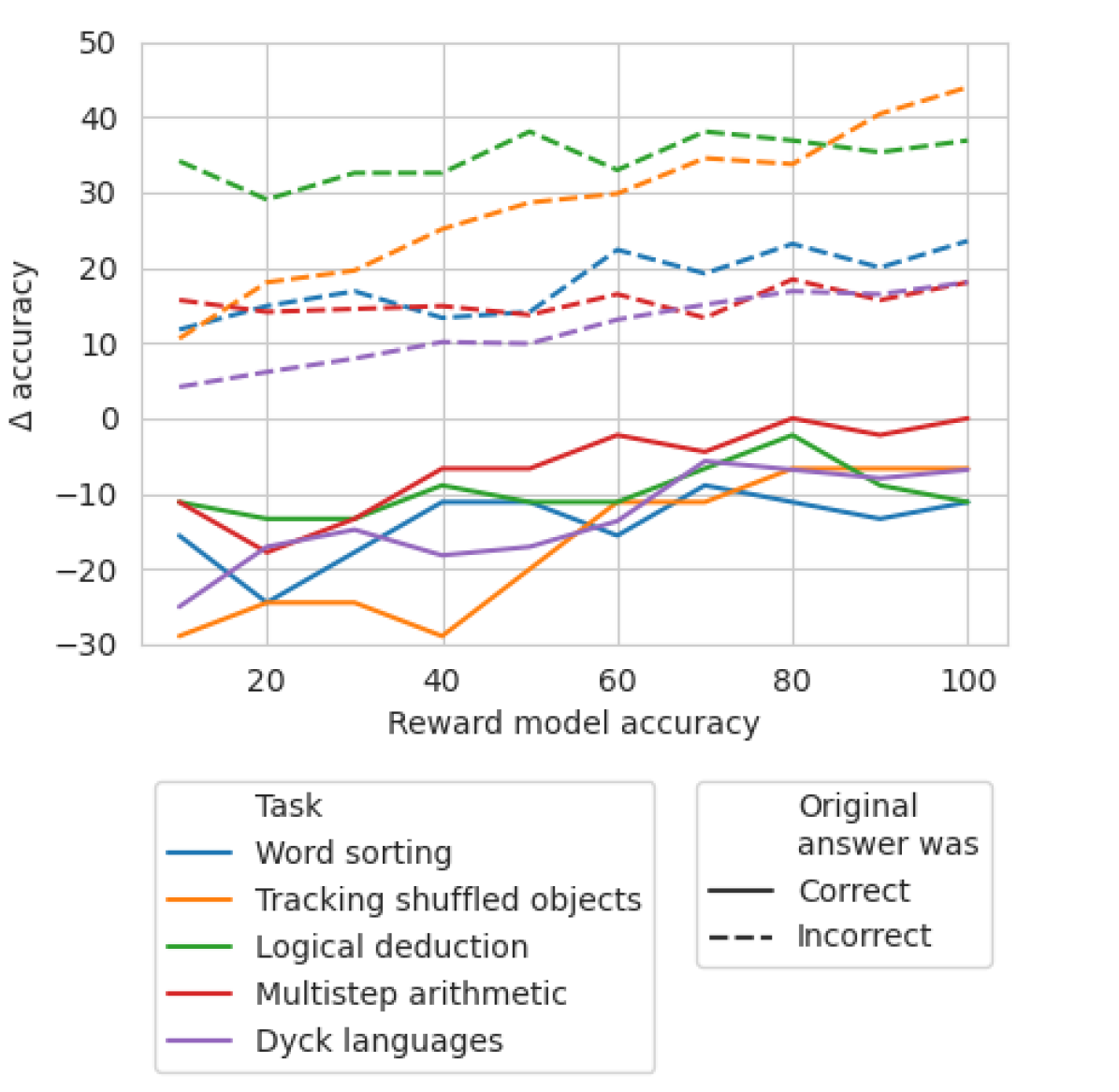
The image is a line chart comparing the delta accuracy (change in accuracy) of different tasks against the reward model accuracy. The chart displays five tasks: Word sorting, Tracking shuffled objects, Logical deduction, Multistep arithmetic, and Dyck languages. Each task is represented by two lines, one solid and one dashed, indicating whether the original answer was correct or incorrect, respectively. The x-axis represents the reward model accuracy, ranging from approximately 10 to 100. The y-axis represents the delta accuracy, ranging from -30 to 50.
### Components/Axes
* **X-axis:** Reward model accuracy, ranging from 10 to 100 in increments of 20.
* **Y-axis:** Δ accuracy (Delta accuracy), ranging from -30 to 50 in increments of 10.
* **Title:** There is no explicit title on the chart.
* **Legend (Left):** Located in the bottom-left corner, it identifies the tasks represented by different colored lines:
* Blue: Word sorting
* Orange: Tracking shuffled objects
* Green: Logical deduction
* Red: Multistep arithmetic
* Purple: Dyck languages
* **Legend (Right):** Located in the bottom-right corner, it indicates the line styles:
* Solid line: Original answer was Correct
* Dashed line: Original answer was Incorrect
### Detailed Analysis
**1. Word sorting (Blue):**
* **Correct (Solid Blue):** Starts at approximately -10 at x=10, decreases slightly to around -15 at x=20, then generally increases to approximately -10 at x=40, -12 at x=60, -13 at x=80, and finally reaches around -10 at x=100.
* **Incorrect (Dashed Blue):** Starts at approximately 15 at x=10, decreases slightly to around 14 at x=20, then generally increases to approximately 22 at x=60, 23 at x=80, and finally reaches around 23 at x=100.
**2. Tracking shuffled objects (Orange):**
* **Correct (Solid Orange):** Starts at approximately -28 at x=10, increases to around -24 at x=20, then increases to approximately -28 at x=40, -10 at x=60, -5 at x=80, and finally reaches around -10 at x=100.
* **Incorrect (Dashed Orange):** Starts at approximately 12 at x=10, increases to around 20 at x=20, then increases to approximately 28 at x=40, 30 at x=60, 35 at x=80, and finally reaches around 44 at x=100.
**3. Logical deduction (Green):**
* **Correct (Solid Green):** Starts at approximately -10 at x=10, decreases slightly to around -15 at x=20, then generally increases to approximately -10 at x=40, -12 at x=60, -1 at x=80, and finally reaches around -10 at x=100.
* **Incorrect (Dashed Green):** Starts at approximately 34 at x=10, decreases slightly to around 30 at x=20, then generally increases to approximately 38 at x=40, 37 at x=60, 38 at x=80, and finally reaches around 36 at x=100.
**4. Multistep arithmetic (Red):**
* **Correct (Solid Red):** Starts at approximately -10 at x=10, increases slightly to around -10 at x=20, then generally decreases to approximately -6 at x=40, -3 at x=60, -1 at x=80, and finally reaches around 0 at x=100.
* **Incorrect (Dashed Red):** Starts at approximately 16 at x=10, decreases slightly to around 15 at x=20, then generally decreases to approximately 14 at x=40, 15 at x=60, 18 at x=80, and finally reaches around 17 at x=100.
**5. Dyck languages (Purple):**
* **Correct (Solid Purple):** Starts at approximately -16 at x=10, increases slightly to around -22 at x=20, then generally decreases to approximately -18 at x=40, -12 at x=60, -8 at x=80, and finally reaches around -10 at x=100.
* **Incorrect (Dashed Purple):** Starts at approximately 5 at x=10, increases slightly to around 8 at x=20, then generally increases to approximately 10 at x=40, 14 at x=60, 15 at x=80, and finally reaches around 18 at x=100.
### Key Observations
* For all tasks, the "Incorrect" answer lines (dashed) generally show a higher delta accuracy compared to the "Correct" answer lines (solid).
* The "Tracking shuffled objects" task (orange) shows the most significant difference in delta accuracy between correct and incorrect answers, with the incorrect answers showing a substantial increase as reward model accuracy increases.
* The "Multistep arithmetic" task (red) shows the least difference in delta accuracy between correct and incorrect answers.
* The delta accuracy for "Correct" answers tends to be negative, while the delta accuracy for "Incorrect" answers tends to be positive.
### Interpretation
The chart suggests that the reward model accuracy has a different impact on the delta accuracy depending on the task and whether the original answer was correct or incorrect. The positive delta accuracy for incorrect answers indicates that as the reward model accuracy increases, the model is more likely to correct its mistakes. Conversely, the negative delta accuracy for correct answers suggests that as the reward model accuracy increases, the model might be more likely to make mistakes on previously correct answers. The "Tracking shuffled objects" task stands out, indicating that the reward model accuracy significantly improves the model's ability to correct incorrect answers for this specific task. The relatively small difference in delta accuracy for the "Multistep arithmetic" task suggests that the reward model accuracy has a less pronounced effect on this task compared to others.