## Line Chart: Δ Accuracy vs Reward Model Accuracy
### Overview
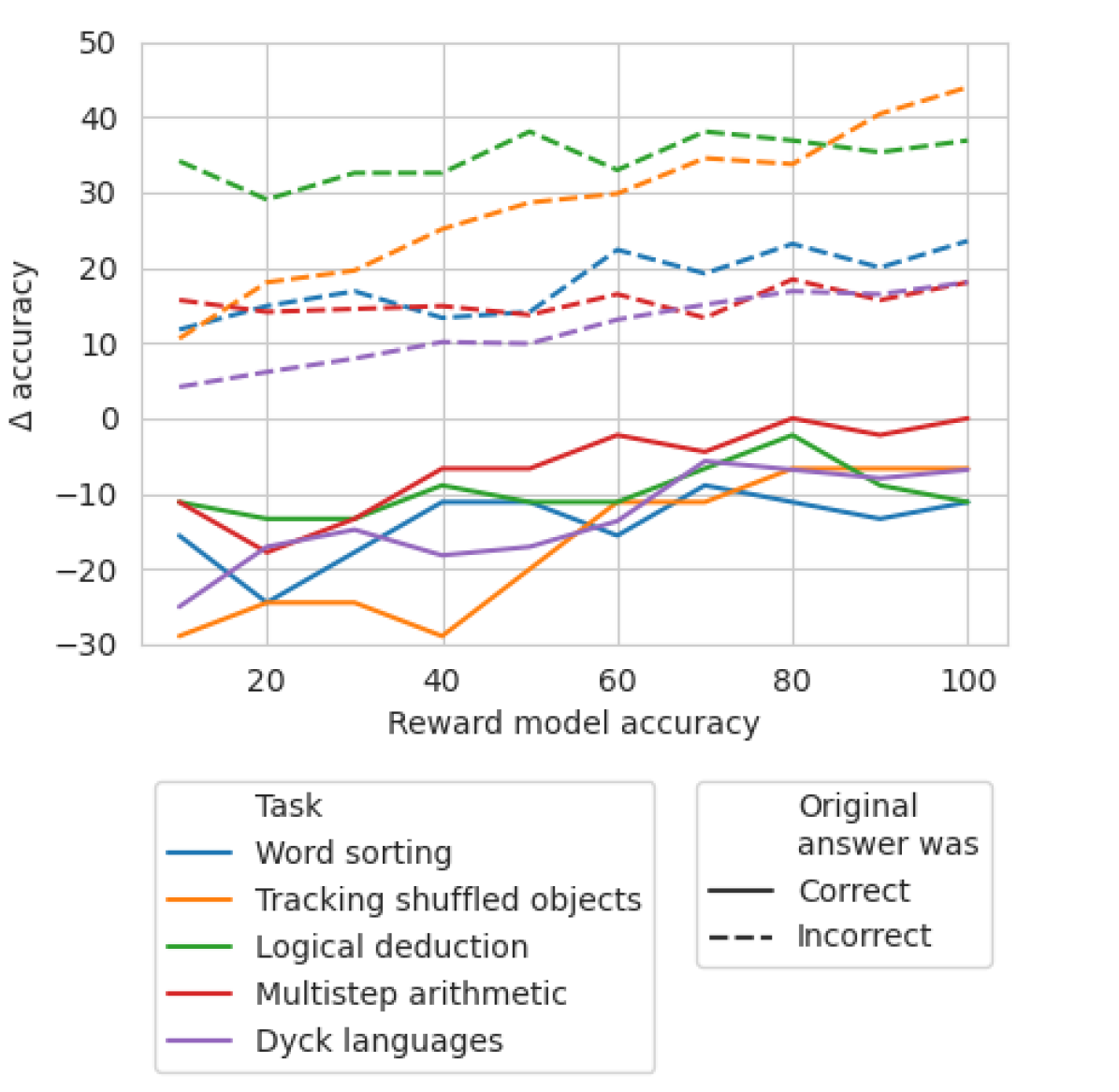
The chart displays the relationship between reward model accuracy (x-axis) and Δ accuracy (y-axis) for five cognitive tasks. Five colored lines represent different tasks, with the y-axis showing performance changes relative to a baseline. All lines are solid, indicating no "incorrect" answer data points are present.
### Components/Axes
- **X-axis**: "Reward model accuracy" (20–100, increments of 20)
- **Y-axis**: "Δ accuracy" (-30–50, increments of 10)
- **Legend**: Located at bottom-left, mapping colors to tasks:
- Blue: Word sorting
- Orange: Tracking shuffled objects
- Green: Logical deduction
- Red: Multistep arithmetic
- Purple: Dyck languages
- **Note**: Bottom-right text states "Original answer was Correct" (solid) / "Incorrect" (dashed), but no dashed lines appear in the chart.
### Detailed Analysis
1. **Logical deduction (green)**:
- Starts at ~35 Δ accuracy at x=20
- Dips to ~30 at x=40, then rises to ~40 at x=100
- Trend: Slight upward trajectory with minor fluctuations
2. **Tracking shuffled objects (orange)**:
- Begins at ~10 Δ accuracy at x=20
- Rises steadily to ~45 at x=100
- Trend: Consistent upward slope with minor plateaus
3. **Word sorting (blue)**:
- Starts at ~10 Δ accuracy at x=20
- Peaks at ~25 at x=60, then fluctuates between 15–25
- Trend: Bimodal pattern with a clear peak at mid-range reward accuracy
4. **Multistep arithmetic (red)**:
- Begins at ~15 Δ accuracy at x=20
- Dips to ~5 at x=40, then rises to ~20 at x=100
- Trend: Volatile with a U-shaped pattern
5. **Dyck languages (purple)**:
- Starts at ~5 Δ accuracy at x=20
- Gradually increases to ~20 at x=100
- Trend: Steady upward progression with minimal fluctuations
### Key Observations
- **Highest performers**: Logical deduction (green) and Tracking shuffled objects (orange) maintain the highest Δ accuracy across most reward model accuracies
- **Peak performance**: Word sorting (blue) shows a distinct peak at x=60 reward accuracy (~25 Δ accuracy)
- **Volatility**: Multistep arithmetic (red) exhibits the most fluctuation, with a notable dip at x=40
- **Consistency**: Dyck languages (purple) demonstrates the most stable growth pattern
### Interpretation
The data suggests that tasks requiring logical reasoning (Logical deduction) and spatial tracking (Tracking shuffled objects) are most robust to variations in reward model accuracy. Word sorting's bimodal pattern implies optimal performance at mid-range reward accuracy levels, while Multistep arithmetic's volatility indicates sensitivity to reward model precision. The absence of dashed lines (incorrect answers) suggests all data points represent correct responses, potentially limiting insights into error patterns. The consistent upward trend in Tracking shuffled objects aligns with its spatial nature, while Dyck languages' gradual improvement may reflect increasing model capability with higher reward accuracy.