## Textual Analysis: AI Consciousness Debate
### Overview
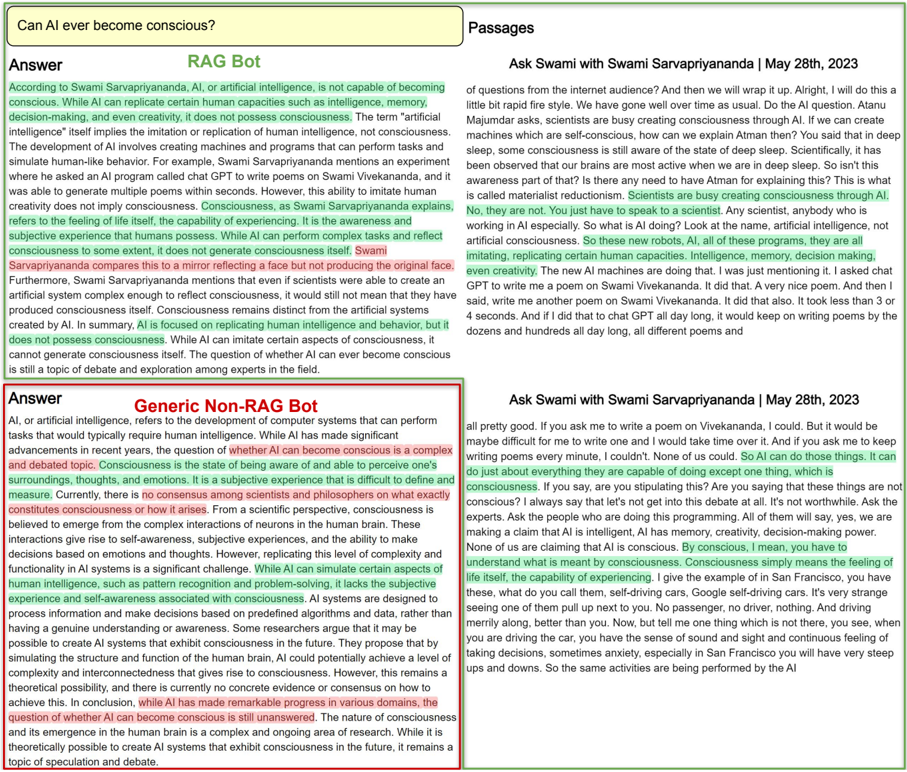
The image presents a discussion on whether Artificial Intelligence (AI) can ever become conscious. It includes answers from two different AI bots (RAG Bot and Generic Non-RAG Bot) and excerpts from a Q&A session with Swami Sarvapriyananda.
### Components/Axes
The image is divided into three main sections:
1. **Left Side:** Two "Answer" sections, one for "RAG Bot" and one for "Generic Non-RAG Bot."
2. **Right Side:** Two "Passages" sections, both titled "Ask Swami with Swami Sarvapriyananda | May 28th, 2023."
### Detailed Analysis or ### Content Details
**1. RAG Bot Answer:**
* **Main Idea:** According to Swami Sarvapriyananda, AI is not capable of becoming conscious, even though it can replicate human capacities like intelligence, memory, decision-making, and creativity.
* **Key Points:**
* "Artificial intelligence" implies imitation, not consciousness.
* AI can perform tasks and simulate human behavior.
* Imitating human creativity does not imply consciousness.
* Consciousness is the feeling of life itself and the capability of experiencing.
* AI can perform complex tasks but does not generate consciousness itself.
* AI is focused on replicating human intelligence and behavior but does not possess consciousness.
* The question of AI becoming conscious is a topic of debate.
**2. Generic Non-RAG Bot Answer:**
* **Main Idea:** AI refers to the development of computer systems that perform tasks requiring human intelligence. The question of AI consciousness is complex and debated.
* **Key Points:**
* Consciousness is the state of being aware and perceiving surroundings, thoughts, and emotions.
* It is a subjective experience difficult to define and measure.
* No consensus exists on what constitutes consciousness.
* Consciousness may emerge from neuron interactions in the human brain.
* Replicating human complexity in AI is a challenge.
* AI lacks subjective experience and self-awareness.
* AI systems use predefined algorithms, not genuine understanding.
* AI consciousness remains a theoretical possibility with no concrete evidence.
* The nature of consciousness and its emergence in the human brain is a complex research area.
**3. Passages - Ask Swami with Swami Sarvapriyananda | May 28th, 2023 (Top):**
* **Main Idea:** Addressing the question of AI consciousness in relation to Atman (the self).
* **Key Points:**
* Scientists are not busy creating consciousness through AI.
* AI is imitating human capacities like intelligence, memory, decision-making, and creativity.
* Mention of using chat GPT to write poems on Swami Vivekananda quickly.
**4. Passages - Ask Swami with Swami Sarvapriyananda | May 28th, 2023 (Bottom):**
* **Main Idea:** AI can do many things, but it lacks consciousness, which is the feeling of life itself.
* **Key Points:**
* AI can do almost everything except consciousness.
* Consciousness is the capability of experiencing.
* Example of self-driving cars in San Francisco, which perform activities but lack the human sense of sound, sight, and continuous feeling of taking decisions.
### Key Observations
* Both AI bots and Swami Sarvapriyananda agree that AI currently lacks consciousness.
* The RAG Bot answer is based on Swami Sarvapriyananda's views.
* The Generic Non-RAG Bot provides a more general scientific perspective.
* Swami Sarvapriyananda emphasizes the importance of the feeling of life itself and the capability of experiencing as essential components of consciousness.
### Interpretation
The image presents a multifaceted perspective on the question of AI consciousness. It highlights the distinction between AI's ability to replicate human intelligence and its lack of subjective experience and self-awareness. The discussion emphasizes that while AI can perform complex tasks, it does not possess the feeling of life itself, which is considered a crucial aspect of consciousness. The inclusion of Swami Sarvapriyananda's views adds a philosophical dimension to the debate, linking it to concepts like Atman. The self-driving car example effectively illustrates the difference between AI's functional capabilities and the human experience of consciousness. The overall tone suggests that AI consciousness remains a complex and unresolved issue, requiring further exploration and debate.